
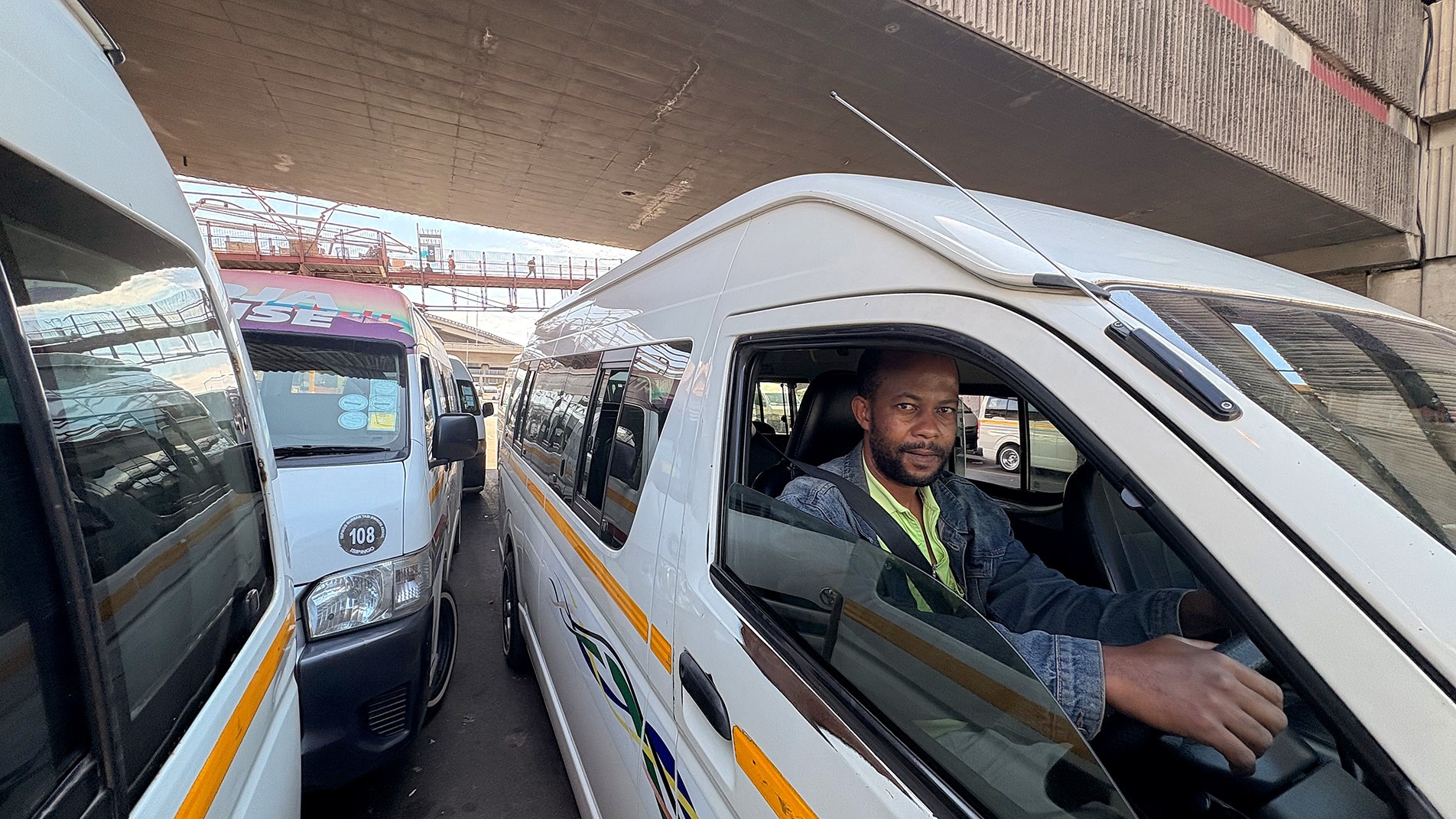
 Njabulo Buthelezi has been at the wheel for 10 years. A new study reveals that South Africa’s taxi drivers endure life-threatening heat stress from long hours in poorly insulated vehicles. (Photo: Leonie Joubert)
 He didn’t choose this life. Lindokuhle Zuma didn’t have any other option. It’s not a great job, being stuck behind the wheel of a taxi: passengers haranguing him for driving too fast, too slow, too... whatever. The cops, the fines. If he could go back in time, to Grade 11 maybe, choose a different path.
“Maybe I’d get a better job, you know?”
No one’s gonna give him money for loafing about at home, though.
“One percent of something is better than a hundred percent of nothing.”
Crazy hours, ridiculous pay. But complaining’s only gonna get him fired. So he bites his tongue, and drives.
“I’m a smooth driver. I’m proud of that,” the 29-year-old says. “Passengers can even sleep. I make sure that if I drive, they don’t get disturbed.”
Zuma doesn’t have time to fret about whether or not it’s hot. He’s got his hands full, what with the job’s thankless daily grind. There’s a first aid kit stashed somewhere, and a two-litre bottle of water next to the driver’s seat, with an upturned polystyrene cup over its cap, in case someone gets into trouble.
/file/attachments/orphans/7IMG_4999copy_336316.jpg "Occupational health expert Rajen Naidoo says we need to think and plan for heat in terms of water, shelter and rest. For now, drivers like Lindokuhle Zuma are running shifts of 12 hours or longer, with little chance of taking a break during the heat of the day. (Photo: Leonie Joubert)")
Nope, he didn’t fill the bottle at the taxi rank; no taps there.
“I bought it,” he nods towards a supermarket down the block.
Gotta keep moving. Soon as you stop, it cooks inside.
He’s not wrong. It’s mid-morning, early March, and his taxi, parked kerbside about a block from Warwick Junction in central Durban, hints at what researchers already know. Within half an hour of parking, if the windows are closed, the inside’s likely to warm by about 4°C, regardless of the outside temperature where some guys – off-duty drivers? – are shooting the breeze and playing pool at an open-air table.
A new study from this notoriously muggy East Coast city shows that taxi drivers like Zuma are spending up to 11 hours a day in hot-box conditions that’ll push even fit young men like him into dangerous territory, health-wise. A single-event high extreme temperature can bring on potentially life-threatening heat stroke. But years of broiling in seriously hot conditions could wear his kidneys out completely.
Hot in the city
There’s a maxim from around here: Where does Warwick Junction start? Where a suburban driver hits the lock on their car door.
This part of the inner city may look chaotic from the air-conditioned bubble of snazzy car; lawless, even. But life on the streets here in central Durban is vibey, alive. Hair salons, barbers, clothing stores with Chinese imports or home-grown chitenge numbers, street traders selling snacks and drinks. Jostling pedestrians. Taxis hooting. An occasional boom box.
This is typical of the beating heart of most African cities. Many city authorities don’t have an appetite for it, though. They see it as ungovernable, hard to tax, unkempt, dirty. For them, the gold standard of what a developed city should be is the one-size-fits-all shopping mall and large retail chain. But as research from the African Food Security Urban Network has shown over the years, informality in its many forms is here to stay. Like it or lump it, city policy and management have to embrace the chaos, the network’s researchers conclude: recognise its legitimacy, deliver services, build infrastructure that will allow it to work better for the tens of millions whose lives and livelihoods depend on it.
/file/attachments/orphans/3WMOUrbanHeatIslandgraphic_267065.jpg "Densely built-up inner cities are heavily tarred, paved and concreted over. These surfaces trap heat, making conditions 5°C to 10°C hotter than a city’s leafier outskirts. This is the urban heat island effect, and Durban’s taxi drivers are operating from the heart of it. (Source: World Meteorological Organization)")
The minibus taxi industry is unapologetically informal and oxygenates this economy. There are roughly 10.7 million bums on seats in taxis every day, according to StatsSA. Drivers like Zuma ferry 80% of the country’s public transport-using workforce. Its annual takings – all cash-based fares – are somewhere between R50-billion and R100-billion, depending on who you ask.
Most drivers, though, only see a fraction of the earnings – Zuma gets R700 a week, and only two Saturdays off a month – but that’s not the only reason his is regarded as such a vulnerable workforce.
Imagine a magnifying glass concentrating sunlight onto paper until it blackens and smoulders. Taxi drivers are in the focal point of three heat mechanisms: their vehicles are hotboxes, often 4°C warmer than outside conditions; city taxis operate in densely built up areas where conditions may be 5°C to 10°C hotter than what a city’s weather station records; and rising global temperatures are pushing up not just headline-grabbing extreme heat episodes, but health-compromising high heat.
Now, for the first time, the SA Medical Research Council has hard data to show just what this means for the country’s indispensable ferrymen.
In March 2024, environmental scientist and doctoral researcher with the council’s Environment and Health Research Unit, Ngwako Kwatala, put digital sensors into 16 taxis operating from the Chesterville taxi rank, three blocks from Warwick Junction. Some of the vehicles used a sheltered section of the rank, some used the unsheltered rank.
The sensors measured temperature and humidity every hour for five days, which Kwatala compared with Durban’s weather station readings.
/file/attachments/orphans/6IMG_4429copy_680859.jpg "Of the 283,000 taxis estimated to be running on the country’s roads, the majority are made by Toyota. Researchers recommend tinted windows and factory-fitted aircon as a start. But redesigning the vehicle so that the engine doesn’t crank out heat beneath the driver’s cab should also be on the drawing board. (Photo: Leonie Joubert)")
Here’s how Wednesday 20 March 2024 turned out. The Ballito meteorological station, about 50km north of the inner city, topped out at 29.6°C after lunch. It was a muggy day, so the relative humidity of 78.1% made the temperature at the peak of the day feel like it was 42°C. According to the humidity index health warning system, this is well into the danger zone. The body’s likely warning signs: racing heart, straining kidneys, tiredness, confusion, fainting. Recommendation: find shelter, drink water, rest, loosen clothing, fan yourself.
Conditions inside the taxis were way hotter than this, though. Zooming in on four of the vehicles that day, the data recorders registered maximum temperatures of between 32°C and 38.6°C. Add the day’s humidity, and the felt temperature – between 40°C and 45°C in three of them – pushed vehicle conditions into even more dangerous territory.
One taxi got to 38.6°C by mid-morning, with a felt temperature of 49°C. Being exposed to this kind of heat for too long puts people at risk of heat stroke, which is far more serious than its benign-sounding name.
Temperature readings from all taxis showed that drivers were broiling for up to 11 hours a day in temperatures higher than 27°C.
Heat like this has a multiplier effect on health: the final straw that pushes people into a medical emergency like a stroke, heart attack, or a complication stemming from diabetes, for instance.
There are various thresholds that health experts use as guidelines for when heat conditions slip into the danger zone. In Kwatala’s study, where he’s working with professor Caradee Wright, the SA Medical Research Council’s chief specialist scientist leading the climate change and health research programme, the red line they reference is when the temperature exceeds 32°C, with a relative humidity of 50%.
Another study from Durban has found that deaths in the city rise noticeably when temperatures climb above 30.6°C, and while a death certificate is unlikely to mention heat as the cause, it may well have contributed to it.
Broken sewer, broken body
There’s no polite way to say this. It’s the body’s broken sewer that kills you in the most severe attack of heat stress.
The body has a finely tuned internal thermostat that’s set to keep the core at 37°C. If the body’s under pressure from heat – either internally, brought on by physical exertion, or external factors like direct sunlight or lack of air movement – the body’s natural aircon kicks in: sweating.
If the heat outpaces the body’s ability to shed it, though, the core temperature rises. Blood vessels balloon, and the heart picks up speed to shunt more blood to the skin, faster, to vent more heat. The trade-off: the body’s inner organs get less blood, and less oxygen. The heart’s racing, and now the kidneys start taking strain: dehydration means the body’s clean-up system is overloaded with salts and toxins with too little water to do the job.
The person will start to feel dizzy, clammy, confused, irritable, tired. A taxi driver might become short-tempered, but also clumsy behind the wheel. This kind of heat exhaustion is reversible if the right measures are taken in time.
What comes next, though, isn’t reversible if it runs its course. To call it heat stroke downplays how serious it is when the body’s core reaches 40°C.
/file/attachments/orphans/2IMG_4583copy_412673.jpg "Minibus taxis ferry 80% of the country’s public transport-using workforce. They are the lifeblood of the country’s unapologetically robust informal economy. City policy and management must embrace the apparent chaos, urban studies experts urge. (Photo: Leonie Joubert)")
Most public service announcements will warn about multiple organ failure, seizures and the likes. They won’t tell you the grimmest part of how heat stroke kills. Professor Ollie Jay who runs a heat-health lab at Sydney University’s department of medicine will, though. Not only are the heart and kidneys labouring, but the cells of the stomach and bowel walls start to collapse. All those bacteria that are hard at work turning food to faeces begin to leak into the bloodstream. Very quickly, it’s system-wide septic shock.
It’s a domino effect of “systemic inflammatory response, multiple blood clotting around the body, multiple organ failure, and death” explains Jay.
Worn-out waterworks
It’s not just the knock-down-drag-out single-event heat extremes that we need to keep an eye on, warns Rajen Naidoo, Professor of Occupational Medicine and Environmental Health at the University of KwaZulu-Natal.
People are already being affected by health-harming high temperatures, even when conditions don’t reach the headline-grabbing record-breaking maximums.
“Studies show that the majority of adverse effects that are taking place in excessive heat conditions, (fall) outside formally designated heat waves,” he says.
Early warning bulletins and heat alerts might only kick communities into taking action before or during extreme events.
“What about the days when conditions are one degree less than a designated heat wave? That’s the mindset we’ve got to get for everyone, from policy makers (onwards),” Naidoo recommends.
There’s a cautionary tale from another vulnerable workforce that’s far removed from the relatively passive day of a taxi driver, but nevertheless worth a look-in.
/file/attachments/orphans/5StoryArkDMRedAlert2TaxitempsinfographicFINAL_666926.jpeg)
For 20-odd years, doctors in parts of Central and South America, India, and some other Global South countries have been picking up chronic kidney disease in agricultural workers. These are people without the usual red flags that might normally wear out someone’s waterworks: hypertension, obesity, diabetes.
It’s seldom a straight line from single cause to lethal outcome. Exposure to things like heavy metals, pesticides and agrochemicals add to the data noise for this group. But the fallout after years of heavy labour in high heat is increasingly coming into the frame. Some medics suggest that what’s been called a silent epidemic of chronic kidney disease of unknown cause in these workers should be relabelled: heat-induced kidney disease.
The United Nations International Labour Organization estimates that 26.2 million people globally have chronic kidney disease brought on by heat stress at work.
“The cases attributed to heat exposure at work constitute about 3% of all chronic kidney disease cases,” says the 2024 ILO Heat at Work report. Africa’s cases sit at 3.3%.
There aren’t any studies amongst taxi drivers to track the extent of kidney disease, but at least most drivers who took part in the SA Medical Research Council research are using common sense: they’re drinking water to manage heat, the first line of defence to protect their kidneys.
Daily grind
“If it were up to me, I’d quit,” says Njabulo Buthelezi from behind the wheel of his taxi beneath the inner city overpass. He’s not a man of many words. Like Lindokuhle Zuma, he’d wouldn’t recommend this job.
“No future in it.”
But he’s got kids to feed, you know? Sole provider. Not a whole lot of options. So he’s been doing this for a decade. Ten whole years.
/file/attachments/orphans/10IMG_4464copy_977225.jpg "If Njabulo Buthelezi could ask the city for anything that would make work conditions a bit more forgiving, it would be a safe place to park, and proper taxi rank with shelter. (Photo: Leonie Joubert)")
There’s a lot of hurry-up-and-wait in his day: park under the overpass, wait in the queue; load up passengers; a quick 20 minute drive south to Isipingo; back in the queue; wait for three, maybe fours; drive to town; back into the queue.
Rinse and repeat.
/file/attachments/orphans/2IMG_45422copy_534598.jpg "Minibus taxi passengers on their daily commute to work. (Photo: Leonie Joubert)")
Taxi driving is a punishing job, and the SA Medical Research Council has a few ideas for how to make conditions a bit more forgiving: improving taxi ranks with shelter, water, and cooling off stations. Shorter waiting times. Flexible working hours. Tinted windows on the vehicles would help. Factory-fitted aircon. Redesign taxis so the engine doesn’t sit beneath the driver’s cabin, cranking out all that heat.
There’s plenty of acknowledgement of the need for solutions, most of which must come from city administrations. Although taxi organisations need to lobby for better pay, forgiving working hours, and the option for drivers to down tools during the worst part of a hot day. But there’s not much clarity on the how and when.
Buthelezi’s shift starts at around 5am, and wraps up at 8pm. He can’t leave the van, and so he waits out those long hours inside the vehicle. No shelter. No aircon. No water, unless he brings some from home. The heat, eish, it makes him tired, sleepy. It irritates his skin.
If he could ask the City for anything to make it better?
“A safe place, with shelter. A proper taxi rank. Where we park isn’t safe.” DM
This article is from Story Ark — tales from southern Africa’s climate tipping points, an award-winning collaboration with the Stellenbosch University School for Climate Studies, Henry Nxumalo Foundation, and the Pulitzer Center.