



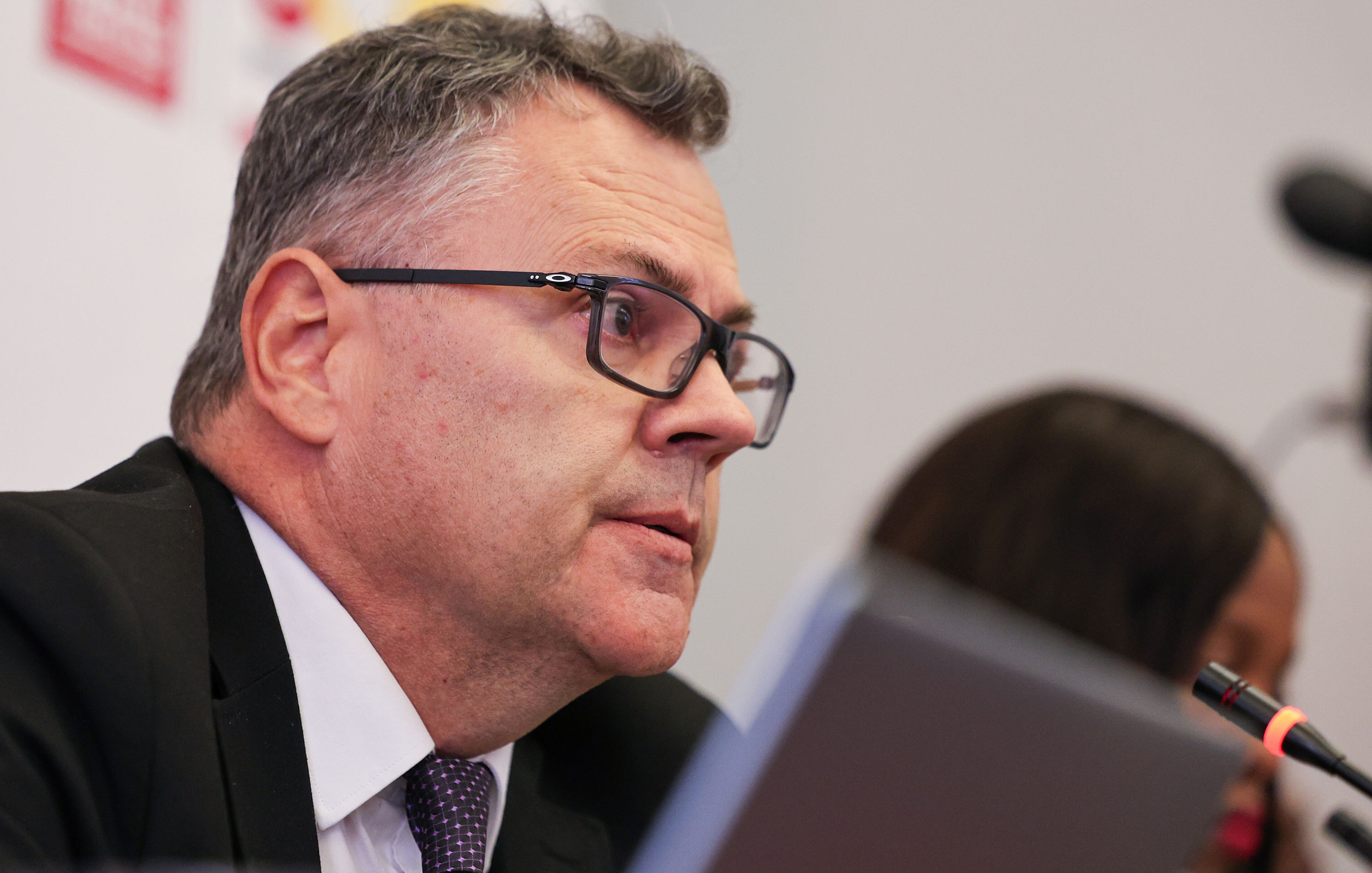
 SAHRC commissioner Henk Boshoff, chairperson of the South African Human Rights Commission’s Gauteng water inquiry. (Photo: Gallo Images / Luba Lesolle)
The South African Human Rights Commission (SAHRC) inquiry into whether the prolonged water outages, infrastructure failures and inconsistent access to clean water in Gauteng amount to a human rights violation came to a close on Thursday, 21 May.
/file/attachments/orphans/163217_402441.jpeg "Director-General of the Department of Water and Sanitation Sean Phillips (centre), Deputy Director-General Dr Risimati Mathye (right) and Gauteng head of operations Wisani Maluleke (left) testify at the South African Human Rights Commission inquiry into the state of water management in the province on Thursday, 21 May 2026. (Photo: South African Human Rights Commission)")
While the first day of the three-day inquiry consisted of testimonies from civil society, ratepayers and community organisations and was more inquisitive than accusatory in nature, inquiry chairperson Henk Boshoff took the gloves off when it was time for municipal managers’ submissions to the panel on Wednesday and Thursday.
Uninspired by the testimonies, Boshoff took a hard line, bringing the feet of the administrative heads to the proverbial coals. From calling them out for trying to gloss over the impact the crisis has on residents’ lives and overselling the interventions implemented, to lambasting the municipalities for disrespecting the authority of the Chapter Nine institution, Boshoff did not hold back.
The inquiry chair revealed that of the six municipal managers called before the inquiry panel, only one came voluntarily, while the others had to be subpoenaed to appear, calling into question the municipalities’ commitment to adequately addressing the widespread crisis.
“You are non-responsive. You’ve not only disregarded your community members, your residents, and the Gauteng provincial office by not responding to or investigating complaints, but you’ve also done that to me,” Boshoff said
Describing the municipalities as uncaring, the chairperson added, “It’s not about the commission and our egos, it’s about the people. Municipal managers are here to serve.”
Best, worst and mediocre municipalities
“Municipalities in the province, in our view, are in trouble,” Boshoff said.
However, based on the submissions and the inquiry panel’s response to the municipal managers, it seems Emfuleni, Merafong, City of Johannesburg and Rand West are the worst among the bunch.
Not a single person from the Rand West City Local Municipality showed up for the proceedings, even failing to excuse themselves or offer a reason for the no-show. Boshoff said that the commission would consider laying criminal charges against Rand West’s municipal manager.
Emfuleni Municipal Manager April Ntuli revealed that the municipality lost nearly 70% of its water supply to leaks, while allocating only 3.8% of its budget to maintenance, far below the national treasury norm of 8%.
Merafong’s key issues included collapsing wastewater infrastructure, chronic sewer spillages and persistent sinkholes affecting the water supply. The municipality had a 70% vacancy rate in the water and sanitation technical department, a 40% water restriction and a historical debt of more than R1-billion with Randwater, further exacerbating the crisis.
Despite spending more than R1-million on water tankers, some communities still lacked access to water.
Boshoff said that while he was concerned about human rights violations in Ratanda in south Heidelberg, where people didn’t have access to water, he noted that the municipality seemed to be trying, even though it had limited resources.
The only municipality that seemed to garner favour with the panel was Midvaal, which, save for an almost 10-year delay on a R22-million upgrade of the Meyerton Wastewater Treatment Plant, could confidently report that there were no human rights violations when it came to access to water and sanitation.
/file/attachments/orphans/163219_920185.jpeg "Midvaal Local Municipality Manager Phumudzo Magodi told the South African Human Rights Commission that there had been no human rights violations in his municipality. (Photo: South African Human Rights Commission)")
Boshoff was reasonably impressed by Midvaal, adding that the municipality should be used as a benchmark for others to learn how to provide adequate services.
Probe into water tanker systems raised
One of the SAHRC’s main objectives in the investigative inquiry was to uncover the depth of the abuses of Gauteng water tanker systems.
The panel heard how in the City of Tshwane, the municipality spent R441-million on water tankers in the 2025/26 financial year, while the City of Johannesburg had a questionable R226-million tanker tender that had recently come under scrutiny.
/file/attachments/orphans/ED_591916_289541.jpg "Residents wait for water from a tanker in Dube, Soweto, on 7 January 2026. (Photo: Gallo Images / Fani Mahuntsi)")
In fact, almost all the municipalities in the province testified that they used water tankers to supply some of their residents with water, particularly those living in informal settlements.
The submissions only reaffirmed Boshoff's view of the existence of brazen financial mismanagement, one in which municipal officers are actively involved.
In light of this, Boshoff said that the panel would consider involving the South African Police Service (SAPS), Hawks and Special Investigating Unit (SIU) in looking into the “scourge” of water tanker systems and associated organised crime.
R4bn siphoned from Joburg Water
— still no explanation
News first broke about the R4-billion that was quietly diverted from Joburg Water’s account to pay other municipal expenses in September 2025.
/file/attachments/orphans/163218_953131.jpeg "Johannesburg City Manager Floyd Brink testifies at the South African Human Rights Commission inquiry into the Gauteng water crisis on Thursday, 21 May 2026. (Photo: South African Human Rights Commission)")
During Joburg City Manager Floyd Brink’s testimony, Boshoff took the opportunity to question him about where the money went and what it was used for.
The chairperson’s inquiries went unanswered, with Brink first saying he was not the accounting officer when the funds were used and then asking the panel for five days to compile a report on what exactly happened to the R4-billion.
In the past the City has failed to answer queries from civil organisations and the media about the fate of the R4-billion.
A man-made crisis
By the end of the day on Thursday, Boshoff and the rest of his panel had listened to at least 19 hours of testimony. The chairperson said reliable access to water remained the cornerstone for the realisation of fundamental rights, spanning education and healthcare to energy, food security and sustainable livelihoods.
However, the ongoing crisis continued to disproportionately affect the province’s most vulnerable residents, including women, children, the elderly, and persons with disabilities, Boshoff said.
“The country is naturally water scarce. However, the water crisis is not to be attributed solely to natural scarcity, but rather to human mismanagement, infrastructure neglect and systemic corruption, amongst others. This clearly demonstrates the failures of municipalities to provide water may not be attributed to the shortage of water in Gauteng, but rather it is a man-made disaster,” Boshoff concluded.
All eyes are now on the SAHRC to determine what comes next. DM


Comments
Scroll down to load comments...