



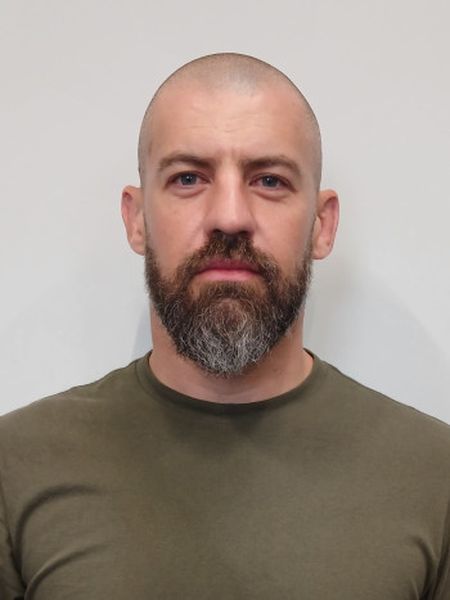
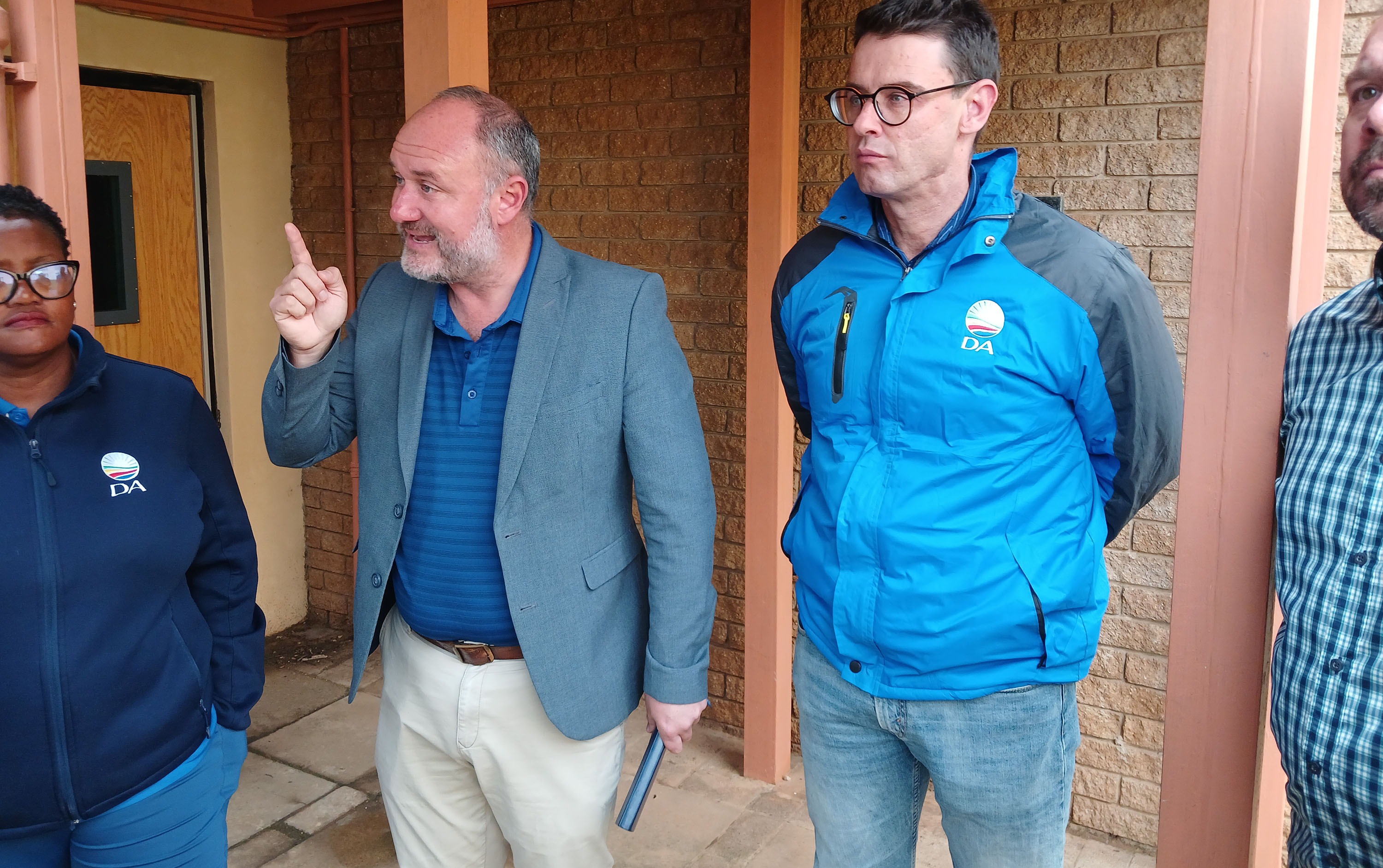
 DA mayoral candidate Retief Odenaal, along with his party’s provincial leader Andrew Whitfield, visited the Nelson Mandela Bay Metro Police satellite office in Kariega, where Odendaal outlined his plans for putting the Metro Police back on track. (Photo: Riaan Marais)
 The opposite ends of Matanzima Road are the main routes into Kwanobuhle – one of the more impoverished communities in Nelson Mandela Bay, constantly plagued by service delivery issues.
Along Matanzima Road, no fewer than 78 streetlights have been cut down by vandals and thieves looking to strip a few metres of copper wire from the crucial roadside infrastructure.
The bulk of the lights have been missing for more than a year.
The concerns over the missing streetlights are two-fold. First, it highlights criminality and a lack of law enforcement to curb the scourge of vandalism in the area. Second, a lack of lighting increases the likelihood of further criminal activity along this arterial road.
/file/attachments/orphans/DAMetroPolice5_528072.jpg "Dozens of streetlights have been cut down and copper wire stripped by thieves and vandals along one of the main routes leading into Kwanobuhle in Kariega. (Photo: Riaan Marais)")
This was just one example mentioned by DA mayoral candidate Retief Odendaal as he unpacked his plans to restore law and order to Nelson Mandela Bay by bolstering the ranks of the city’s Metro Police should he be elected in the upcoming November municipal polls.
Odendaal, with his party’s provincial head Andrew Whitfield and other councillors, led a visit to the NMB Metro Police satellite office in Kwanobuhle.
However, upon arrival, it was found that the doors were locked and there was no sign of any officials on duty.
The visit came after a safety and security portfolio committee meeting last month brought to light that only 18% of the directorate’s R72-million budget had been spent.
“No matter how I look at what needs to be done to get this city working again, one crucial point needs to be addressed first, and that is ensuring safety in Nelson Mandela Bay,” Odendaal said.
‘Law enforcement vacuum’
He said a lack of support for the South African Police Service, the collapse of crime-fighting technology and the absence of by-law enforcement had created an environment for criminality to thrive, and where regular residents ignore basic laws as they no longer fear law enforcement.
“The Metro Police currently consists of 126 officers. However, they can only man three vehicles per shift as the rest of their fleet has become inoperable. Now compare this to the Metro Police forces in Cape Town and Johannesburg, where they are forces to be reckoned with.”
He said every 12-hour shift consisted of 18 officers across the entire metro, and of the 22 vehicles allocated to them, only four were operational.
Using the streetlights in Matanzima Road as an example, Odendaal said the city was fighting a losing battle against organised syndicates and opportunistic criminals targeting electrical infrastructure such as streetlights and underground cables. However, if law enforcement could not prevent wanton theft and vandalism, repairs would be a recurring expense.
Odendaal’s plan to revive the Metro Police includes a short-term injection of additional resources to ensure better response and coverage across the city, and a longer-term goal of more than tripling the number of active members on the force.
“We need at least 60 vehicles on the beat at any given time. This equates to one vehicle per ward across the metro.
“My team and I further looked at manpower, and we believe within our first year in office, we will be able to double the current number of officers.”
The long-term plan would be to increase the Metro Police force to a minimum of 500 members within a five-year term in government.
/file/attachments/orphans/DAMetroPolice2_628523.jpg "DA provincial leader Andrew Whitfield shows the plaque where a DA-led local government opened the Metro Police satellite office in Kariega in 2017. (Photo: Riaan Marais)")
Odendaal said this would require a close look at members currently employed in the municipality’s insourced security services, whose efficacy he questioned, but who he believed could be upskilled and trained to become members of the Metro Police.
Traffic services could also potentially be absorbed into the Metro Police to bolster the enforcement of municipal by-laws, traffic violations and general safety and security across the city.
“I recently asked in a public meeting who would be willing to go out at night, drink a beer and still drive themselves home. I didn’t expect anyone to raise their hands, but everyone agreed there was no risk of being caught because there were no traffic services after 10pm. Our city has deteriorated into a state of lawlessness,” Odendaal said.
When asked how funds would be allocated for his proposed improvements to the Metro Police, Odendaal said budgets would have to be adapted, as safety and security were non-negotiable.
In addition to his plans for the Metro Police, he said the re-establishment of an effective camera network across the city, along with an effective joint operations centre where police, Metro Police, private security and other emergency services could pool resources, would be crucial.
When asked about the metro’s R6-million Mobile Surveillance Vehicle (MSV), or the so-called “Loerbroer”, councillor Jason Grobbelaar, who serves on the safety and security committee, said they were still waiting for updates on the refurbishment of the vehicle and its equipment, as there were certain contractual issues with a local supplier. He hoped to have more clarity after the next committee meeting.
He explained that while 18% of the safety and security budget had been spent, the total potential spend sat at 39% when taking spending commitments into account.
“We asked the portfolio to [redirect] funding from projects where spending would be impossible, so that we can allocate that money for more effective spending.”
Grobbelaar said it was his understanding that more vehicles would be purchased, but he was waiting for the latest reports to see where the money had been moved from and where the new vehicles had been allocated. DM