



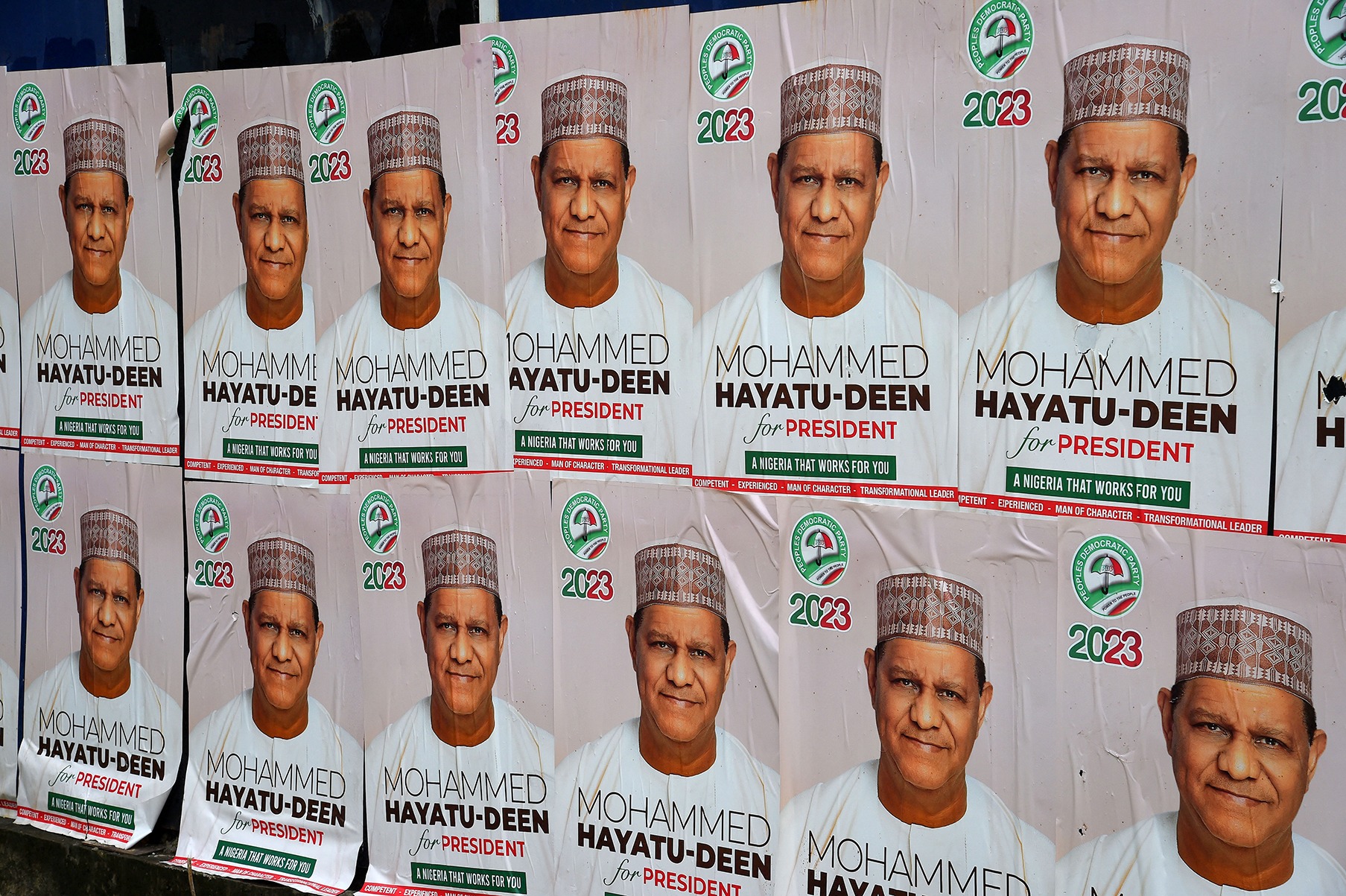
 Posters of Nigerian presidential aspirant from the opposition People’s Democratic Party, Mohammed Hayatu-Deen, in the run-up to presidential primaries in Lagos on 23 May 2022. (Photo: Pius Utomi Ekpei / AFP)
 /file/dailymaverick/wp-content/uploads/2025/10/label-Op-Ed.jpg)
Nigeria is not only Africa’s most-populous country but one of the youngest: its 243 million people have a median age of just 18. Not that you’d know it, looking at the leadership.
President Bola Tinubu is 74 and his predecessor, the late Muhammadu Buhari, was close to 80 when he stepped down in 2023.
Not unusual on a continent where men past their prime dominate the hold on power, topped by Paul Biya in nearby Cameroon who at 93 is the world’s oldest head of state. Then again, Donald Trump turns 80 in June and Cyril Ramaphosa is 73.
Nigerians have a reverence for age and wisdom; a string of coups – the last in 1996 – were led by young officers who throttled democracy, controlled the press, deterred investment and embezzled billions.
Primaries are under way to select candidates for president. Since the return to multiparty rule in 1999, the ballot paper has been long with no-hopers, splitting the vote in a country that is ethnically diverse and divided between Islam and Christianity.
This time may be different: opposition leaders have combined in a number of coalitions, making it hard to predict the outcome.
Last time, Peter Obi and Rabiu Kwankwaso came third and forth. In the quest for unity they briefly joined forces in the African Democratic Congress (ADC) along with Atiku Abubakar who, at 79, has made a record six losing runs for the top job. He served two terms as vice-president during the transition to democracy after the last coup leader, Sani Abacha, died in office in 1999. In 2023, he came second, but together with his rivals they took almost two-thirds of the ballot and would have won had they been united.
Each of the new coalitions has yet to choose a single candidate, hence the primaries in a country where a lament rolled out at election time sums it up: “Everyone wants to be president.” In early May, the infighting proved too much for Obi and Kwankwaso who moved to another group, the Nigeria Democratic Congress.
At ADC, this left Abubakar as the obvious choice for leader, but his time as VP was marred by allegations of corruption (he denies wrongdoing) and those six failed runs don’t bode well.
“I see Nigerians running companies in Britain and South Africa, but less so here. Why? Because our bureaucracy strangles enterprise.”
For the campaign itself, the issues are clear. A third of homes have no electricity, unemployment is a worry for young people in a country with almost no welfare, and corruption has for decades left Nigeria near the bottom of Transparency International’s list of nations on the take.
The ADC has brought together voters who traditionally back someone from their own region. In the 1960s, the Igbo people of the southeast broke away to form their own country known as Biafra. A civil war left an estimated two million dead, and scars remain. But there’s an Igbo wing of the ADC and if unity prevails, Tinubu could be in trouble.
Abubakar’s advantage is wealth, with money enough to exhaust the others and woo a media that, while free, includes outlets happy to run stories for a fee.
Homes in London and Dubai add to his prestige, though while some see a successful businessman, others view it as evidence of looting.
Bringing the opposition together is smart but it draws in ambitious leaders of other parties. If Abubakar wins, they stand to get cabinet posts or a chance to run one of the state-owned companies marked for privatisation. Their worry is that if, for the seventh time, he fails, they face another term in the cold.
His health is also an issue. In mid-May, doctors placed him on extended bed rest and meetings were cancelled; sources close to the contest say it was exhaustion brought on by the campaign.
Polls suggest Tinubu may have closed the historic rift between voters from the north and south, but he is vulnerable. On his watch the naira has crashed, pushing up cost of living; this is Africa’s biggest oil exporter yet in three years the price of fuel has risen fourfold.
In west Africa, Nigeria is Britain’s key partner in the war on terror, with regular meetings of defence ministers and shared intelligence on threats across the region.
But under the veil of “security” Tinubu tells his people little about Islamic rebels in the north. By contrast, the press has an almost daily take on a rising number of soldiers and civilians either killed or ransomed by the guerrillas.
“There is no plan for a country with such a young population. If we have too few jobs now, where will it be in 10 or 20 years?”
When the government responds, the figures are dismissed as an exaggeration, usually without any facts to take their place. Reports in the media can be ludicrous, with millions of abductions, and payouts that rival the defence budget, now a record $5-billion.
If the president could announce victory or even a negotiated peace, the election would be his to win; instead, rumour fills a vacuum left by silence from the top. With this – and a need for bombings in the north by the US Air Force – it’s hard to counter a notion that Abuja is losing the fight, though after another raid this month, Trump was able to announce that Islamic State’s second in command, Abu Bakr al-Mainuki, had been killed.
For Abubakar, confident he would lead the challenge, the past few weeks have not gone well. The defection of Obi and Kwankaso was a blow, and now a business leader with no political baggage has his hand up as ADC candidate.
Mohammed Hayatu-Deen – known by his initials MHD – is an economist who knows his way around Harvard and the London Business School.
At 72 he is younger than both Abubakar and Tinubu, and achieved more than most with a swag of companies under his belt. Well known at the World Economic Forum, he also owns two of the country’s largest shopping malls.
It has been his frankness that turned heads. “There is no plan for a country with such a young population,” he says. “If we have too few jobs now, where will it be in 10 or 20 years?”
MHD borrows Ronald Reagan’s line that, far from government being able to solve problems, “government is the problem!”
Without change, he says, the best brains will continue to leave. “I see Nigerians running companies in Britain and South Africa, but less so here. Why? Because our bureaucracy strangles enterprise.”
“If my words scare the old guard, it means I’m on the right track.”
And to keep the nation honest, “far greater freedom of the press”. He has promised open and transparent briefings, “taking our people into the confidence of a government that has nothing to hide”. He also wants a lot more youngsters at the top.
Tinubu and Abubakar are known to the electorate, but the new man is winning support from their grandchildren.
Close on half the world’s governments are a coalition of parties. Britain saw the difficulties in 2010 when the Conservatives under David Cameron worked with Nick Clegg and his Liberal Democrats. Cameron had pledged a referendum on the EU and a rise in university fees; the Lib-Dems were passionately against both.
Botswana and South Africa, both ruled by a mix of parties, have struggled to keep the marriage together in squabbles over portfolios, with small partners wanting a say over foreign affairs and Treasury and few takers for ministries that draw the ire of voters: housing, health and employment.
Likewise, if ADC wins next year, it will take the wisdom of Solomon to build a cabinet. After decades of chairing boards and calming shareholders, Mohammed Hayatu-Deen may have the edge.
His goal, he says, lies in giving hope to a generation “who feel abandoned by a leadership that barely knows they exist”.
This may alarm some of the old-timers used to a culture of camouflage.
He shrugs. “All my life I’ve watched the same politicians pass half-truths for policy as their promise of a better Nigeria went unfulfilled. If my words scare the old guard, it means I’m on the right track.” DM