



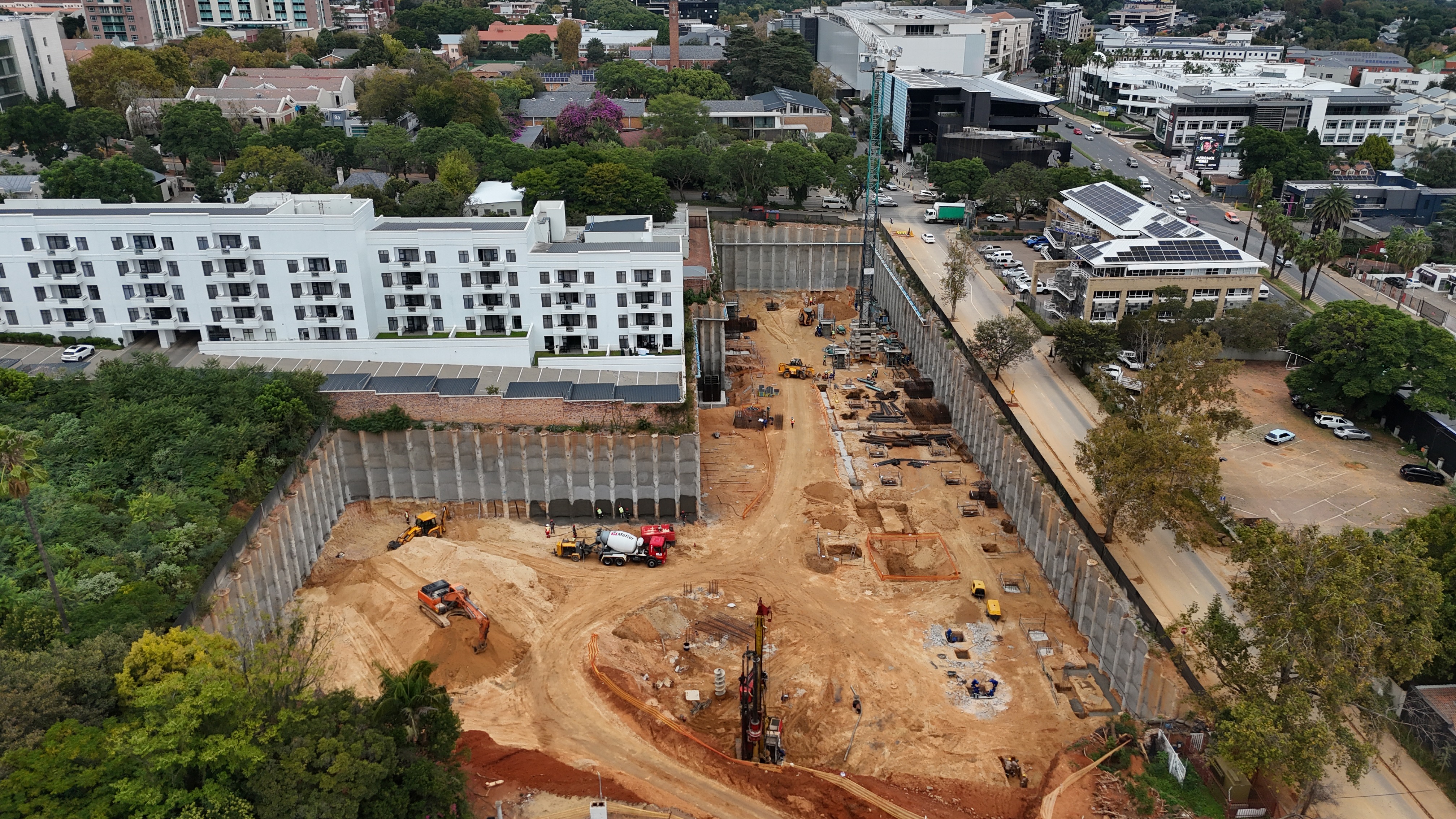
 Construction is under way at the Keyes Art Mile 2.0 in Rosebank. (Photo: Supplied)
 Time in Joburg doesn’t move in a straight line. It bends, stalls, accelerates and loops. A minute here can hold a universe of change – and just as easily, years can pass while you wait for a pothole to be filled or a streetlight to stop blinking.
Ten years ago, the Keyes Art Mile launched in lower Rosebank with the Trumpet building beside Circa Gallery. What was imagined as the beginning of a new precinct gradually drew in its neighbours, from St Teresa’s School to Everard Read, sketching the outline of an art mile.
And then came the wait.
It has taken close to a decade for the precinct plan to be formally registered. Ten years for bureaucracy to catch up with what investment banker-turned-property developer Anton Taljaard and his team first imagined. That is the diplomatic version. For years, the City’s building plans lay strewn across the floor of a condemned Metro Centre in Braamfontein, a fitting metaphor for how urban ambition in Joburg so often is trapped between vision and approval.
Despite being more Keyes Art Inch than Keyes Art Mile, the Trumpet building has become woven into Rosebank’s cultural life, somehow bigger than its physical footprint. Keyes has become synonymous with creative energy and urban gathering. On any given day the city’s stylish set rub shoulders with students, while influencers and young creatives stage impromptu photoshoots on the Trumpet steps, all for the Gram.
The building has earned its place in the city’s rhythms: pricy cocktails with a view at Marble, a near-constant queue for soft serve at Pantry, and Keyes Art Night on the first Thursday of every month, which has quietly become a Joburg cultural ritual. Over time, galleries, fashion, food, performance and creative programming have shifted through the space.
Keyes has always been about experiences, and drawing people together.
/file/attachments/orphans/ED_576576_553485.jpg "Gallery 1 during Keyes Art Night on the Keyes Art Mile in Rosebank on 2 October 2025. (Photo: Gallo Images / Alet Pretorius)")
/file/attachments/orphans/ED_576575_760970.jpg "Keyes Art Night on the Keyes Art Mile on 2 October 2025. (Photo: Gallo Images / Alet Pretorius)")
At the April launch of Keyes 2.0, the long-awaited next phase of the precinct, Taljaard reflected that while art has always sat at the centre of the vision, so too has the life that gathers around it.
It sounds obvious, but having just returned from the Venice Biennale, the idea lingered. You see what becomes possible when cities create ecosystems around culture – where art spills into cafés, public squares, conversations, economies and imagination, and the globe. Cities shift when creative life is allowed to shape them.
Now, after years of speculation, the cityscape itself is shifting. At the corner of Cradock and Keyes avenues, a vast 23m deep excavation has opened. After a decade of dreaming, something Taljaard calls his “favourite topic” is finally moving.
Perhaps it feels personal because years ago I stood at the Trumpet building site watching concrete being poured, trying to imagine what this part of Rosebank might become.
To describe Taljaard simply as a developer undersells him. He is a collector, an obsessive urbanist and someone unusually persistent in his belief that cities can evolve into something better. He also speaks with reverence about what existed before development. Alongside plans for expansion comes an insistence on ecological restoration and reconnecting Rosebank with fragments of the indigenous grassland biome that once lived here.
/file/attachments/orphans/ED_576573_681356.jpg "A life drawing demo at the Lizamore on Keyes gallery. (Photo: Gallo Images / Alet Pretorius)")
In late April, Gallery 1 hosted Ground-Work, curated by Ann Roberts – an exhibition that mirrored what was unfolding outside. Visitors entered a dramatically lit space focused on soil, material and process, where artists explored excavation, layering and transformation through earth-based and industrial mediums. Outside, the ground was being remade; inside, it was being interpreted.
Keyes 2.0 will extend across 36 properties, with residential spaces, a hotel, retail, galleries, outdoor activation space and the possibility of a museum. The launch also revealed that star chef Wandile Mabaso will bring Les Créatifs into the mix, beginning with the Atrium bar – another layer in how the precinct plans to function.
But what feels most significant is not the architecture but the opportunity to reshape how street life functions in Joburg. The registered precinct plan allows intervention at ground level – pavements, planting, edges, gathering spaces. Wider walkways instead of narrow pavements. Greenery not as decoration but infrastructure. Taljaard points to the original green wall at St Teresa’s, planted with more than 6,000 indigenous plants across 45 species. “The test was simple,” he said. “The birds moved in.”
/file/attachments/orphans/Image10_118266.jpg "Construction is under way at the Keyes Art Mile 2.0 in Rosebank. (Photo: Supplied)")
/file/attachments/orphans/Image8_766732.jpg "Keyes Art Mile 2.0 takes shape. (Photo: Supplied)")
/file/attachments/orphans/Image6_303522.jpg "Keyes Art Mile 2.0 has been years in the making. (Photo: Supplied)")
That thinking now expands. While thousands of cubic metres of concrete will be poured, the ambition is for greenery to exceed it through indigenous planting and pollinator pathways. Birds and bees. It reflects a wider shift, visible at places like NIROX Sculpture Park, the gardens of Victoria Yards and the newer development, Nine Yards – where landscape is part of the structure rather than an afterthought.
Keyes has never been only about buildings. It has built momentum through programming, atmosphere and the quiet work of creating reasons for people to linger. Now there is talk of outdoor film, live music and public events. Taljaard imagines something as ambitious as a William Kentridge opera unfolding indoors or under the open sky.
So what does this mean for our city? It signals a move from isolated buildings to connected urban life. From destinations to walkable districts. From quick interventions to something more embedded – spatially, culturally and ecologically.
And perhaps it says something essential about Joburg too: sometimes the work is not in having the idea. It is in holding onto it long enough for the city to catch up. DM
Laurice Taitz-Buntman is an avowed urbanist and the founder of Johannesburg In Your Pocket, a city guide and media platform dedicated to reframing Johannesburg through storytelling, travel and urban experience.
/file/dailymaverick/wp-content/uploads/2025/08/B6B4783.jpg "Art lovers in the Keyes Atrium for Looking Back, Seeing Now at Gallery 1 on the Keyes Art Mile. (Photo: Alet Pretorius)")
/file/dailymaverick/wp-content/uploads/2025/02/8973505.jpg "A woman walks up the spiral stairs at the Circa Gallery as part of the Keyes Art Mile on 21 August 2019. (Photo: EPA-EFE / Kim Ludbrook)")
/file/dailymaverick/wp-content/uploads/2021/06/27h_56955904.jpeg "A sculpture of a naked woman in a water feature at the Circa Gallery on the Keyes Art Mile on 10 June 2021. (Photo: EPA-EFE / Kim Ludbrook)")