




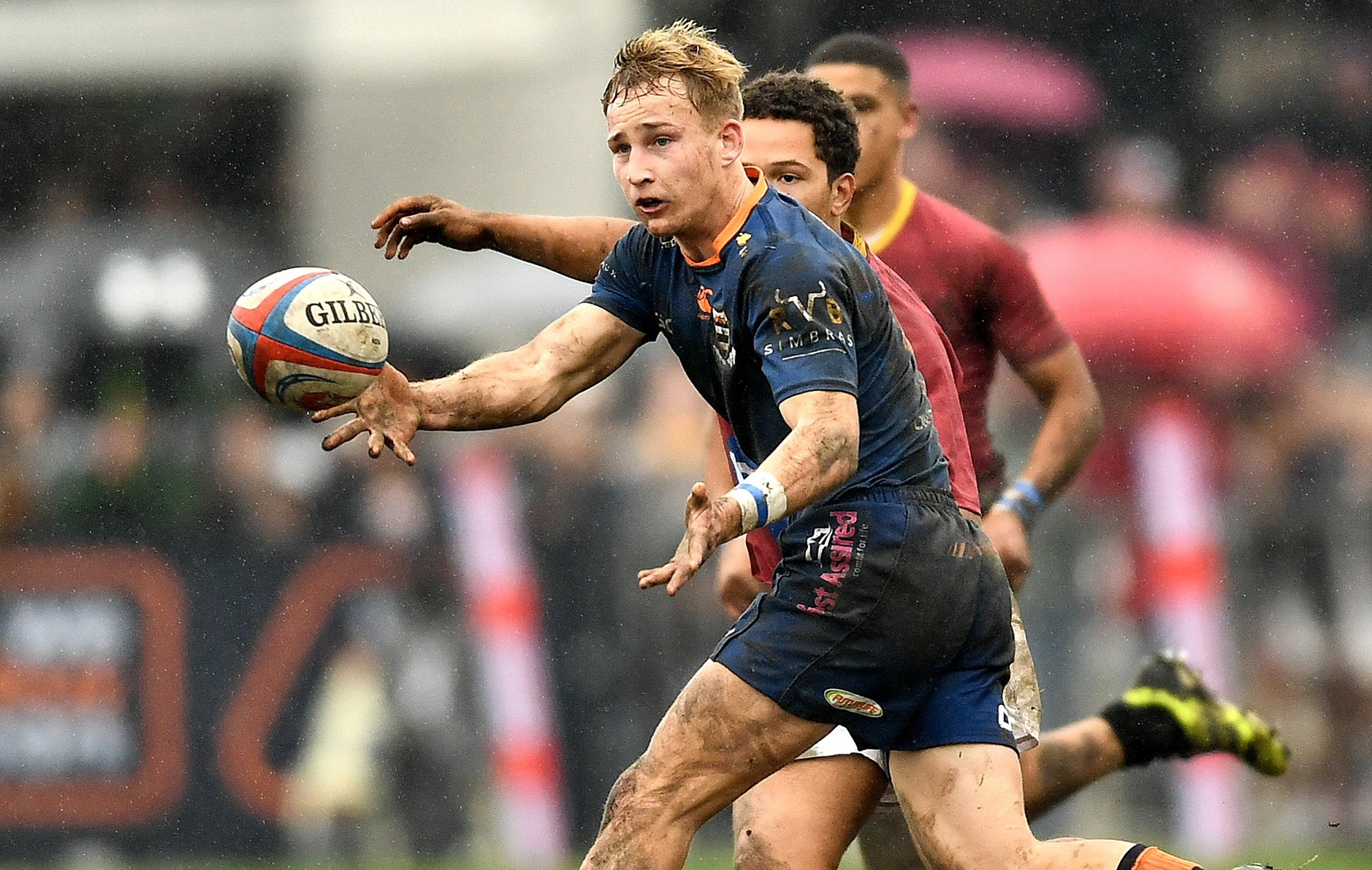
 Philip McLaren of Grey College during the Premier Interschools match between Paul Roos Gymnasium and Grey College at Paul Roos Gymnasium on 17 August 2024 in Stellenbosch, South Africa. (Photo: Ashley Vlotman / Gallo Images)
This past Saturday, 16 May 2026, the King Price Derby Series brought one of South Africa’s most anticipated schoolboy rugby clashes to Pretoria: Afrikaanse Hoër Seunskool (Affies) versus Grey College. Every bone-crunching tackle, blistering counter-attack and raucous try celebration was broadcast nationwide on SuperSport Schools’ DStv channel 216 and via its app.
In April, George Harris, Headmaster at Hilton College, sent a letter to the wider school community in which he wrote that the start of winter sports could create intense pressure and celebrity around young athletes. He stated that televised coverage and rankings amplified this arena, turning games into stages that risked overshadowing the true educational values of sport, which were sportsmanship, fairness, teamwork, resilience and respect for officials.
In South African school sports today, there is a growing concern that its rapid commercialisation is shifting the game away from its fundamental purpose.
“Everything about the sport has changed. The expectations have risen, the interest has risen, the stress attached to winning has become very important,” said Theo Garrun, a writer who has extensively covered school sports.
Garrun pointed out that while the teenagers on the pitch weren’t professional athletes, the entire system built around them was. Because the people running the programmes were highly qualified and well paid, there was pressure and expectation on the players to always win.
He added that when winning became the ultimate motive, vital ethical, moral and educational principles were quickly pushed aside.
Tim Jarvis, a high school counsellor and education blogger, echoes this warning, stating that the relentless pursuit of rankings, recruitment and profit is fundamentally stealing the joy from the game.
“School sport is losing its way,” Jarvis noted, explaining that spaces once reserved for play, growth and friendship are being swallowed by a high-pressure performance culture.
The introduction of mass broadcasting has only poured petrol on the fire. While Jarvis acknowledges there may be arguments for live-streaming games, he argues that few actually benefit the players.
“Not many teenagers are ready for this level of scrutiny, especially when it is broadcast on the national network,” he said, emphasising that teenagers need the space to fail without having their errors shown on constant action replay.
Jude Foulston, an Eastern Cape-based parent, echoes these concerns.
“The pressure on these kids is immense, and as a parent I just don't think it’s worth it. As a parent, I want my child to learn mindset, resilience, and human skills from sport, but right now I don’t think we are supporting them holistically,” she said.
Children under the media microscope
The broadcasting of school sports has evolved into a viewership juggernaut. By the end of the first quarter of 2026, the SuperSport Schools app surged past 1.4 million registered users. Across the app and channel, there were 19 million total views and 317.7 million consumption minutes.
Mo Barendse, Head of Rugby at Western Province Preparatory School, cautioned that the modern ecosystem driven by rankings, digital visibility, and an obsession with outcomes was exposing children to intense public scrutiny far earlier than ever before.
“Live streaming has exposed kids to the public much sooner than would have happened in the past,” Barendse explained. He noted that while this visibility created incredible scouting pathways for universities and provincial structures, the microscope came with a big price.
“If you look at the social media coverage, kids are now under a constant spotlight. Their flaws and mistakes are being viewed on a day-to-day basis. There is a massive emotional and psychological load placed on these teenagers that needs to be managed very carefully,” he said.
Barendse said that while parents and alumni almost always mean well, their immense pride in the school could unintentionally suffocate the players.
“That pride is highlighted and amplified into expectations placed on the schools and the players. At the moment, a lot of stakeholders are measuring success entirely based on where schools lie on those rankings, and that filters down to the kids,” he said.
Former world-ranked professional tennis player Toni Gaddie, who represented South Africa and is now a clinical and sports psychologist, said that when young players were placed in the spotlight, it was vital to question what support systems were placed around them.
Her concerns are rooted in her own experiences on the professional tennis circuit, growing up alongside Jennifer Capriati, a tennis prodigy who turned professional at just 13 and later took a 14-month hiatus from the sport, citing burnout and personal struggles.
/file/dailymaverick/wp-content/uploads/2025/08/Ukhanyo-Primary-school-children-playing-soccer.jpg "Ukhanyo Primary School pupils have fun during a game of soccer. (Photo: Michael Attfield / Starbound)")
Gaddie said it required a parent’s self-awareness to remember that their child was a child at the end of the day.
“Coaches, school counsellors, and parents [need] to ensure that it’s not about the outcome, it is about the journey. It is really a journey of growth, learning and enjoyment, and winning takes care of itself when it’s about the journey,” she said.
Marketing the minors
However, as many people sound the alarm, the business of school sports continues to accelerate. The sheer scale of this commercialisation was on full display earlier this year at a conference held at St Alban’s College, titled School Sports Commercialisation, dedicated to “unlocking the business” of youth sport, with tickets priced at R9,500.
“Streaming, social media, data and brand investment have transformed participation into measurable value. Yet many schools and youth organisations are still figuring out how to unlock, protect and monetise what they already create,” read the event’s promotional material.
/file/dailymaverick/wp-content/uploads/2022/06/yanga-MAIN.jpeg "The boys’ football team from Onderstepoort Primary School warm up with their coach before a match at the Gauteng Farm and Rural Schools Sport Festival at Vaal University of Technology, Sedibeng, on 11 October 2019. (Photo: Yanga Sibembe)")
With peripheral industries already profiting off the “school sports monster”, Jarvis notes that recent pushes to formally monetise the space are seen by some as a way for schools to get a piece of the pie.
However, he cautions that this reduces students to “units of production” carrying a monetary value.
“By implication, this means that some boys and some girls will matter more than others. Schools will be tempted to see certain students as income-generating,” he said, noting that this insidious creep robbed children of the space to simply be kids.
What does the law say?
Belinda Matore, an LLD candidate and expert in child rights and digital governance, explained that viewed strictly through Section 28(2) of the Constitution, the mass broadcasting of school sports was difficult to justify.
“Mass broadcasting of school sports similarly exposes children to indiscriminate and permanent global visibility. That reality is difficult to reconcile with the constitutional principle that a child’s best interests are ‘paramount’,” she said.
Matore stated that children’s image rights should be situated within a child-safeguarding framework, not a commercial broadcasting model.
She highlighted two primary concerns with the current system: the adultification and commercialisation of minors through sponsorship structures, and the complete absence of a compelling educational justification for placing children on national platforms.
“The primary counterarguments of community pride and exposure opportunities for talented athletes do not, in my view, outweigh the constitutional and safeguarding concerns involved,” she said.
Matore explained that children essentially become “unpaid child entertainers” when the following factors align:
- Broadcasts generate subscription or advertising revenue.
- Corporate sponsorships are integrated into the event.
- Children are individually marketed.
- The broadcast is predominantly commercial.
- The children receive no financial protection.
“In practical terms, South African school sports broadcasting has already crossed many of these thresholds. What began as amateur extracurricular participation now generates substantial commercial revenue streams... while the participating children receive neither compensation nor meaningful rights protection,” she said.
To correct this, Matore said SA urgently required legislative interventions, including sector-specific Protection of Personal Information Act (Popia) codes for sports broadcasting and formal child performer protections for commercialised youth sports.
Protecting the player behind the jersey
Barendse acknowledged that the commercialisation of school sport isn’t going away, and that it does offer life-changing opportunities. Teenagers are learning high-performance work ethics, gaining access to elite mentorship, and in some cases securing professional contracts while still in uniform.
The question is no longer how to stop the commercial machine, but how to protect the children feeding it.
“The challenge to us as coaches, parents and educators is clear: to manage expectations responsibly, and to ensure that the pursuit of excellence never comes at the expense of the young person behind the player,” he said.
Nielsen Sports SA weighs in
Responding to questions from Daily Maverick, Nielsen Sports SA said that when properly managed, the commercialisation of youth sport was a structural and moral necessity rather than an exploitative enterprise.
Managing Director Tumelo Selikane acknowledged that the risk of a child being valued primarily for commercial utility was real and not hypothetical, but maintained that athlete burnout and psychological pressure stemmed from poor coaching cultures and governance failures rather than the presence of cameras or commercial partnerships.
“The balance Nielsen Sports SA and responsible operators must strike is therefore not philosophical, but structural: school sovereignty preserved through genuine opt-in governance, revenue returned transparently to schools and students rather than extracted by external operators, individual athlete protections enforced through age-appropriate consent and full Popia compliance and coaching investment treated as the primary outcome measure of whether a commercial framework is serving children or consuming them,” he said.
Selikane said that the distinction between ethical and exploitative data use came down to design intent. A responsible data framework tracked individual improvement over time to assist coaches with training loads, whereas an irresponsible system published public leaderboards and searchable athlete profiles for minors.
The latter, Selikane said, “is extracting value from children, not investing in them”. To mitigate this, he said that Protection of Personal Information Act compliance must be treated as “a floor, not a ceiling”, requiring explicit parental opt-ins and demanding that the unit of data analysis always be the team, never the individual child.
Furthermore, he cautioned that banning institutional streaming simply created an unregulated vacuum, leaving children exposed to spectators who scraped and posted footage without consent across social media with zero oversight.
‘Unwitting donors’
Selikane said the commercial value of a school match was derived from community loyalty, school identity, and the emotional investment of families, rather than the commodification of an individual child.
However, he conceded that the industry must evolve to ensure that children do not become “unwitting donors” to corporate bottom lines. This required a structural commitment to transparent revenue-sharing models that funneled broadcast profits directly back into the school ecosystem, funding bursaries, facility upgrades and student welfare.
Nielsen Sports SA Chairperson Kelvin Watt framed the commercialisation debate as a matter of economic equity rather than exploitation. Pointing to internal data showing that nearly three in five parents faced intense financial stress from sporting costs, and that 75% have considered removing their children from sport entirely, Watt argued that critics defending the “purity” of pure amateurism were inadvertently protecting a luxury available only to wealthy, elite institutions.
For a talented child in an under-resourced area like Limpopo, whose school could not afford equipment and whose family could not travel, a transparent, school-led commercial model was often her only gateway to being discovered.
“The child who is most at risk of becoming a unit of production in South African school sport is not the child whose match is being streamed,” Watt stated. “It is the child whose talent is invisible because no one outside the school fence ever sees them play, who loses their place in the system not because they were exploited, but because they were never found.” DM
Comments
Scroll down to load comments...