




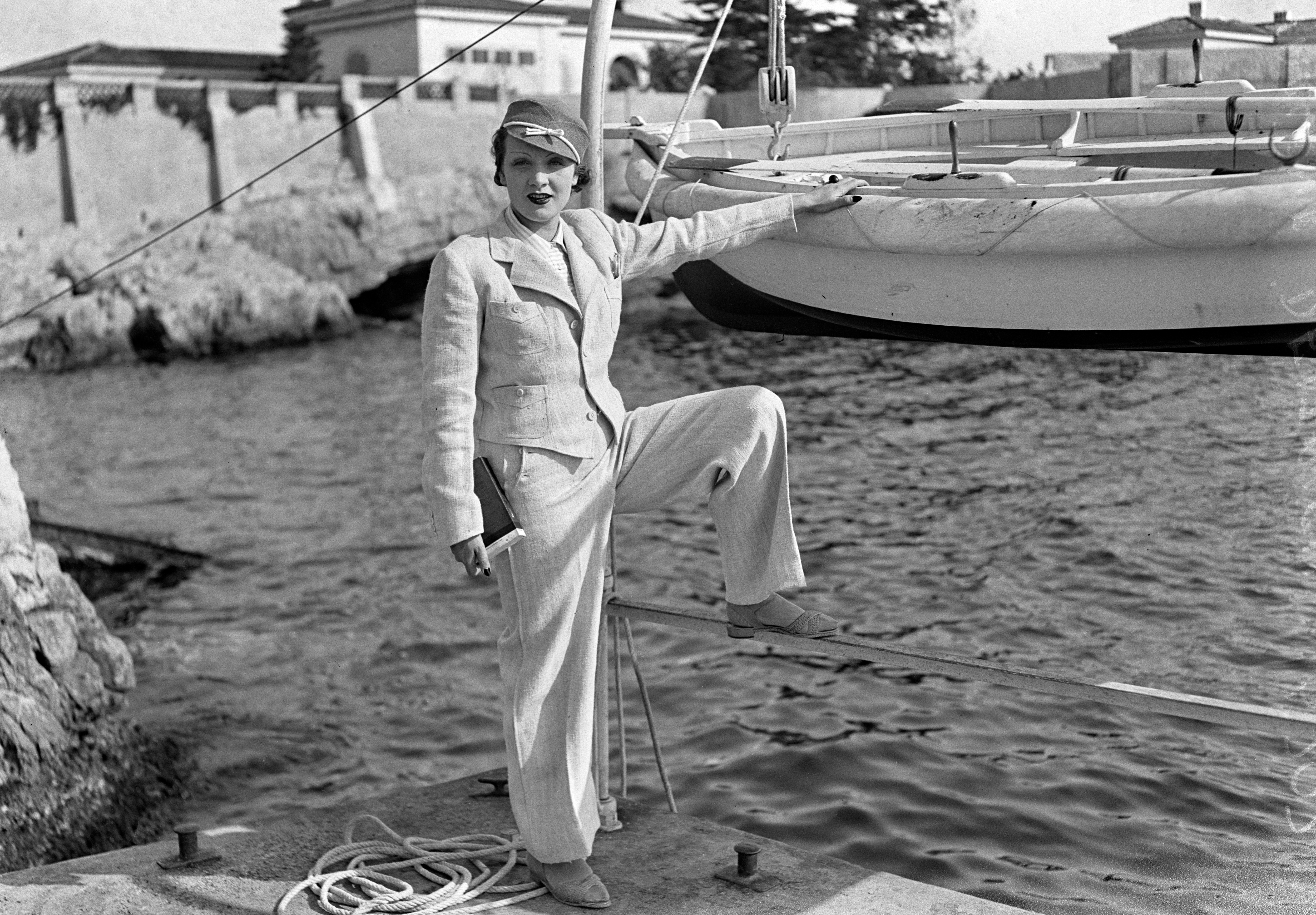
 German-born American actress Marlene Dietrich (1901-1992) on a seaside quay in France. (Photo: Bruslin / Central Press / Hulton Archive / Getty Images)
Sometime in the 1990s, I was discussing the growingly fragile future of our beloved city with a friend of mine who was an opera singer, when he said: “Marlene Dietrich loved Joburg.”
I didn’t know much about her. As a drama and film student at Wits I watched her as showgirl Lola Lola in Josef von Sternberg’s magnificent 1930 black and white classic movie The Blue Angel. She dominated the film with her languid presence, imperturbably powerful and self-contained amid the growing madness that surrounded her. She was indeed one of the goddesses of cinema.
Joburg is the city of my soul. I have lived here most of my life and seen its better days and their fading. Like so many, I love the fragile strands of our half-remembered city. Dietrich performing at the Civic Theatre in both 1965 and again in 1966 is one of these strands I have carried with me for years, and recently I found the time to look for memories of her ghostly, silvered presence in our city.
It’s hard to believe now that Marlene Dietrich was here – that mysterious, glamorous star who beguiled men and women alike, on the screen, on the stage and in her private life. The star of so many movies. The shimmering presence who radiated sexuality to a world that hungered constantly for more of her.
She was not only beautiful and alluring, there was a core of moral steel in her deepest being. A star in Germany in the 1930s, she left the country as the Nazis rose to power. She moved to America and during the war she toured Europe, entertaining Allied troops and holding up their morale as they suffered and died in the brutal years of World War 2. When she returned for a tour in post-war Germany, some regarded her as a traitor. Some even spat at her, but she never lost her cool. Most Germans loved her for her moral bravery.
Why did she come here then? In 1965, Joburg was a faraway, racist outpost of apartheid – more liberal, indeed, than many towns and cities in our country, but a place where theatre audiences were segregated and no black person could watch a show in the new Civic Theatre. Completed in 1962, its looming concrete bulk was a strong source of pride for white Joburgers. It was a theatre they knew was world class and good enough to host the famously demanding Dietrich.
But if she could turn her back on her homeland because of the Nazis, why did she come here to perform during apartheid? Her first performance in Joburg was in April 1965, less than a year after Nelson Mandela had been sentenced to life imprisonment at the Rivonia Trial.
/file/attachments/orphans/GettyImages-3309372_546953.jpg "Marlene Dietrich on set. (Photo: General Photographic Agency / Getty Images)")
It’s not a question that has a clear answer. The cultural boycott was just beginning, but the world knew about apartheid. A number of prominent international theatre people were already boycotting the country. Her career, though, was fading, and Joburg must have offered her new horizons for her image and her art.
Ruth Jacobs-Spector, from a family of racially mixed heritage, describes her feelings about the visit. In the 1960s she felt that the Civic Theatre was an “entertainment monument to apartheid”.
“It was the start of my career. I thought, she’s going to be the one that will project me into the big time!”
“Although Marlene Dietrich arrived on the basis of her anti-fascism credentials, few of the disenfranchised were aware of the stance of the gold-attired woman who was admired by a politically carefree minority population.”
There was tension from the majority black population “about exclusionary performances at Whites Only venues. Ms Dietrich,” she adds gently, “must have been uninformed.”
Yet the story of Dietrich in Joburg within those limits of privileged white memories is one that is also complex and inspiring. It is the story of the sheer guts and determination of a very young man searching for something greater than what his limited world seemed to offer.
Pieter Toerien is an international name today, but then he was a young, aspiring theatre impresario when, at the age of 19, he conceived the notion of bringing Dietrich to perform here.
When I speak to him on the phone about Marlene, his voice resonates with joy.
“It was the start of my career,” he says. “I thought, she’s going to be the one that will project me into the big time!”
He flew to London and through contacts he had made at UCT’s drama school, he tried to get her agent to book her for Joburg. “The answer was: ‘No she’s not interested.’”
Undaunted, Toerien flew to Paris and went to the agent’s office. The answer, again, was “no”.
“So I said, ‘I’m in Paris. Do you think I could go and see her?’” Toerien laughs. “How things have changed. Imagine trying to see Madonna today! He said ‘yes’. And he wrote down her address.”
“A French maid came. She pointed at the couch. I waited till five o’clock. I went back the next day, did the same thing. I returned on the third morning.
“The door opened. Everything in the apartment was white and you could see the Champs-Élysées. Suddenly, this voice said, ‘how do you like your eggs?’ And I nearly fainted. It was Marlene in white shirt and blue jeans. She made me breakfast while I talked to her, and months later it came together.”
“She was sensational! She had 65 cues before she sang a note.”
Dietrich’s arrival at Jan Smuts Airport in April 1965 was a triumph. Percy Tucker, the founder of Computicket and a fan of Marlene, in his book, Just the Ticket, described “the large crowd who fought for a glimpse of this famous woman… mysterious, seductive, a symbol of eternal glamour, she carried the aura of her own legend”.
Tucker describes both her rehearsals and performances at the Civic, “silhouetted against only a working light, singing the haunting Where Have all the Flowers Gone, in that low, unique, almost toneless voice familiar to the troops from her Lili Marlene… I attended every performance, savoured every night’s thunderous applause.”
Toerien was in awe of Dietrich’s famous attention to detail. “I was sent to stand on stage while she watched the lighting designer work. The sheer professionalism of this incredible woman amazed me.”
For him, the opening night was a dream he could hardly believe: “She was sensational! She had 65 cues before she sang a note. Cue one was, ‘ladies and gentlemen, this is Marlene Dietrich!’
“The spotlight came. And there she was. She would bow to the audience, and then she started to wriggle because she had this phenomenal dress that she could hardly move in. But she sure as hell moved, from the wings to centre stage to her microphone. Cue 66 was when the gold spot came on the back of her head and she started to sing.
/file/attachments/orphans/GettyImages-2669203_360859.jpg "Marlene Dietrich makes a phone call to her daughter from her bed in Hollywood. (Photo: Erich Salomon / Getty Images)")
“It was two and a half weeks of performances, and every night was sold out. They stood and cheered and bravoed and then ran for the stage. Rose petals fell from the sky and ushers rushed up with bouquets of flowers for her. The people were going ballistic, screaming and carrying on. We had this 22-piece orchestra with Burt Bacharach, which was stupendous.
“She could make you cry. You know, when she sang Where Have All The Flowers Gone? she cried every night, and I think half the audience cried. I couldn’t believe the energy. It was theatre magic.”
After the show, Dietrich went out for dinner. One of her favourite places was the Blue Fox at the old Oxford Hotel in Rosebank. She had a black driver called Ben who took her around. According to some stories, she even invited him to dinner with her.
Toerien can’t confirm the story. “I wonder if she would have been able to do that. We were so isolated and cut off from each other in those days. She might have, because she always got what she wanted. I just don’t know.” He pauses, thinking back to the cruelty of that time. “I feel quite ashamed about not remembering. When you’re 20 or so, your priorities are quite different. It was important to me to try to make a success of this.”
But Dietrich, he says, was against apartheid. “The colour issue and the problems she would not discuss. She just felt that one should open one’s mind and see for yourself. She would look you firmly in the eye and say ‘the situation in your country is a crime and time will sort it out’. That was her attitude.
“I always thought she was two people. She was to me, Marlene, the person and to everybody else she was Dietrich, the star.”
“While she was here she made several visits into Soweto to see how people were living. They were in awe of this woman who carried it off because she was a star.”
Night after night she played in her magnificent dress, but she was carrying a secret. Her daughter, Maria Riva, writes in her book, Marlene Dietrich: By Her Daughter Maria Riva, that her mother had just undergone invasive treatment, including a hysterectomy, for cancer of the cervix. “On the 24th of April, three and half weeks after her last radium implant, Marlene Dietrich opened her one-woman show in Johannesburg, South Africa, to jubilant acclaim.”
Marlene was indeed brave and determined, but the operation, at the age of 64, marked a turning point in her health. Underneath all the carefully staged glitz, she must have been deeply anxious and wracked by physical pain as she stood under the lights at the Civic Theatre.
She did, though, love her time in Joburg. She agreed to come again in 1966 and also to tour Durban and Cape Town. It was another series of rapturous performances.
But behind it all, Toerien remembers her vulnerability and humanity. “I always thought she was two people. She was to me, Marlene, the person and to everybody else she was Dietrich, the star. Marlene created Dietrich and she protected the image fiercely because she spent her life building it.”
And Miss Dietrich is not seeing anybody and is not well.
They remained friends until her death in 1992. She didn’t want to take his calls anymore, but he could write to her.
“She worked at the image, and it trapped her in the end, because she didn’t want people to see her when she was beginning to fall apart. She died at 90, and the last few years I don’t think were very happy.
“I know she went out of her apartment. She disguised herself brilliantly and out she went. But nonetheless, Dietrich vanished from sight. Marlene took Dietrich off the map because she wanted the memory to remain.”
Her half-remembered presence in our city is a story of ambiguity and human frailty. Of wistful, disappearing beauty, of nostalgia and desperation, of truths, both about her and about us, hidden behind the glimmering, sheer, spotlit stage presence.
The bitter truth that Marlene’s glamour couldn’t, and cannot, hide is that we are still haunted by the ghosts of apartheid. And yet, she also means something else: the city alive beyond that cruelty. She shows us an ethereal presence that was dazzling, even magnificent – drawing memory out of the shadows of our painful past, trying to find its way into our broken present. Finding ways to reimagine the future of the city we love. DM
Hamilton Wende is a South African writer and journalist who has worked on a number of television projects and films for National Geographic, CNN, BBC, ZDF and ARD, among others. He has published nine books based on his travels as a war correspondent in Africa and the Middle East, and two children’s books. His latest thriller, Red Air, reflects his experiences with the US Marines in Afghanistan.
Comments
Scroll down to load comments...