



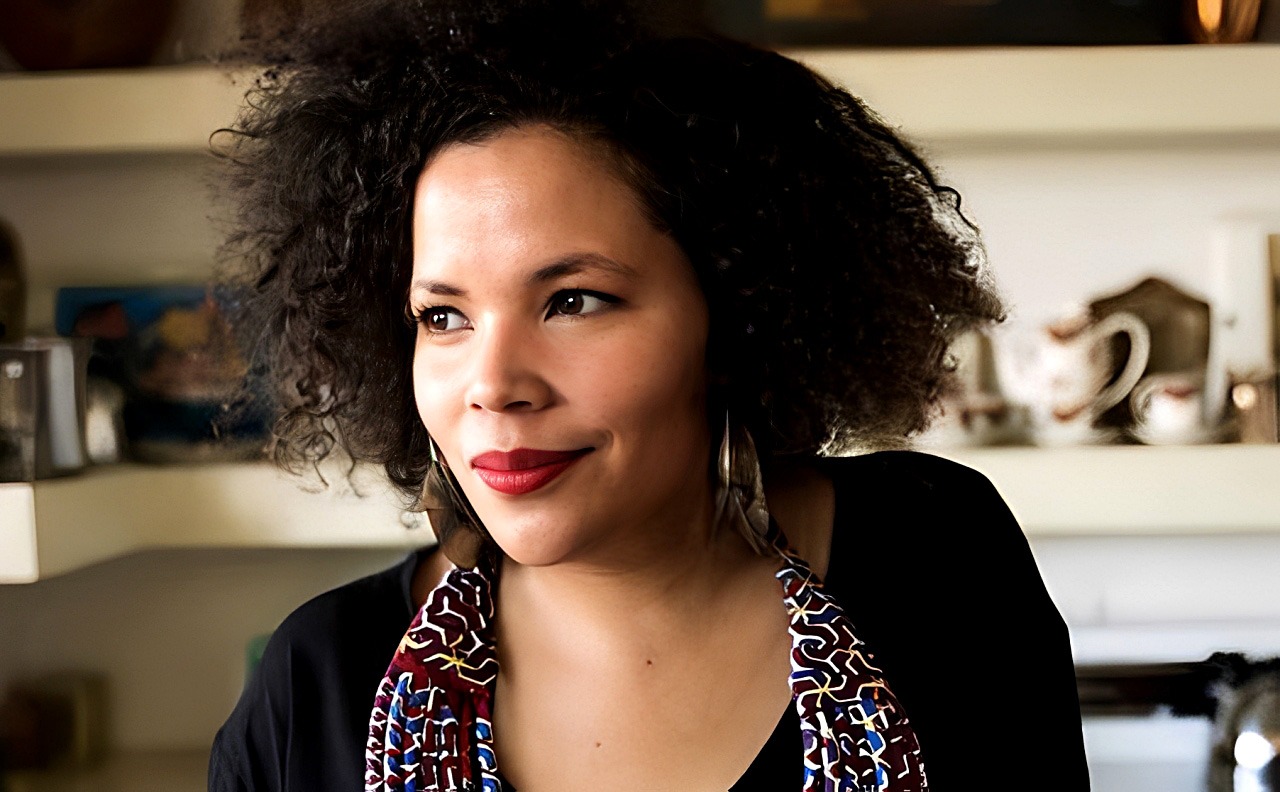
 Maria McCloy. (Photo: Africa Affair Journal / X)
 It’s unimaginable that Maria McCloy isn’t there any more. Maria was always there. Generously so. At birthdays, weddings, funerals, parties, launches, art openings, shows, in the restaurants and on the streets, collecting people and artefacts as she went. She generated a seemingly endless stream of posts about her finds and her joy at Joburg’s cultural vibrancy. She was driven by her network of family and friends, her love of art and the key ingredient that makes a journalist: her curiosity about the world.
But she was more than a journalist, treasure hunter and OG influencer. She was, in her unique way, a cultural pioneer. She also posted her own fashion creations, writing, deejay sets and the events of artists that she was promoting, actively connecting people and shaping the urban culture scene for decades.
Scanning my memory across almost 30 years of friendship, there are two moments that stand out, and they’re connected.
/file/attachments/orphans/WhatsAppImage2026-05-19at181033_148953.jpeg "Charl Blignaut and Maria McCloy. (Photo: Supplied)")
The first is the last time I got to hug her, at her star-studded 50th birthday celebration in Braamfontein in January. It’s the look of utter, childlike glee on her face the moment that Ding Dong started to play and out walked Joe Nina with a microphone, singing his kwaito anthem about a girl called Maria Podesta specially for her birthday. The hit was officially released in 1994 as a new generation of musicians stormed the industry and Maria was a young journalism student at Rhodes University. It soon earned her the nickname Maria Podesta on campus.
/file/attachments/orphans/ED_189458_120167.jpeg "Maria McCloy during the launch of the AfricaRise Retail Concept Store at the Sandton City mall on 24 October 2019. (Photo: Gallo Images / Oupa Bopape)")
The second moment is the first time I met her. I encountered Maria McCloy in a flip file in 1997. We were preparing to launch Friday in the Mail & Guardian, and I was told I could choose an intern from dozens of applicants. Handed the file and asked for a shortlist, I concluded there was only one possible choice, the young student from Rhodes University with the no-nonsense writing style and love of urban culture. When she arrived in our offices in Braam a few months later, I asked her what culture beats she would be covering.
“Kwaito” was her reply.
And?
“And what?”
Maria, you’re working for a whole arts and lifestyle section, you can’t just write about kwaito.
A frown and a little snort.
“Fine, then hip-hop too.”
/file/attachments/orphans/WhatsAppImage2026-05-19at181036_369312.jpeg "Maria McCloy. (Photo: Charl Blignaut)")
Kwaito dreams
As democracy dawned on the country in 1994, a new sound had emerged from the back rooms and garages and onto the streets, reclaiming them from apartheid and white supremacy. Kwaito was a young people’s movement. Kids who’d grown up on US hip-hop and global dance music took these styles, slowed them down, injected the lyrics with local flavour and sold it all back to the world. Kwaito (and local house music) restored pride in the townships.
It painted the aesthetics of freedom. It spoke of the dreams of the underdog. It tested the limits of free speech. It would lead to genuine black economic empowerment that allowed young producers to show mainstream record companies the finger. It would be a bridge that inspired several new dance music styles, manifesting today in the global obsession with amapiano.
Maria was its greatest champion. She put it in the mainstream headlines. As Friday entered a spelling war with a rival newspaper (who insisted it should be spelled kwaitow) she rounded up new acts and demanded they get the cover. This week Bongo Maffin, next month TKZee, why are we not doing Thebe? She knew exactly how big this thing would be. But there was more to it than that.
There was also history and the inspirations drawn from Maria’s life story: a pan-African dream and a love of the village.
/file/attachments/orphans/WhatsAppImage2026-05-19at181039_382044.jpeg "Maria McCloy, Marianne Fassler and Charl Blignaut. (Photo: Charl Blignaut)")
African styles
When Bongo Maffin released their breakthrough album Final Entry, for example, it included an updated version of Miriam Makeba’s own breakthrough song Pata Pata. Makeba had returned from exile by then and Maria organised that Bongo singer Thandiswa Mazwai go with her to play the song to Makeba and record her response. Makeba liked it very much.
It was one of the best stories we’d ever publish in Friday. Maria had neatly connected the dots to show how the styles and resistance of the past lived in the new generation. Makeba’s African mindset and modern traditional fashion choices were part of what would shape Maria McCloy Accessories many years later. The brand would go on to release shoes and a clothing line alongside big-name young designers. At its heart would be southern Africa’s Seshweshwe prints and Lesotho’s Basotho blanket motifs.
Maria and her sisters, Thandiwe and Natasha, were children of a vision that shaped a wave of African independence in the 1960s. Her mother was from a village in Lesotho. Her father was an architect from the UK working in the continent. Political forces and career opportunities shaped their early union. Pregnant with Maria, they travelled to the UK for her birth in 1976, the same year as the Soweto Uprising. She would spend a childhood in Sudan, Nigeria, Mozambique and then Lesotho, where the hybrid family put down roots in Maseru. Boarding school at St Anne’s Diocesan College in South Africa was followed by the varsity campus in Makhanda.
An internship at Friday was only a small part of why Maria needed to be in Joburg, where she would live for most of her adult life in Westminster Mansions at the top of Yeoville. At varsity she had met Kutloano “Thuli” Skosana from South Africa and Addiel “Dzino” Dzinoreva from Zimbabwe. They invited her to create a dream company called Black Rage with them.
/file/attachments/orphans/IMG_9275_655050.jpg "Maria McCloy. (Photo: @mariamccloy / instagram)")
Often when you were out on stories you’d lose Maria and a perplexed photographer or driver would ask where she is. “Look for the nearest magazine stand,” was my stock reply. Maria hated drugs but she snorted media, consuming every TV show, album and publication that came her way. The dream was to create Black Rage the magazine. But the internet had emerged and Rage.co.za was launched, a pioneering youth culture site with McCloy as editor. Thuli started pitching TV shows, Dzino launched Outrageous Records. They put South African hip-hop on the map and reinvented TV magazine formats with shows like Street Journal and Bassiq.
Black Rage Productions was able to set up shop in Norwood and help birth a whole new school of music, presenting stars that made the Simunye kids seem silly. Rage was always drawn to cultural polymaths and long after they closed, their southern African networks would live on and multiply.
/file/attachments/orphans/WhatsAppImage2026-05-19at1805381_156969.jpeg "Maria McCloy. (Photo: Charl Blignaut)")
Lasting legacy
Which is how Maria McCloy Publicity came to be. Choosing her musicians, artists and events with care and political alignment, she started representing the industry and connecting media to it. What today’s influencers often miss is that, in a fragmented online landscape, true power does not lie in products and destinations. It’s about community. McCloy PR wasn’t just about concerts and publicity. It was about building community. Connecting the right kind of people.
/file/attachments/orphans/HILncOJWIAEJUhP_528244.jpeg "Maria McCloy. (Photo: @MikeyMashila / X)<br> <br>")
Community is not just shaped by shared interests. It’s woven together by story. We live by stories, the ones we are told, the ones we tell ourselves and the ones told about our nations. Maria knew this better than anyone. She would tell the story through her writing, her clothing and later through her deejaying. Her sets were where it all came together. Dressed in her urban African styles, playing kwaito mixed up with today’s beats, graciously connecting the dots with enormous rings on her fingers.
She had a tongue on her and a fierce feminist politics, but she never judged people. She accepted our faults and brought us together in a room to show us how powerful culture is, how art can transform lives, create community and demand a more just society.
As a mutual friend pointed out, her next chapter was to travel more in Africa to help weave an even bigger story. She has left us a template of how we can do it. Doing it without her is what I still can’t get my head around. DM