




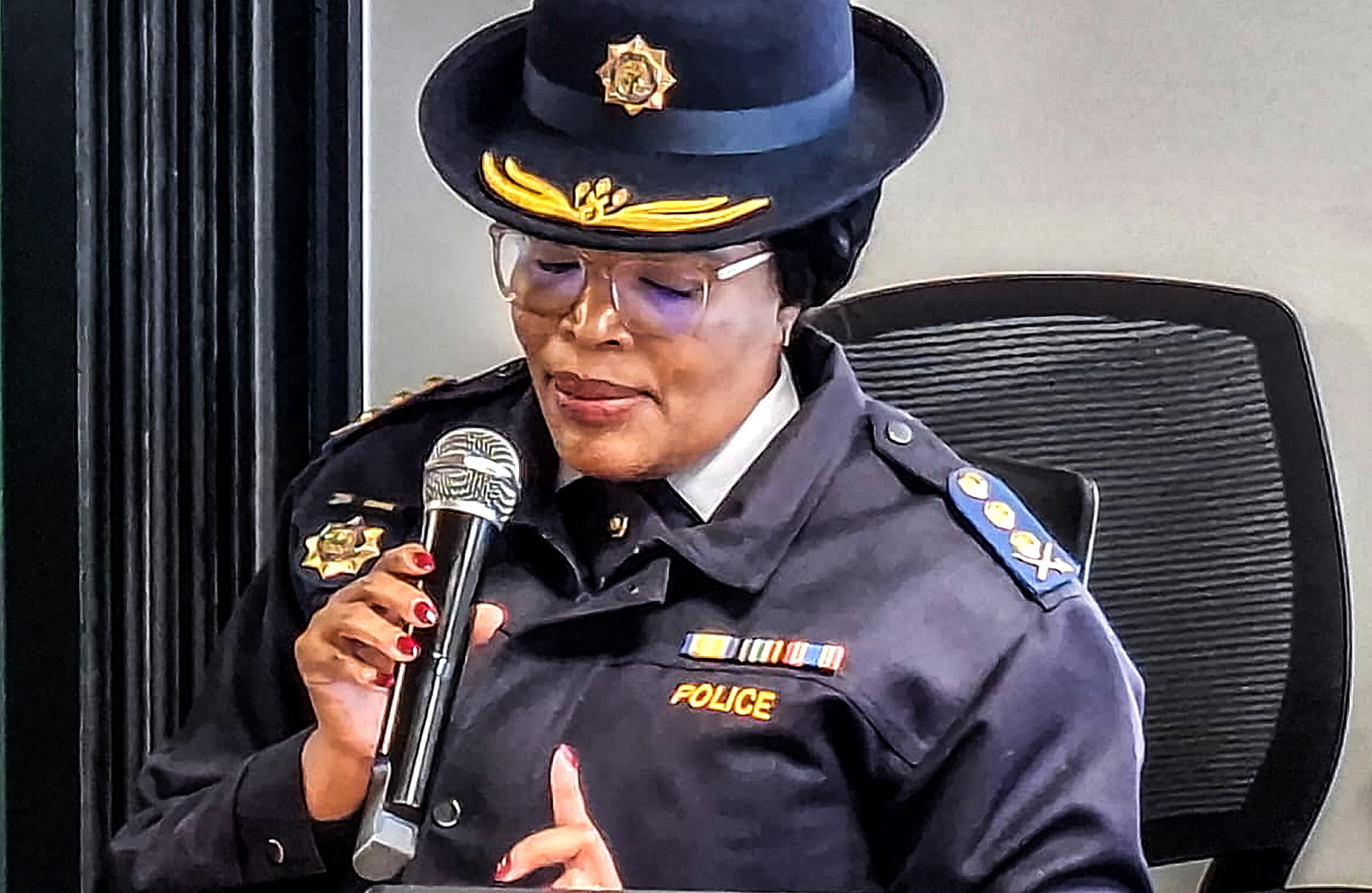
 Acting National Police Commissioner Puleng Dimpane responds in Parliament on 20 May 2026 to questions on plans to strengthen the South African Police Service. (Photo: Caryn Dolley)
 The lifestyles of South Africa’s highest-ranking police officers are being closely examined by the State Security Agency (SSA), not only to sniff out corruption, but to restore faith in a scandal-rocked SAPS.
Acting National Police Commissioner Puleng Dimpane provided details on Wednesday, 20 May 2026, during a briefing before the parliamentary select committee on security and justice.
The lifestyle audits are part of a broader plan to restore public trust in the beleaguered South African Police Service (SAPS).
They are also in keeping with President Cyril Ramaphosa’s announcement in his State of the Nation Address earlier this year, that the SSA would re-vet the senior management of the SAPS.
Lifestyle audits for police generals
“All lieutenant generals are currently under lifestyle audits by the State Security Agency,” Dimpane said, explaining that this was the first phase of a vetting process. The second phase would focus on lifestyle audits of “all” major generals.
It was not clear how many generals this came to, when the process would wrap up, and whether other lower-ranking officers also faced vetting.
Dimpane said that when possible, she would provide an update on whether police officers had been red-flagged in these processes and what would happen to them.
/file/attachments/orphans/ED_6054201_995380.jpg "Acting National Police Commissioner Puleng Dimpane. (Photo: Gallo Images / Frennie Shivambu)")
Dimpane, responding to questions at the parliamentary meeting, said the SAPS was trying to build public trust.
“Indeed, this is what the reset agenda is all about,” she said. “It starts with accountability.”
During Wednesday’s meeting, it was heard that aside from trying to restore and build public trust, the SAPS was:
- Pushing for body-worn cameras to be used in crimefighting as part of a modernisation strategy;
- Working on a long-term infrastructure programme to improve and increase its facilities; and
- Trying to bolster its numbers.
As these plans are laid, the SAPS is roiled by unprecedented turmoil.
Shaky state of affairs
The situation ignited in July last year when KwaZulu-Natal police boss Nhlanhla Mkhwanazi publicly alleged that a drug cartel had infiltrated South Africa’s criminal justice system, politics and private security.
The Madlanga Commission of Inquiry and an ad hoc committee in Parliament were created to investigate Mkhwanazi’s accusations.
/file/attachments/orphans/ED_604870_825232.jpg "Suspended National Police Commissioner General Fannie Masemola appears in the Pretoria Magistrates’ Court on 21 April 2026. Masemola faces criminal charges linked to alleged breaches of the Public Finance Management Act. (Photo: Gallo Images / Frennie Shivambu)")
Repercussions from Madlanga Commission evidence include the suspensions and arrests of law enforcers.
Among several senior police officers now facing criminal charges is Fannie Masemola, who was suspended as national police commissioner last month, and whose position Dimpane now fills.
Police Minister Senzo Mchunu was also sidelined in the law enforcement scandal, and Firoz Cachalia now occupies his position.
A budget of billions
On Tuesday, 19 May, Cachalia outlined the police budget vote, in which he said the SAPS had been allocated R127.072-billion for the 2026/227 financial year. This was expected to increase to R135.8 billion by 2028/2029.
Like Dimpane, Cachalia focused on the “reset” of the SAPS.
/file/attachments/orphans/ED_572639_912858.jpg "Acting Police Minister Firoz Cachalia. (Photo: Gallo Images / Brenton Geach)")
“It is important to understand that the police ‘reset agenda’ is not a one‑year project finalised in an annual budget cycle,” he said.
“It requires a multi‑year turnaround strategy that is consistently implemented.”
Cachalia said strengthening the Crime Intelligence unit was among the key priorities.
This has been referred to several times at the Madlanga Commission and the parallel parliamentary ad hoc committee, with accusations that rogue elements are operating in it and its secret account has been looted.
Madlanga recommendations prioritised
During Wednesday’s meeting in Parliament, attended by Dimpane and several senior police officers, the SAPS’s budget and annual performance plan were outlined.
The presentation highlighted various priorities, some of which were raised in Ramaphosa’s State of the Nation Address.
At the top of this list was the “fight against corruption, including the Madlanga Commission recommendations”.
SC on Security and Justice engage with @SAPoliceService on APP and budget. Chairpersons Jane Mananiso speaks about the eroding of morality in the SAPS. @ParliamentofRSA pic.twitter.com/yWHs1VzcPx
— Justice-and-security-Cluster (@JustSecuCluster) May 20, 2026
This indicates that the police are geared to act on what has been exposed at the Madlanga Commission and its resulting recommendations. Recent arrests suggest that this is indeed happening.
Other policing priorities, linked to Ramaphosa’s annual address, included capacitating the SAPS and tackling firearm crimes.
Cops, guns and integrity
Controls at the police’s Central Firearms Registry (CFR), aimed at cracking down on illegal firearm matters and where problems had previously emerged, were also flagged.
Irregular firearm licence applications were being submitted for ad-hoc audits and dedicated officers were handling corruption-related issues.

“These measures have already led to active cases, suspensions and strengthened evidence-based oversight, ensuring accountability and early detection of misconduct,” the SAPS presentation said.
“Integrity assurance is further promoted through structured vetting measures. CFR members must complete annual Integrity Declarations, disclose external remunerative work, and acknowledge the SAPS Code of Conduct.”
During Wednesday’s proceedings in Parliament, it also became clear that while the SAPS was trying to modernise its technology to tackle crime, it was grappling with older issues.
Modernisation
An information, communications and technology modernisation programme was being phased in.
“This includes the large-scale roll-out of end-user equipment, with approximately 12,600 desktops, 4,650 laptops, and 3,900 scanners planned to be deployed to stations, prioritised according to operational demand,” the SAPS presentation said.
“This investment is aimed at addressing equipment shortages, improving administrative capability and enabling more efficient case handling and service delivery.”
Radio communication systems would be upgraded.
“In addition, SAPS is introducing body-worn cameras and vehicle dashboard cameras to support improved accountability and evidence collection,” the presentation said.
“The roll-out includes approximately 450 body-worn cameras distributed across high-priority stations and districts, and deployment of dashboard cameras across 100 operational sites, including specialised units such as Public Order Policing and Highway Patrol.”
It was put to Dimpane at Wednesday’s meeting that plans for body-worn cameras were nothing new.
She explained that there had been “delays” in rolling out the cameras due to procurement matters at the State Information Technology Agency.
Ageing vehicle fleet
Meanwhile, it became clear that the SAPS’ vehicle fleet was not up to scratch.
The presentation said the police service had 42,186 vehicles, most of which were operational patrol vans and sedans.
It explained the vehicle fleet was “under increasing operational pressure, reflected in the high proportion of high‑mileage vehicles, an ageing fleet profile, and rising repair and maintenance costs that, in some instances, outweigh the cost of vehicle replacement.”
The presentation added: “On average, approximately 7,500 vehicles are undergoing mechanical repairs or maintenance at any given time, which places sustained strain on fleet availability and operational readiness.” DM