




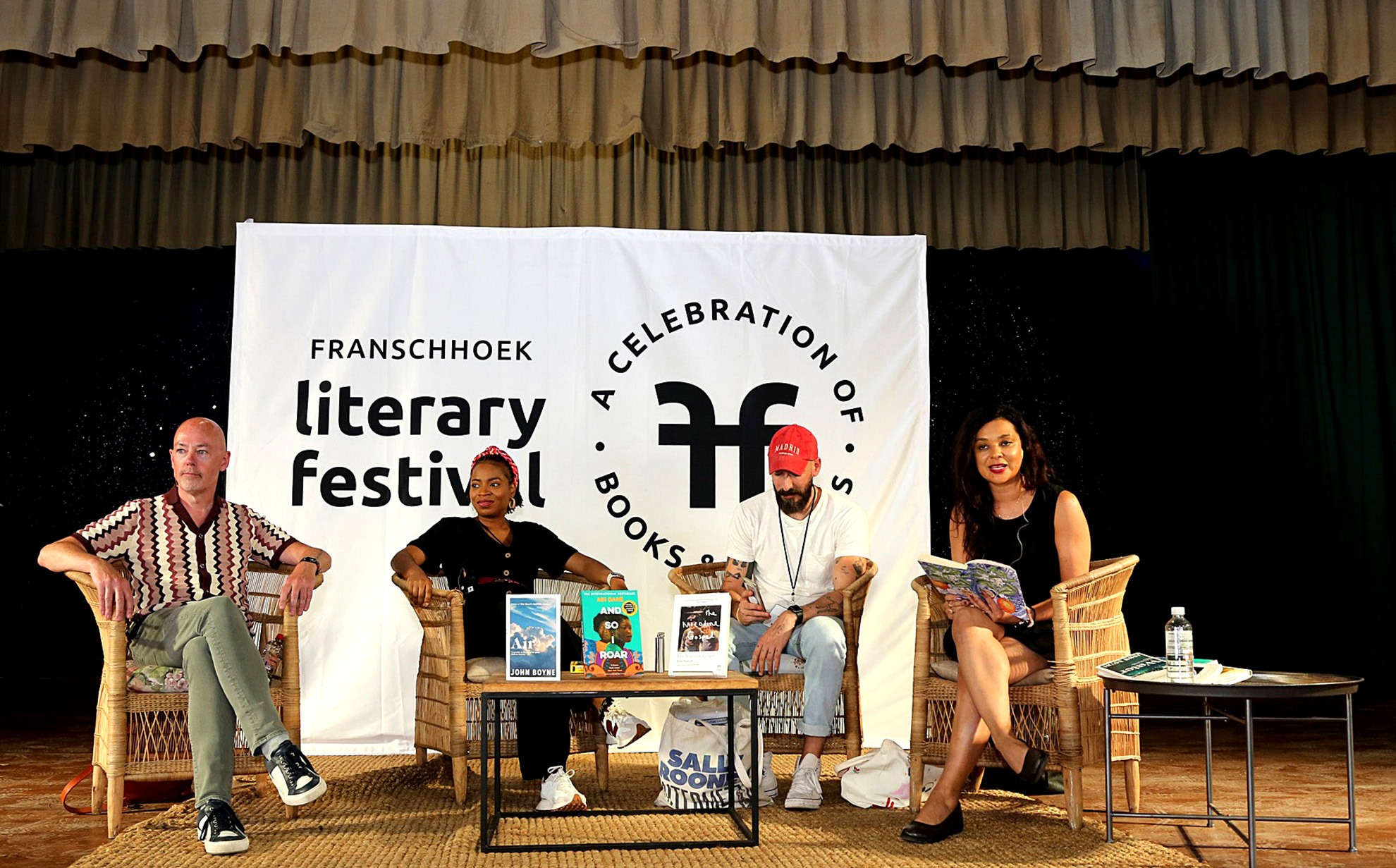
 A panel at the 2025 Franschhoek Literary Festival. (Photo: Franschhoek Literary Festival)
The Green Room at the Franschhoek Literary Festival has very much a secret society energy. A kind of literary Freemasons vibe. Until, of course, this article blows the whole operation wide open.
It is plush in all the right ways: velvet couches, soft lighting, very good coffee, decadent snacks (I managed four slices of quiche in a single sitting, which feels both excessive and somehow entirely defensible in a literary context), a crackling fireplace and chilled wine permanently on tap. You get the picture.
Then there are the authors: prepping for panels, hiding from panels, lost in conversations, occasionally lost in actual books, but mostly there to vibe. And because everyone is briefly trapped there between sessions, the room becomes its own strange little ecosystem. Writers drift into conversations with each other, moderators and strangers.
You overhear things you desperately wish you could include in print. Philosophical debates over cups of tea. Mild emotional breakdowns near the rosé. Someone discussing murder over mini pastries. Someone else enlightening me on the romantasy genre in which a man with ten arms can apparently use his many hands to stroke… actually, never mind. This is not that kind of article.
I managed to catch up with Sven Axelrad. It is very easy to spot Sven in a crowd because he is very tall, and he always wears a red cap. I am tremendously fond of Sven, partly because he is a genuinely decent person, which feels increasingly rare and worth celebrating. But also because he gives out freebies. Specifically, beautifully designed little doggie badges made to celebrate The Dogs of Vivo, his latest novel. Frankly, more authors should understand the emotional power of tiny merch.
Dogs of Vivo follows three aspiring artists whose lives implode after a stranger walks into their regular bar. Set largely in a downtrodden local haunt called the Mean Monsoon, the novel centres on Arturo, an aspiring novelist with a vertical scar on his ribs rumoured to come from a dog heart transplant; Maggie, a waitress and musician chasing a bigger life with her butterscotch-yellow Telecaster guitar; and Felix, a charismatic artist secretly living in a hospital morgue.
Their slightly shabby but comfortable world is upended by the arrival of a mysterious, sharply dressed stranger.
Sven told me in all seriousness that he writes before work every morning, which immediately triggered a violent bout of envy in me. My own creativity has been known to enjoy a long lie-in.
Sven described waking while the rest of the world is still dark, putting music on, writing for 45 uninterrupted minutes and then heading off to work.
“I write to stay sane,” he said. “Otherwise I’m just an accountant.” Which is both deeply productive and deeply annoying to those of us hitting snooze five times before opening a laptop.
A huge highlight of the festival was spending a significant amount of time with Lebohang Mazibuko, where we spoke about almost everything other than literature.
The first thing you should know about Lebo is that she is exceptionally beautiful. She is also, devastatingly for the nation, not single. Her novel Fabrics of Love is a sweeping family saga told through the lives of the third generation of women surrounding Lemohang Ntoi, the patriarch struggling to hold onto the version of family, culture and authority he understands.
Around him, the Ntoi women are pursuing ambition, healing old wounds, questioning expectations and quietly unsettling the foundations of the world he thought he controlled.
The novel navigates culture, legacy, marriage, love and trauma, but what Lebo spoke about most passionately was wanting to make Soweto feel alive on the page as a sensory experience. The food. The smells. The sounds. The kwaito. The texture of community and freedom.
“I wanted people to feel like they were really there,” she told me. And having read the book, I can attest to the fact that she absolutely gets this right. Lebo is irritatingly competent like that.
/file/attachments/orphans/GuestsbrowsingbooksatFranschhoekLiteraryFestival2025_FranschhoekLiteraryFestival_309880.jpg "Guests browse books at Franschhoek Literary Festival 2025. (Photo: Franschhoek Literary Festival)")
Paige Nick and Charlotte Bauer sat in the Green Room between sessions relentlessly working on live festival updates for News24. At one point, Paige managed to slice her finger on a piece of paper with such dramatic intensity that the evidence remained splattered across the page. Paige is exactly the kind of person clever enough to point out the irony of being Paige Nick, a woman wounded by paper, which, honestly, feels like the kind of nominative destiny authors should strive for.
Her latest novel, Book People, is a comedy about social media, publishing, cancel culture and online disasters.
The book follows Norma Reilly, an apparently ordinary accountant living quietly in London. Except she is also being threatened by a badly behaved author, questioned by the police about an attempted murder, and starting a new job as the only 42-year-old intern in publishing history, while simultaneously running a Facebook book club with more than 100,000 deeply chaotic members. In other words: a gentle cautionary tale about the literary world.
Then there is Karina Szczurek, the founder of Karavan Press. Karina moves through literary spaces with a combination of deep gentleness and terrifying competence. One minute she is discussing publishing schedules that would kill lesser mortals, the next she is talking with enormous passion about the women whose stories she has recently helped bring into the world.
One of her latest offerings is Unbridling, co-written by Sheryl James and her mother Sandy James. Born with cerebral palsy, Sheryl has spent her life refusing the limitations imposed on her.
She also told me about Chasing Waves: The Rise of Women’s Surfing in South Africa by Melissa A Volker, the fascinating and empowering history of the women who paved the way for Bianca Buitendag’s first ever Olympic surfing medal for South Africa.
Thinking about the challenges South African women had to overcome to charge the waves, Melissa chronicles the journey and, through meticulous research and wonderful interviews, tells the story of these sportswomen who have defined the local surfing scene.
And in a complete productivity flex on the rest of us, Karina will also be publishing a book on the most-capped footballer on the African continent, former Banyana Banyana captain Janine van Wyk. Janine shared her riveting story with sports journalist Firdose Moonda. Between the two of them, they have captured this extraordinary achievement in what Karina describes as a page-turning memoir that will empower others to aim for the impossible, which frankly feels like the sort of energy we all need access to at the moment.
But wait, there’s more. This superhero is also somehow finding time to work on her own novel.
“The manuscript will be with my prospective publisher by the end of June,” she said. “Maybe unsurprisingly, because I have been surrounded by these women’s stories, it is about a young artist and her mothers.” Honestly, if somebody could bottle Karina’s work ethic and distribute it commercially, South Africa’s GDP would increase overnight.
/file/attachments/orphans/FranschhoekLiteraryFestivalin2024_FranschhoekLiteraryFestival_888269.jpg "Franschhoek Literary Festival in 2024. (Photo: Franschhoek Literary Festival)")
I also managed to nail down Bonnie Espie and force her to tell me about her new book. Tragically, despite my best efforts, she refused to hand over spoilers. Authors are selfish like that.
Her latest novel Lifting the Lid returns readers to the gloriously unhinged little town of Riviersvalleij, where Winnie and Sylvie are trying to keep both their struggling bookshop-café, The Novel Eatery, and their deeply questionable side hustle afloat. Unfortunately, somebody in town knows entirely too much about what the pair have been up to, which is never ideal in a tiny village where gossip travels faster than Wi-Fi.
And then, because chaos apparently enjoys Riviersvalleij as a holiday destination, a wine-themed reality TV show arrives in town. Suddenly everybody is losing their minds, there are cameras everywhere, suspiciously slick presenters lurking about, and even the local mampoer king is somehow reinventing himself as a premium wine producer.
Bonnie described the book with such delight that I immediately wanted to move into Riviersvalleij for approximately 48 hours before inevitably becoming implicated in whatever criminal disaster is unfolding there.
The novel has all the ingredients I love most: sharp humour, village dysfunction, women behaving badly, wine, secrets, escalating panic and the growing certainty that absolutely nobody in this town should be trusted.
I also met and interviewed Alka Joshi to talk about Six Days in Bombay and The Perfumist of Paris – more on this soon – who shared insights generously and spoke with the sort of warmth that makes you briefly forget you are talking to an internationally bestselling author and not an old friend with exceptional earrings.
By the end of the weekend, I realised that what I loved most about the Green Room was not the literary glamour, although there was plenty of that, but the atmosphere of it all.
The strange intimacy of writers, journalists and publishers briefly sharing the same little world between panels. There was something oddly comforting about the constant hum of conversation, nervous energy, laughter and people talking passionately about books as though they still believed literature matters deeply in the world.
For a few days, the Green Room felt like its own tiny universe: warm, chaotic, funny, intellectually alive and full of people trying, in wildly different ways, to make sense of being human through stories.
Also, if anyone from the FLF catering team is reading this: congratulations again on the quiche. It changed me. DM
Joy Watson is Book Editor-At-Large at Daily Maverick.
Comments
Scroll down to load comments...