




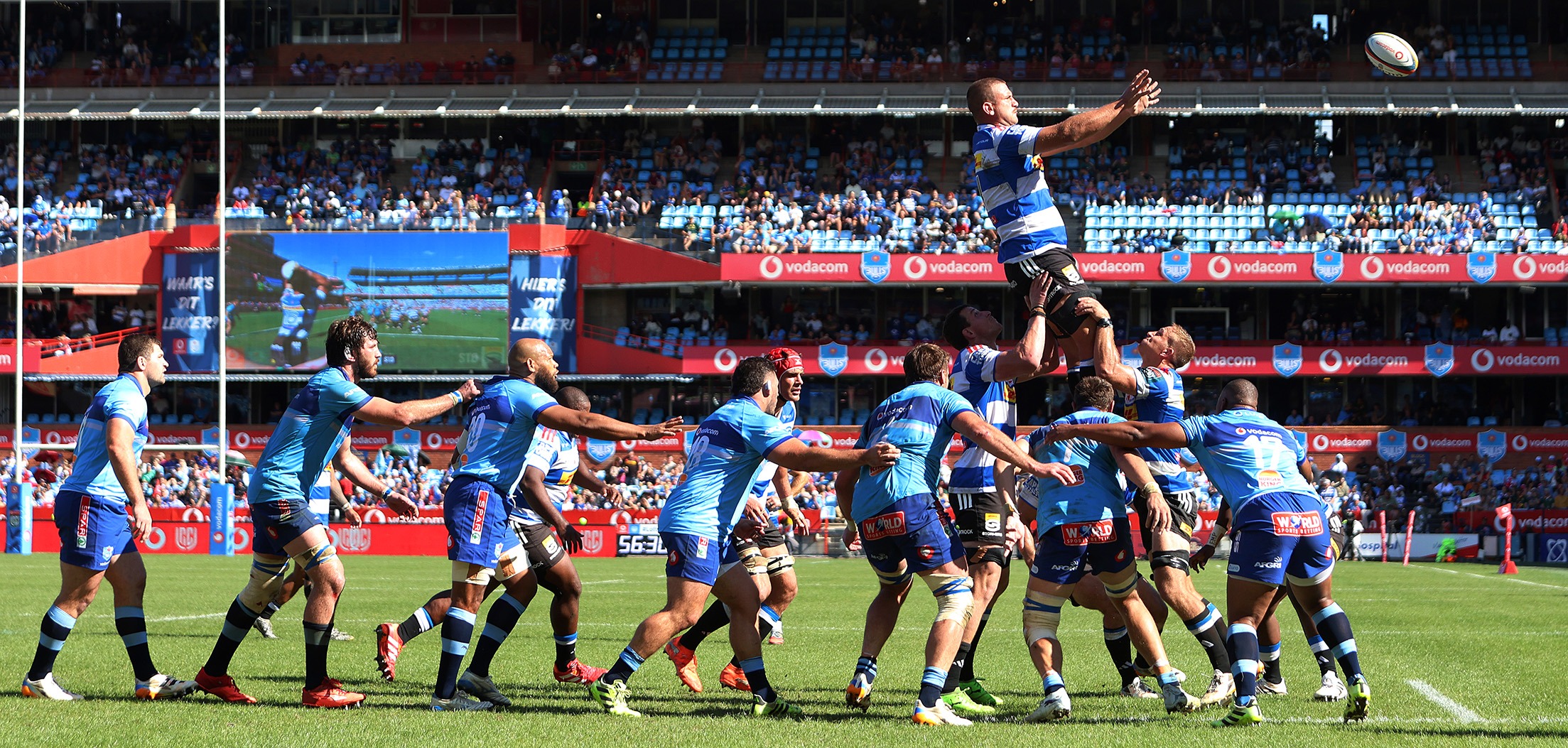
 Stormers lock Adré Smith takes a lineout during the United Rugby Championship match against the Bulls at Loftus Versfeld earlier this year. Increasingly fatigued SA players need a dedicated off-season. (Photo: Gallo Images)
 Few would argue that Bordeaux Bégles and Leinster deserve to be in the Champions Cup final staged in Bilbao this Saturday, or that the contest could live up to its billing as one of the highlights of the sporting calendar.
But the Champions Cup format is broken. This much was true before South Africa’s top teams joined the tournament in 2022 and exacerbated the region’s existing logistical and player-welfare problems.
The convoluted pool format has come in for criticism in recent seasons, as has the push to include 24 teams, some of which have no realistic chance of winning the title.
Home sides continue to dominate, while visiting teams often field weakened lineups in order to manage their squad’s workload with future club fixtures in mind.
While the fiercely contested playoffs typically compensate for a series of one-sided pool results, the Champions Cup – in its current guise – is no longer the club game’s golden standard.
Tournament organisers have refused to address these concerns in recent seasons, and the powers that be have yet to consider a club season restructure that could benefit all and sundry.
Many have noted the competition’s decline, with some commentators in the north laying all of the blame at South African rugby’s door. In a sense, one can understand their player-welfare concerns, but the structural problems of the tournament and the club season run a lot deeper than most are willing to admit.
/file/attachments/orphans/TL_2497890_387693.jpg "Stormers hooker JJ Kotzé on the charge during the Investec Champions Cup match against French club La Rochelle at Nelson Mandela Bay Stadium on 13 December, 2025. (Photo: Cole Cruickshank / Gallo Images)")
Rugby Championship move is first priority
Over the past week, the owners of the respective South African franchises have reiterated their commitment to the Champions Cup, in response to rumours that the South African Rugby Union (Saru) could withdraw the Bulls, Lions, Sharks and Stormers from the European showpiece.
Meanwhile, Saru president Mark Alexander has moved to clarify his recent comments about the future of the franchises, a proposed global season, and the burning issue of player welfare.
Alexander told News24 that the talk of South Africa leaving Europe amounts to “speculation”, and that Saru would host a strategic planning session to discuss the wider competition schedule with the franchises before the end of July.
/file/attachments/orphans/TL_2566695_325338.jpg "Saru president Mark Alexander. (Photo: Grant Pitcher / Gallo Images)")
Shifting the Rugby Championship from its existing slot in August and September to February and March would solve a number of player-welfare issues for elite competitors from SA and Argentina.
As things stand, the Springboks and Pumas play for their clubs in the northern hemisphere tournaments from September to June and for their Test teams from July to November. In short, they play competitive rugby throughout the year, and don’t have a designated off-season.
Saru has taken extraordinary steps to mitigate this workload, implementing a 32-game cap over the course of a season and insisting on an eight-week break for leading players. The move has worked to an extent, when one considers that none of the Boks have breached the cap over the past 12 months.
While the local franchises appreciate the need for these player-welfare restrictions, some have been hampered by enforced resting protocols at key phases of a campaign.
The cap and the resting protocols have always been viewed as temporary measures, as Saru and MyPlayers – the players’ organisation – have pushed for greater alignment between the northern and southern hemisphere schedules in the long term.
Recently, World Rugby took an important first step towards aligning the international game when it created the biennial Nations Championship – a cross-hemisphere tournament that will formalise the Test schedule in the July and November windows.
This past week, Alexander reiterated that Saru wants the Rugby Championship to be played in February and March – during the same window as the Six Nations – for player-welfare reasons.
/file/attachments/orphans/22351737261_812900.jpg "The Rugby Championship needs to move to a February/March window to align with the Six Nations. Here Bok flank Pieter-Steph du Toit is tackled by All Black centre Quinn Tupaea during the Rugby Championship in Wellington on 13 September, 2025. (Photo: Hagen Hopkins / Getty Images)")
If that move receives the green light, SA and Argentina’s leading players will have an opportunity to rest during the months of August and September – an opportunity that players from most other nations currently enjoy.
Club game restructure essential to future growth
Player-welfare remains the biggest issue in the game, and it’s plain to see how an aligned global season would go a long way towards mitigating workloads and fatigue-induced injuries.
A restructure of the season could address other problems between club and country, providing that the respective tournaments are given the chance to breathe and develop, instead of competing against one another for relevance.
The sport cannot continue to schedule Tests and major club matches within close proximity, or in some cases, on the very same weekend.
There’s merit in staging the United Rugby Championship (URC), French Top 14 and English Premiership in the first part of the season, and the entire Champions Cup thereafter.
If the Champions Cup is to live up to its name, qualifying spots should be limited – with four rather than eight teams advancing from each of the aforementioned domestic leagues – and the whole competition playing out in an eight-week block.
In that event, the format would be easier to follow, and tournament integrity wouldn’t be an issue.
/file/attachments/orphans/2254959880_537589.jpg "Bulls flyhalf Handré Pollard in action during the Investec Champions Cup against Bristol Bears at Loftus Versfeld in January. (Photo: Sydney Seshibedi / Gallo Images / Getty Images)")
The strongest available lineups would feature throughout the Champions Cup. Coaches wouldn’t have to worry about saving their best players for a subsequent URC league game that could have a bearing on whether their team qualifies for the next edition of the European showpiece – a bizarre scenario that is unfortunately the norm in the current set-up.
One would hope that sanity prevails sooner rather than later, but future generations may have a hard time believing that the current shambles was ever the status quo. DM