




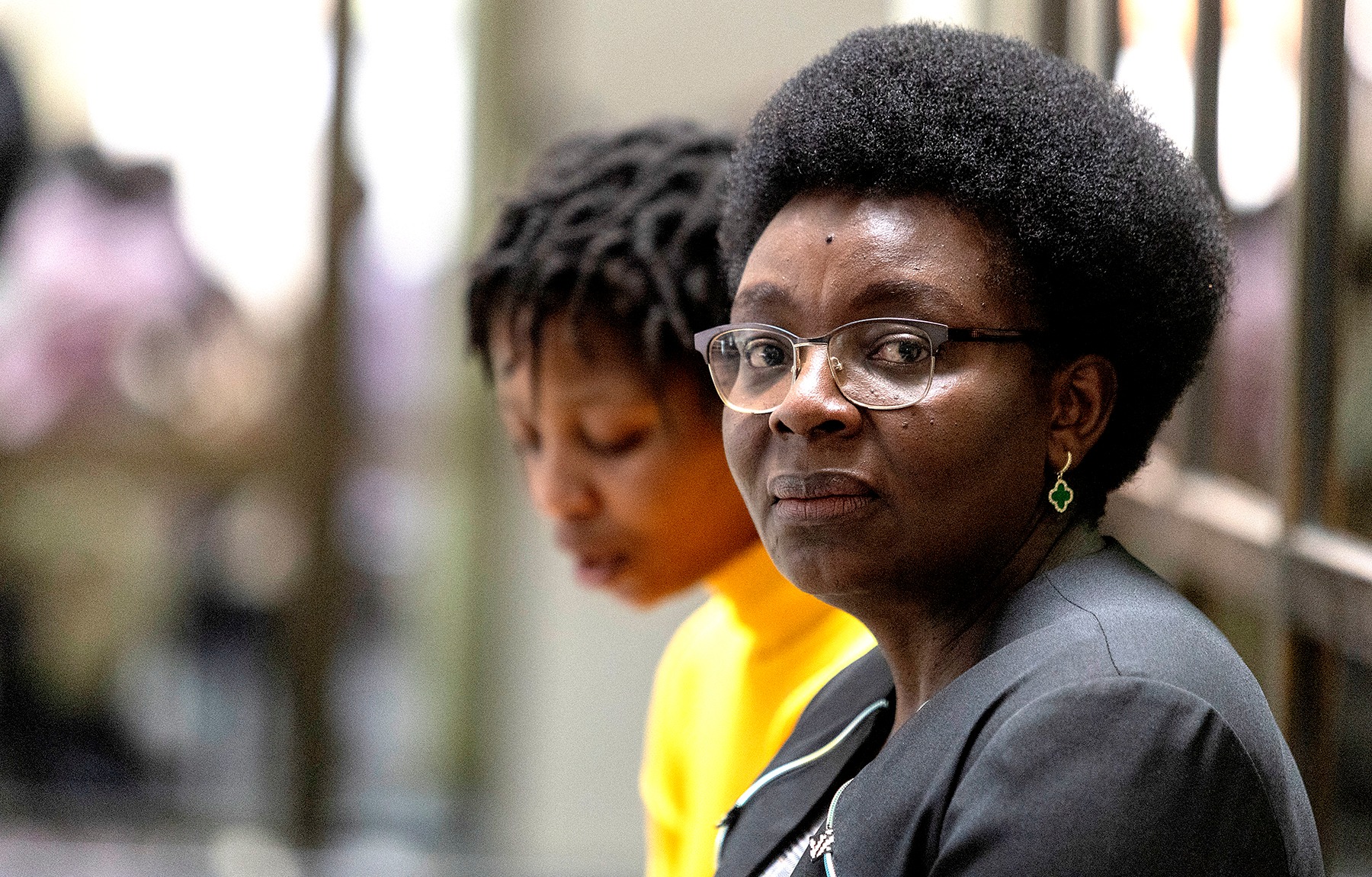
 Rwandan opposition politician Victoire Ingabire looks on at the High Court in Kigali on 13 March 2024. (Photo: Guillem Sartorio / AFP)
Victoire Ingabire, Rwanda’s most persecuted opposition leader, was due to go on trial again on Wednesday, 20 May, facing possible life in prison for daring to challenge President Paul Kagame politically.
It would have been the second time she stood trial in recent years, in a seemingly endless ordeal of torment which peaks when she threatens to launch election campaigns against Kagame.
Alongside nine others, mostly members of her political party, the Development and Liberty for All (Développement et Liberté pour tous or Dalfa-Umurinzi), she has been charged with establishing or joining a criminal organisation, inciting public unrest or disturbances and various other offences, all of which she denies.
Late on Tuesday, Rwandan authorities postponed the trial until 15 June. This seems to have been because lawyers for Ingabire and the nine other accused complained that they were struggling to prepare their defence because the prison authorities were not allowing them to meet all the defendants together.
In September 2018, she was released on a pardon from Kagame after serving eight years of a 15-year sentence. Ingabire had returned to Rwanda in 2010 after spending many years in exile, intending to form a political party to oppose Kagame in the elections that year.
She was arrested on 14 October 2010 and charged alongside four alleged co-conspirators for plotting to destabilise the country through terrorism and denying the 1994 genocide in which some 800,000 Rwandans were murdered, mostly ethnic Tutsis. Ingabire, an ethnic Hutu, was charged with this offence for publicly stating that the murder of many ethnic Hutus in the genocide should also be recognised.
/file/dailymaverick/wp-content/uploads/marelise-rwanda-_5093.jpg "A file picture dated 6 April 2005 shows volunteers forming a human chain to carry the remains of victims of the 1994 genocide to be buried, in Nyakizu, south Rwanda. (Photo: Stringer / EPA)")
Daily Maverick asked Kate Gibson, a member of Ingabire’s international legal team, how it had happened that Ingabire was back in court after her first long ordeal.
Gibson explained that Ingabire’s release from prison in 2018 was not a full commutation of sentence, and she had remained under some restrictions until the expiry of her original 15-year sentence. She was allowed to live in her house, but it became an “open-air prison” where she was monitored all the time and wasn’t allowed to leave Rwanda without the government’s permission, not even to visit her unwell husband and her children and grandchildren in Europe.
“And then the time period for her original charges was set to expire, meaning that she was then allowed under Rwandan law to have other civic rights reinstalled, which would have allowed her then to challenge President Kagame in the 2024 presidential election.
/file/dailymaverick/wp-content/uploads/2025/06/12539022-2-1.jpg "Rwandan President Paul Kagame. (Photo: Toms Kalnins / EPA-EFE)")
The trigger
“And that’s where everything again went wrong. We filed a claim on her behalf in front of the East African Court of Justice, asking for her civil rights and her political rights to be reinstated.
“And then we think that was the trigger for this second criminal process against her.”
Gibson explained that Ingabire’s trial had now been joined with the ongoing trial of the group of nine, which included other members of her party, who had been arrested for meeting online to discuss non-violent opposition to the government.
Ingabire was not at that meeting, but when her lawyers pushed the courts to restore all her rights, the judges in the case of the nine directed the prosecution to bring her to court to answer questions.
Even though the Rwandan Public Prosecution Service found that there was no evidence that she had been involved in the online meetings of the others or in any wrongdoing, she was summoned to answer questions at their trial. The judges were not satisfied with her answers and directed the prosecution to join her to the other case.
Gibson said Ingabire’s Rwandan lawyers had challenged this decision as an interference by the judges with the presumption of Ingabire’s innocence and that the decision was up to the prosecutor, and not the judges.
However, the Rwandan Supreme Court ruled in March that the judges’ decision to join Ingabire to the other case was not unconstitutional. “And so the newly joined trial process starts tomorrow, on the 20th.”
Gibson added that the new case was “a continuation of the weaponisation of the judicial system against political opponents. And she's being detained in a way that her rights aren’t being respected.
“So she has, I think, had two phone calls with her family since June. She is treated differently from other prisoners. She’s not allowed the medicine she needs. She’s not allowed to worship in the same way. She’s not allowed to go to the church service. She’s treated very poorly, which reflects how she was treated during the first period of arrest.
“And we all felt, and she felt, that this was coming again: she wouldn’t be allowed to have this strong opposition voice, that at some point she would be going back inside. We didn’t know how it would happen or what it would look like. But it seemed inevitable that we would end up back here.”
Gibson also noted that Kagame continued to publicly threaten Ingabire. “During a campaign rally on July 6, 2024, he described her as a ‘small woman of a genocidaire’ and claimed she ‘wish[ed] or talk[ed] evil about Rwanda’, before stating, ‘We will find an appropriate solution’ and, ‘You know she will not end up well.’ In late 2024, Kagame stated, ‘Those who slip through our net, their days are numbered, including those we pardoned.’”
Gibson said Ingabire’s lawyers saw these “increasingly defamatory statements about [Ingabire]” from Kagame and his officials “as sort of a foreshadowing of her rearrest”.
Gibson noted that in Rwanda, the life sentence Ingabire was facing meant literally that: prison for the rest of one’s life. DM
This story was updated following the announcement of the postponement of Ingabire’s case to 15 June. (Updated: 20 May 2026)
Comments
Scroll down to load comments...