




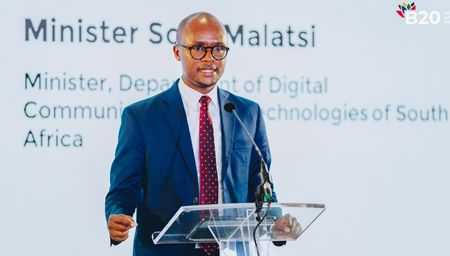
 The minister of communications and digital technologies, Solly Malatsi. (Photo: OJ Koloti / Gallo Images)
There was a moment of rare alignment in the minister of communications and digital technologies, Solly Malatsi’s, 2026/2027 budget vote speech last week. He said that Low Earth Orbit (LEO) satellite services are a vital part of South Africa’s digital future, arguing that “rather than wait a decade to develop domestic LEO capacity, we must create conditions for international operators to serve our people now”.
It was a rare alignment with the Independent Communications Authority of South Africa (Icasa), which rejected his policy directive in the same week, but is also looking to lower the technical and administrative barriers for these satellite internet companies.

While Malatsi addressed South Africa’s equity ownership laws multiple times in 2025, Icasa’s draft amendments to the Radio Frequency Spectrum Regulations specifically target the technical licensing hurdles that would otherwise deter a foreign satellite operator.
The times they are a-changin’
The first thing the draft regulations introduce is a new foreign satellite space segment registration process (Regulation 28B). Foreign space segment operators only need to register their systems with Icasa, at no fee, which establishes direct contact for interference and security issues without granting formal service rights or creating an additional burden to enter the market.
There’s even a handy explanatory memo which details that this approach avoids imposing full licensing burdens on foreign satellite networks (it seems like code for: “speak directly to us, we won’t bite and it won’t cost anything”).
Icasa’s new framework also proposes a blanket licensing formula for user-terminal networks. Crucially, the regulations state that this approach “will ensure accountability of operations even in an event where the satellite network’s gateway is not located in South Africa”.
This perfectly accommodates modern LEO constellations like Starlink, which can use inter-satellite laser links to provide service without needing to build extensive physical gateway infrastructure inside South African borders.
It must be said that under Regulation 28A, all satellite services and transmissions to terminals in South Africa require explicit prior authorisation, or face fines of up to R5-million.
The core of the argument
The next phase of mobile connectivity, though, is mobile. Icasa clarified that gateway Earth station and user-terminal network licences will simply be treated as radio frequency spectrum (RFS) licences, and Icasa does “not see any need to introduce a new type of licence” or categorise them under Chapter 3 service licences — the same as existing cellular networks.
This is where it gets interesting for the Starlink debate. Daily Maverick reporting has explained how far ahead of the competition the SpaceX sky internet project was. Then Amazon — the other company with a space programme — dropped $11-billion on buying Globalstar to help strengthen its satellite-to-phone capabilities.
/file/dailymaverick/wp-content/uploads/2025/04/GettyImages-2132036599.jpg "A person walks on a pier beneath the contrail remaining from a SpaceX Falcon 9 rocket carrying a payload of 22 Starlink internet satellites into space after launching from Vandenberg Space Force Base on 1 April 2024 in San Clemente, California. (Photo: Mario Tama / Getty Images)")
This was just in time for the announcement that Apple was choosing Amazon LEO (formerly known as Project Kuiper) as its satellite partner of choice for the iPhone and Apple Watch. Vodacom, of course, through its Vodafone connection, is an investor in the Starlink rival, although the African arm of the global telecoms provider also cameos as an admin partner to bring Starlink to some of South Africa’s neighbours.
“There are billions of customers out there living, travelling and operating in places beyond the reach of existing networks, and we started Amazon Leo to help bridge that divide,” said Panos Panay, senior vice-president of devices and services at Amazon.
That, you will also recognise, is one of the main points Starlink made in its equity equivalent investment programme pitch — you know, the one that promises to connect 5,000 schools as part of the R500-million deal to bypass giving up the 30% local equity to historically disadvantaged groups.
When times are dark
A key part of Malatsi’s swagger when arguing the shortcomings of the legitimate policy gap between the ICT sector codes (the BBBEE rules) and the Electronic Communications Act — the minister is seeking to bring the Act in line with the codes — was the confidence that Equity Equivalent Investment Programme (EEIP) decisions are under the purview of his buddy in the Department of Trade, Industry and Competition, Mpho Parks Franklyn Tau.
But, earlier this year, that confidence may have been dented when Tau’s office called the tech sector EEIPs into question in a written response to a parliamentary question:
“The latest B-BBEE Commission report shows that the ICT sector has a sizeable share of Level 8 or non-compliance of around 30% between 2018-2023, but a decent share of Level 1-4 at around 60% over the period. Level 1 compliance has been around 25% among ICT entities in the 2019-2023 sample.
“The report further states that the performance of ICT sector entities is against the maximum points available for scorecard elements. The report indicates a steep increase in the average number of points attained for Enterprise and Supplier Development (ESD), likely due to a scorecard that strongly promotes ESD, which is allocated almost half the points.
“For ownership and skills development, there have been limited increases in points attained, and for management control, there has been a decline since 2018.”
The question came shortly after Malatsi made a very public showing of Dell Technologies’ relatively procedural renewal of its EEIP commitments. Microsoft got its R1.32-billion EEIP renewal approved in 2024 to far less fanfare, but that was when it wasn’t such a hot topic.
The Department of Communications and Digital Technologies is still on a mission, though. Malatsi responded quickly to the Icasa cold shoulder in a firm statement, mentioning that his job is to “ensure that every person in South Africa has access to affordable and meaningful connectivity that they can use to build sustainable livelihoods and get out of poverty”.
“As announced in my budget speech yesterday, we will pursue legislative amendments that will enable equity equivalent investment programmes to complement ownership requirements in telecommunications, through amendments to the Electronic Communications Act (ECA),” said the minister.
Hopefully, the legislative route will be more successful for Malatisi, who is facing increasing pressure from Parliament and the public. At least there is alignment. DM
Comments
Scroll down to load comments...