




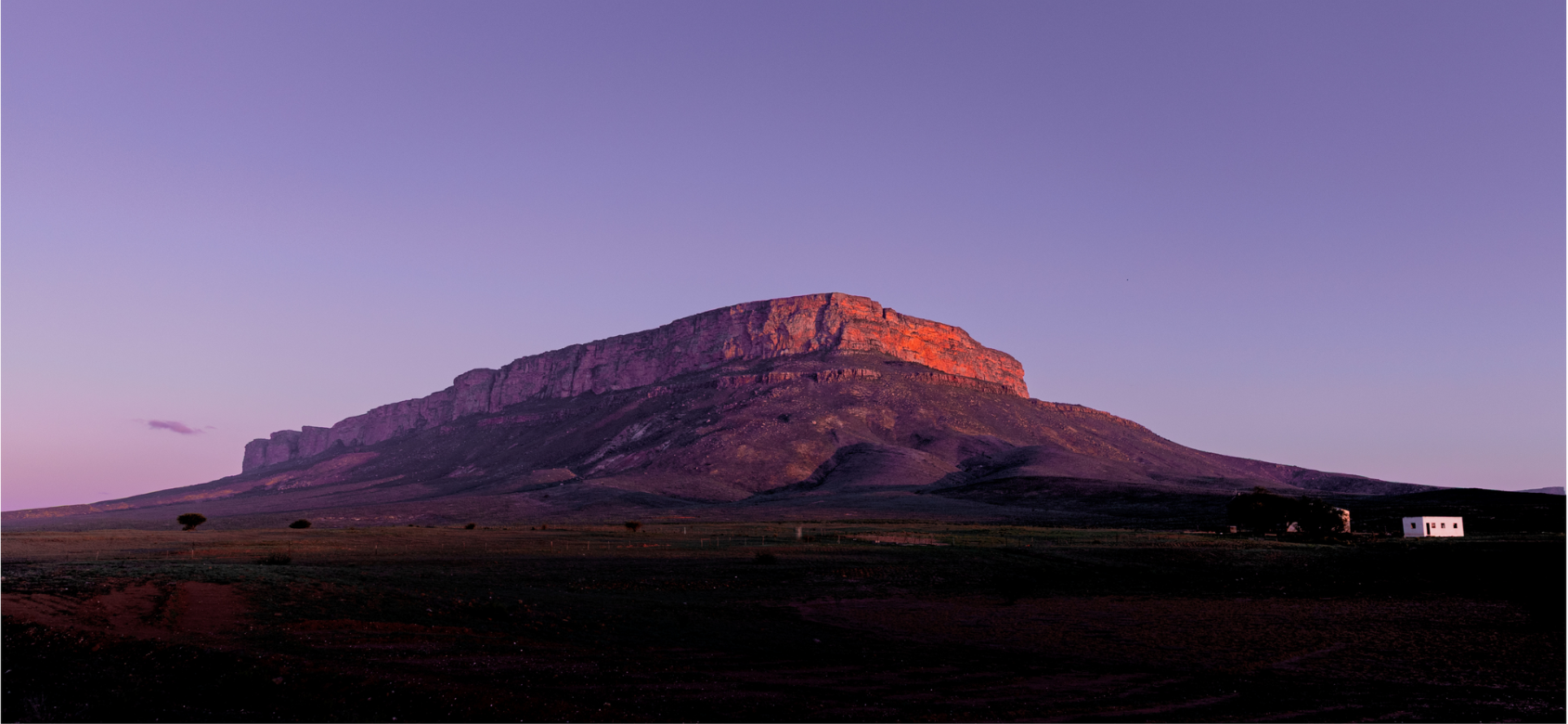
 Maskam Mountain.
 The documentary follows filmmaker Melt van der Spuy as he sets out to recreate a decades-old photo of the mountain. The image was once featured on a bottle of wine.
The Maskam mountain itself, a flat-topped landmark near Vanrhynsdorp, towers over the surrounding area, which includes parts of the Matzikama municipality, such as Vredendal, Lutzville, Klawer, Papendorp, Doringbaai, and Nuwerus. All too often overlooked from the outside.
Van der Spuy is joined by award-winning filmmaker and director, Dewet van Rooyen, and together they travel through the hinterland of Van der Spuy’s youth.
Shot in Afrikaans with English subtitles, the film takes a contemplative, poetic look at a lesser-known, understated region of the country and why it, too, is special and place of contradiction.
The region runs on contrast: barren for most of the year, then suddenly flooded by the Olifants River.
Don’t expect a travel show featuring the best coffee shops in towns or the history of the area's oldest church. Returning to Maskam takes the backroads, lingering on the people of the region, their love for it, and above all, the mountain.
The specific towns aren’t the main story. Identity, culture and belonging are.
Part of what makes the documentary distinctive is the fact that the region has rarely been documented visually. This isn’t Paternoster or the Drakensberg mountains. This shows something new, yet so incredibly old.
/file/attachments/2992/Slot1-ScreengrabCarousel-Takingtheback-roads_106636_835922.png "Taking the back-roads.")
Giving back
The idea for the documentary came from his frequent returns to the town.
“I saw the town systematically decline, with more potholes, electricity and water problems,” he says.
“I wanted to do something because I know how incredibly powerful storytelling can be.”
He has been working as a creative strategist and branded content filmmaker for years and set out to see whether he could do for people what he does for brands.
The documentary is only available on YouTube. “The documentary’s intent was to purely localise it and put it out to locals. It's a product of the region for the region.”
Returning to Maskam manages what so many other shows struggle to do: to capture a specific, unpolished Afrikaans dialect readily spoken there. Like the film and the area, it’s almost poetic, quiet and easily missed if you don’t pay close attention.
/file/attachments/2992/Slot1-ScreengrabCarousel-OomSypietoucehstheinfamousGifboomPoisonTree_641073_263676.png "Oom Sypie toucehs the infamous Gifboom(Poison Tree).")
Ambiguity
A golden thread throughout the film is his connection to his roots, shown poignantly in his discussions with his elderly grandfather, also Melt van der Spuy.
Grandfather and grandson share similar views on the region's identity crisis. Many of the towns in Matzikama lie somewhere between the West Coast and Namakwaland. Yet “Whenever someone asks you where you are from, Vredendal, Vanrhynsdorp, we freeze, because how do you define it? Who are we to the outside world?”
The towns in Matzikama are in a bit of a limbo - too inland for the West Coast and too coastal to really be called Namakwaland. Unlike places like the Swartland, the Overberg, and the West Coast, Matzikama has no easy identity.
Van der Spuy (senior) served as deputy mayor of Matzikama in the early 2000s.
He also grew up in the area, and his parents, just like him, were actively involved in developing Vredendal. “We saw the area get bigger and bigger,” he tells his grandson.
“We always spoke about Maskam (while growing up),” he recalls in the documentary. “We did not call it Matzikama.”
He talks of learning the meaning of the word from a book by a previous inhabitant, the prominent 20th-century writer, FA Venter. In “Die Middag Voel Na Warm As”. The writer reveals that the word “Matzikama” means “place of water”. Maskam means “The mountain that yields water.”
When they started the new municipality, they looked for something that all the inhabitants from the differing towns shared.
“It was quite an exercise to get towns like Vanrhynsdorp, Klawer, Vredendal, Lutzville, Papendorp Ebenheaser, Doringbaai and Strandfontein together under one blanket,” he tells his grandson.
“It wasn't that easy,” he admits. “The only thing we could use to pull this lot together was Maskam.”
Seen from almost every town, it offers common ground in a place that lacks it.
/file/attachments/2992/Slot2-MeltvanderSpuyJnrinconversation_403845.png "Melt Van der Spuy in conversation.")
Identity
The team felt it was important to include more about the Griqua and Khoi roots of those in the region. “The Griqua, the San, the Khoi. This area is their place just as much as it became my place and for millennia longer,” Van der Spuy tells the camera.
Serendipity led them to the chairperson of the National Khoisan Council, Cecil le Fleur, who, unbeknownst to them, is a Vredendal local.
To their further surprise, Le Fleur also told them the area boasts a site sacred to the Griqua, which to this day inspires yearly pilgrimages to the farm Ratelgat.
“It was, for me, quite a profound connection to all our ancestors and really quite special,” Van der Spuy says.
/file/attachments/2992/Slot1-ScreengrabCarousel-CecilleFleur_128960_849051.png "Cecil le Fleur")
Challenges
Van der Spuy and Van Rooyen faced numerous challenges during the shoot - a limited budget “cobbled together through community funding” being but one of them.
Then the weather started acting up.
“We had planned a very specific aesthetic,” Van der Spuy explains. “We wanted to capture the mountain’s famous purple hue. We went out there when the skies were historically crystal clear. Instead, from day one, we got low cloud, fog, and drizzle.”
For three days, the mountain couldn’t be seen through the dense fog. But on the last day, in the exact hour they set aside, the sky opened.
“The sunset hit the rock, giving us a beautiful purple hue that contrasted with a dark foreground featuring a small farmhouse. It captured human smallness and temporality perfectly,” he says.
“The contrast was unbelievable. You had this intense light on one side of the mountain and deep, dark shadows on the other. It was a perfect visual representation of the area itself, an environment defined entirely by extremes.”
It lasted for an hour before mist engulfed the mountain again.
That moment, when the mountain finally revealed itself, became more than just a shot. It became the film’s central idea.
Home
He sees the area differently from what locals and travellers see.
“I think I've felt like this for a long time, that it's not a place of scarcity, but a place of abundance.”
It’s a place of contrasts, something they actively tried to capture.
“The contrast is locked up through feast and famine, darkness and light and flood and drought, and the temporality in between. This contrast is locked up in the people, too, in me. How could it not?”
Perhaps Van der Spuy’s journey is best described as seeing a place you know so well as it truly is, for the first time.
His story of returning embodies T.S. Eliot's words.
“We shall not cease from exploration
And the end of all our exploring
Will be to arrive where we started
And know the place for the first time.” DM
Author: Nielen de Klerk