




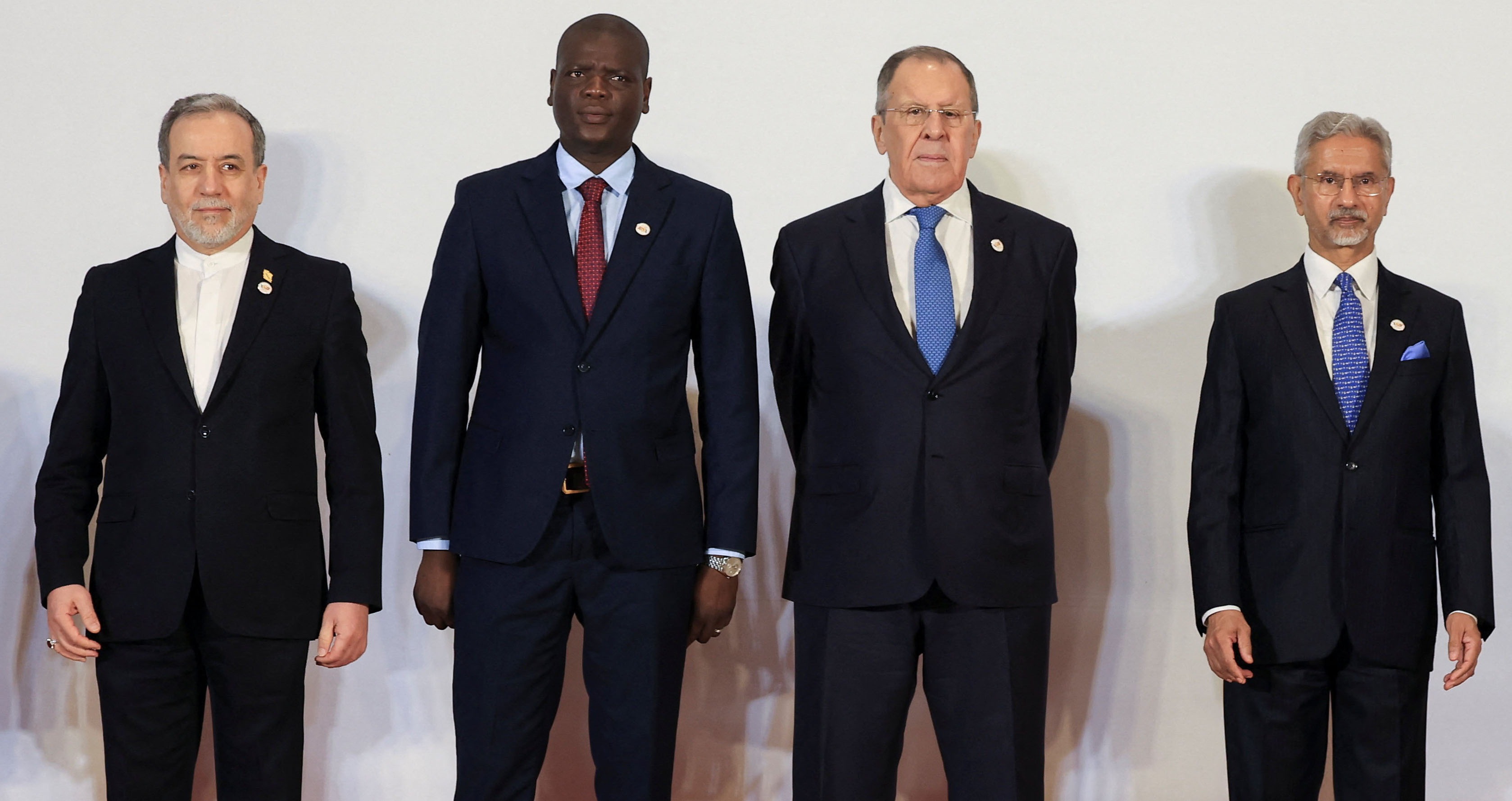
 Iranian Foreign Minister Abbas Araqchi, South African Foreign Minister Ronald Lamola, Russian Foreign Minister Sergey Lavrov and Indian Foreign Minister Subrahmanyam Jaishankar at the BRICS foreign ministers’ meeting in New Delhi on 14 May. (Photo: Adnan Abidi / Reuters)
International Relations and Cooperation Minister Ronald Lamola does not believe the solidarity of BRICS has been damaged by its failure to agree on a common position on the Iran war.
Sharp differences between member states Iran and the United Arab Emirates (UAE) — which are on opposite sides in the war — prevented the BRICS foreign ministers from issuing a consensus communique after their meeting in New Delhi on Friday. Instead, they could only put out a Chair’s Statement, which is the usual diplomatic fallback position when consensus can’t be reached.
The 63-point statement by Subrahmanyam Jaishankar, the foreign minister of India, which is chairing BRICS this year, instead described, in vague terms, the “differing views” of members on the war and the blockage by both Iran and the United States of the vital Strait of Hormuz.
/file/attachments/orphans/GettyImages-2222973614_904040.jpg "Subrahmanyam Jaishankar, India’s minister of external affairs. (Photo: Roy Rochlin / Getty Images for Newsweek)")
Iran and the UAE clashed behind closed doors at the meeting, with Iran accusing the UAE of actively participating in the US and Israeli military assault on Iran.
Some commentators have said the sharp differences on the Iran war have been damaging to BRICS solidarity, but Lamola, speaking to Daily Maverick, disagreed.
“Not at all, because …we agreed on almost everything. Except this matter, where obviously the two countries involved had reservations about a collective agreement. ”
Lamola noted that there had been almost 99% agreement on the wide range of other issues the meeting discussed, “and only 1% disagreement, which is normal in any multilateral forum. So I don’t think that can erode the solidarity within the BRICS.”
But surely it is serious when two BRICS members are at war with each other, we asked.
‘Progress’
Lamola agreed it was serious, “but I believe we have also made progress because they were all able to come to the meeting. They were able to state their positions.” He added that Iran and the UAE had agreed that the only way to resolve the conflict was through peaceful diplomacy.
Lamola said the meeting had encouraged both of them to take more steps among the Gulf countries to engage diplomatically and for Iran to take more steps to engage in the diplomatic effort by Pakistan to resolve the conflict with the US and Israel.
He said he had repeated in the meeting South Africa’s condemnation of both sides — the US and Israel for attacking Iran, and Iran for attacking the Gulf states — and had called for a peaceful resolution.
Though the controversy over Iran was kept out of the outcome document, there were sharp clashes in the meeting, according to media reports.
Iran’s foreign minister, Abbas Araghchi, had urged the other BRICS member states to condemn “violations of international law” by the US and Israel, and to “take concrete action to halt warmongering and bring an end to the impunity of those who violate the UN Charter”, according to Al Jazeera.
He clashed with the Emirati deputy foreign minister, Khalifa bin Shaheen Al Marar, who had called for BRICS to condemn Iran for its attacks on the UAE and other Persian Gulf states.
Araghchi responded: “The UAE was directly involved in the aggression against my country,” according to the Iranian state media, quoted by Al Jazeera. “When the attacks started, they didn’t even issue a condemnation.”
He accused the UAE of allowing the US to use Emirati territory to launch attacks on Iran and said Emirati warplanes had directly participated in strikes, according to Iran’s Irna news agency, quoted by Al Jazeera.
/file/attachments/orphans/GettyImages-2275785342_517946.jpg "Iran's foreign minister, Abbas Araghchi, attends a press conference at the Iranian embassy in New Delhi on 15 May. (Photo: Elke Scholiers / Getty Images)")
Iran also registered differences with the nine other BRICS member states on Palestine and on freedom of navigation through the Red Sea, according to an inside source. The Chair’s Statement underlined the importance of unifying the West Bank and the Gaza Strip under the Palestinian Authority, “and reaffirmed the right of the Palestinian people to self-determination, including the right to their independent State of Palestine”. The statement: “A member had reservation on some aspects of this paragraph.”
Official sources told Daily Maverick that this member was Iran, which registered its reservation because it does not recognise the separate states of Israel and Palestine.
The statement also said the ministers had “stressed the importance of ensuring the exercise of navigational rights and freedoms of vessels of all states in the Red Sea and Bab al-Mandab Strait, in accordance with international law”, adding: “A member had reservation on some aspects of this paragraph.”
Again, the member with reservations was Iran, according to an official, who told Daily Maverick that this was because this paragraph “speaks indirectly to their blocking of the Strait of Hormuz”.
/file/attachments/orphans/13945505_686410.jpg "Iranians walk past a billboard in Tehran on 2 May depicting US President Donald Trump and the Strait of Hormuz. (Photo: Abedin Taherkenareh / EPA)")
Lamola would not comment on who had expressed reservations, saying only India, as chair, could do that.
‘Fundamental problems’
The head of research at the China Global South project, Cobus van Staden, told SABC News the failure to agree on Iran “raises some of the fundamental problems in the BRICS group, which is that a lot of the BRICS members actually have quite significant differences between them.
“At the same time, BRICS is also supposed to function as a space where they put those differences aside and try and work on global issues. So I think we’ve kind of seen the limits of that this week. Clearly, the war in Iran and the direct impact on Iran and on the UAE is making it very hard to bring the BRICS nations together at the moment. So it's a big geopolitical problem.”
Van Staden added that BRICS had always had very different positions on some issues, and two founding members, China and India, had a long-standing border dispute. He added that the relatively quick expansion of BRICS had made it harder for it to reach consensus.
“And it raises questions about what they’ll actually be working on in the future,” he said, especially as the UAE was a US ally and hosted significant US military assets, including bases.
“And it also works closely with Israel, which, of course, raises the stakes in the current Middle Eastern situation.”
He noted that there had always been tensions in BRICS, particularly between China and India over their border dispute in Kashmir.
He said BRICS was pushing for global reform that would uplift the Global South. Iran was looking for solidarity and expected BRICS to provide it, but that was complicated because of these divisions. DM
Comments
Scroll down to load comments...