




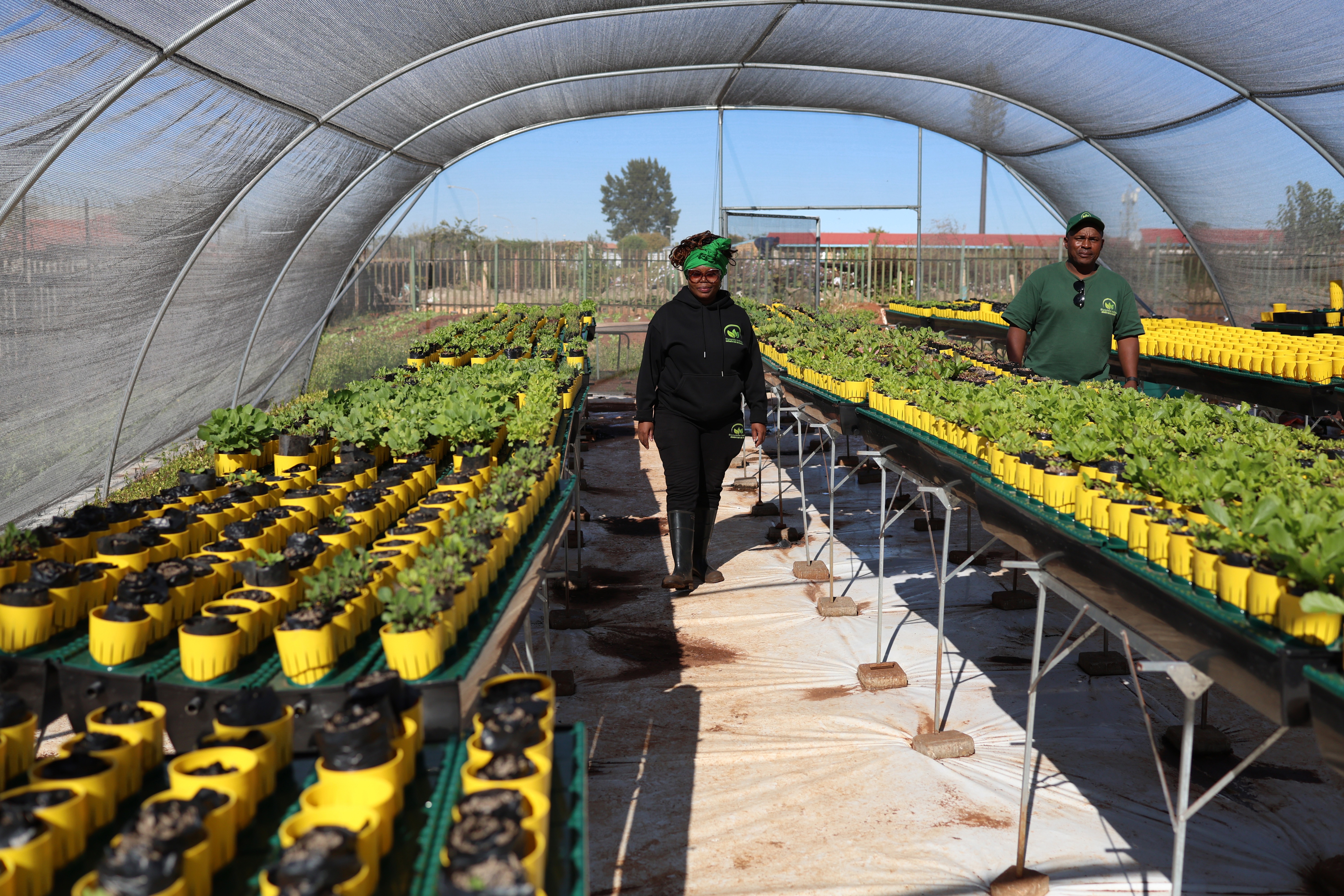
 Nthabiseng and Gregory Mkhize inside the dualponic tunnel, where seedlings are grown using the dual root zone method, on 14 May 2026. (Photo: Felix Dlangamandla)
The Jerusalem artichokes don’t look like much. Sprawling and a little wild against the fence line of Faranani Primary School in Soweto, they could pass for overgrowth. Then Gregory Mkhize crouches down and starts to pull. What comes out of the red soil is a pale, knobbed tuber, selling at R150 a kilogram to buyers in Johannesburg. One plant, he said, can fill a five-litre bucket.
Siyoyisile Indlala Community Farm and Projects sits on land that a Soweto primary school has leased to the Mkhizes in a 99-year agreement.
Gregory, the project development manager of the organisation, and his wife, Nthabiseng, did not start out as farmers. Before 2019 they were marketing agents for a vitamin company, but after supply chains collapsed, they found themselves back in Soweto.
“We saw the need,” said Nthabiseng, who is the chief executive of Siyoyisile. Looking around their community, they saw many friends and neighbours who were unemployed, without skills and struggling to access nutritious food.
/file/attachments/orphans/WFD_2626_678987.jpg "The Siyoyisile Indlala farm employs about six people and relies entirely on organic inputs, such as compost, worm tea and rabbit manure, to maintain soil health. (Photo: Felix Dlangamandla)")
They approached Faranani, made their case and started digging, literally. The soil they found was chemically exhausted, almost sand. They rebuilt it layer by layer, digging deep trenches and filling them with cardboard for carbon, bones collected from street vendors for calcium, tin cans for iron, branches, food waste, leaves, and mulch on top. Restoring the soil without synthetic inputs, without having to spend a tremendous amount of money. “We know that [our] soil will be fertile for over 20 years,” Nthabiseng said.
Today, the farm holds dual organic certification from both the Participatory Guarantee System and the South African Organic Sector Organisation. That status now allows them to sell certified organic veggies and to audit and certify other farms in the area.
What started as a response to unemployment and hunger in their immediate community has grown into a certified organic operation with a clear mission: to fight hunger and promote sustainable farming practices that can easily be replicated.
Everything rotates
At the heart of the operation is a growing tunnel that keeps crops warm year-round, with dualponic growing boxes that use a a (DRZ) system that allows plants to draw nutrients simultaneously from soil and water.
/file/attachments/orphans/6I1A1433_925598.jpg "Rabbits at the Siyoyisile Indlala farm that relies entirely on organic inputs, such as compost, worm tea and rabbit manure, to maintain soil health. (Photo: Felix Dlangamandla)")
The farm runs a circular system that finds innovative ways to create everything they need. The rabbits’ droppings are used and sold as organic fertiliser at R500 for 50kg. Residents who bring 5l of urine or food waste receive a discount on fresh produce; the urine is combined with comfrey and processed for a minimum of seven days until pathogens die and pH levels shift, becoming a high-nitrogen liquid fertiliser the Mkhizes call bio-nitrate.
Seeds from each harvest are saved and replanted or sold – heirloom varieties, some more than 50 years old, which produce a reliable crop generation after generation, Gregory said. Grass cut on the school fields becomes mulch that suppresses weeds, retains moisture and protects crops against the elements.
“We are not buying anything,” Gregory said. “Everything here rotates itself.”
The farm currently employs about six people from the community and often has volunteers, providing a job and a chance to learn invaluable skills. According to Gregory, if this model were to be replicated, a tunnel with dualponic growing boxes could employ four people to care for the seedlings growing there.
A skill for life
The most important thing the farm does, however, may be the smallest thing it produces. Inside the tunnel seedlings are grown using what Nthabiseng calls the snail method – seeds planted in soil rolled inside plastic the way one might roll sushi, producing dense, water-efficient seedlings that can be sold at R20 to R30 each.
/file/attachments/orphans/WFD_2692_324230.jpg "Nthabiseng Mkhize inside the dualponic tunnel, where seedlings are grown using the dual root zone method, which combines traditional soil-based growing with aquaponics, before being distributed to pupils and sold to residents to grow their own food at home. (Photo: Felix Dlangamandla)")
The method creates as many seedlings as possible for as little as possible, and the method was designed with households in mind. The seedlings can be planted in a cut 2l cooldrink bottle, a replication of the DRZ system, and placed on a windowsill, a balcony or in a home with no garden, without growing experience.
On Saturdays, 64 children from Faranani and their parents come to the farm to learn. They leave with DRZ-bottle systems, seedlings, soil and the knowledge of what to do with them, along with a meal cooked from produce harvested on-site. Some proudly send back photographs of what they have grown at home.
Gregory and Nthabiseng have trained four farmers in organic growing, who now run their own operations nearby. “Our programmes count as a skill for life,” Nthabiseng said. Participants are taught innovative ways to grow their own and to share those skills with anyone they can.
/file/attachments/orphans/WFD_2570_518390.jpg "Victus Zikalala, who has worked at Siyoyisile Indlala for three years, tends to the outdoor beds on 14 May 2026. (Photo: Felix Dlangamandla)")
The reach extends further, according to Gregory, through Zero Hunger Quest, a free educational game at app.zerohunger.org.za that teaches the same growing techniques in quiz format, with monthly prizes. About 150 people engage through the farm’s online academy each month.
Doing more with less
All of this runs almost entirely on what the farm itself generates. The Mkhizes pay their staff, feed 64 children every Saturday and maintain the tunnel and beds without a regular funder.
“We buy everything with our own money,” Gregory says. “We pay these people with the money that we are creating.”
The City of Johannesburg has recognised them with a Township Economic Impact Award and has committed to providing six shipping containers for an organic shop, eatery and food-processing facility on-site.
/file/attachments/orphans/WFD_2727_448206.jpg "Gregory Mkhize at Siyoyisile Indlala Community Farm on the grounds of Faranani Primary School in Soweto. The couple started the farm in 2019 after Covid shut down their previous business, turning an abandoned school plot into a certified organic growing operation. (Photo: Felix Dlangamandla)")
According to Gregory, they are in the process of pitching proposals for a 13-hectare plot nearby, which would be an “undeniable improvement” if secured. But for now, the kitchen where children are fed every week is a shed with a gas burner, many of their crops are exposed to the elements after they sustained significant hail damage, and due to a lack of fencing they can’t keep the farm’s pigs on the premises.
For now, what they have built is proof that it can be done. The school serves as a production hub, seedling kits carry the method into households and Zero Hunger Quest reinforces it through play, a complete system that Gregory said could be established in almost any township in the country.
“If it can happen here,” he said, “it can happen in all the communities.” DM
Siyoyisile Indlala Community Farm and Projects operates at Faranani Primary School, Soweto. Those interested in learning more or getting involved can contact Gregory Mkhize at greg@siyoyisileindlala.org.za .
Comments
Scroll down to load comments...