




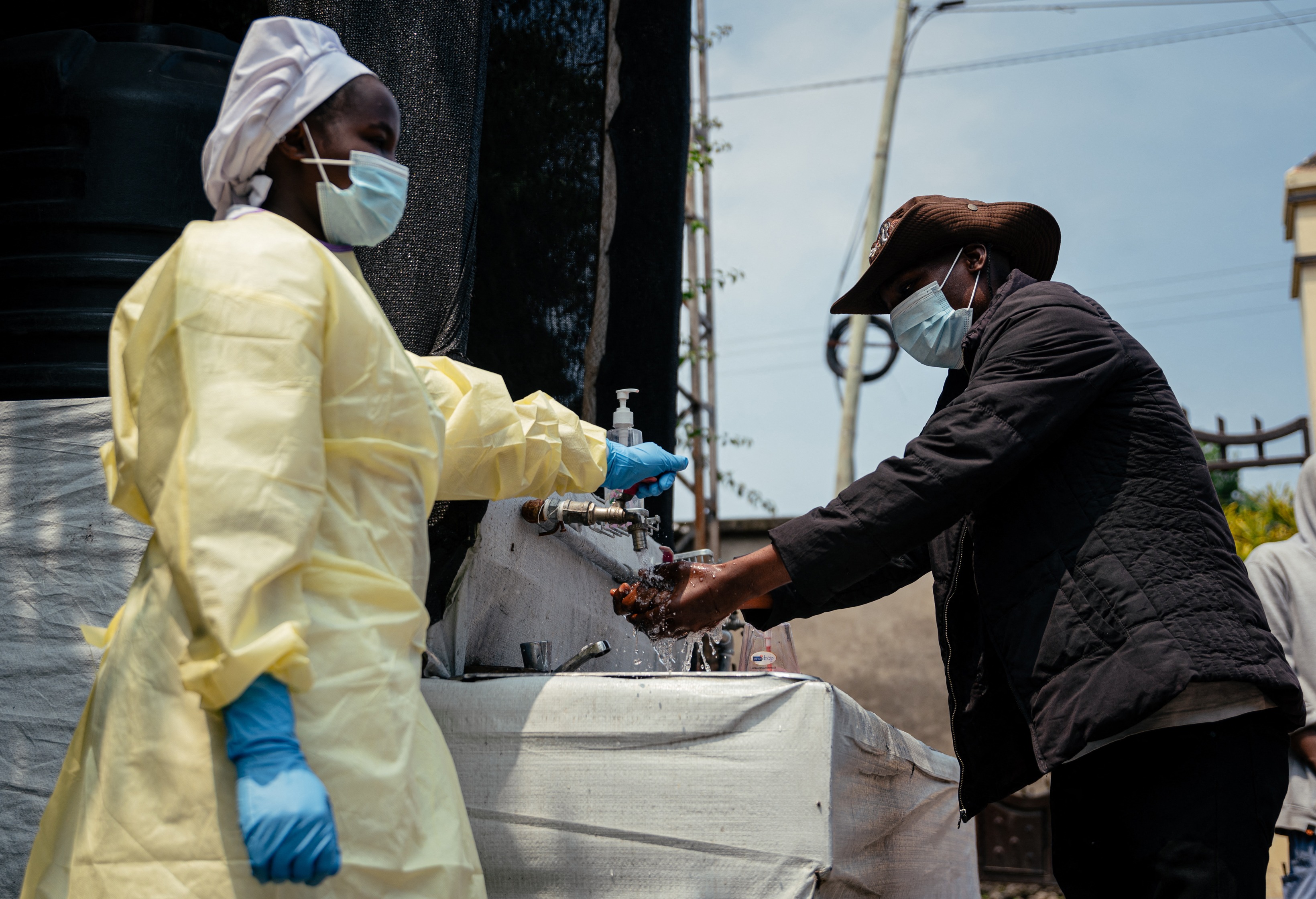
 A visitor washes his hands at a checkpoint before entering Kyeshero Hospital in Goma, DRC, on 18 May as part of Ebola prevention measures. (Photo: Jospin Mwisha / AFP)
The National Institute for Communicable Diseases (NICD) has said that based on current assessments, there is a low risk of the ongoing Ebola outbreak spreading to South Africa.
This follows the World Health Organization (WHO) declaring the latest outbreak of Ebola detected in Uganda and Democratic Republic of the Congo (DRC) “a public health emergency of international concern” on 16 May.
The declaration was made in light of the new outbreak being driven by the Bundibugyo virus, which was detected after a hospital in the Ituri province in DRC reported an unusual cluster of severe illnesses and deaths among healthcare workers, who showed symptoms consistent with the Bundibugyo virus.
Unlike other strains, there are no approved vaccines or treatments for the Bundibugyo virus. It has a death rate ranging from 25-40%.
So far, there have been 10 confirmed cases, 390 suspected cases and at least 100 suspected deaths in the latest outbreak. At least one death was confirmed in Uganda after a 59-year-old Congolese man travelled into the country. US news organisations have also reported that at least six Americans were exposed to the virus, although it is unclear whether any have been infected.
/file/attachments/orphans/13990845_381164.jpg "The executive secretary of the Congo River Alliance and M23 armed group, Benjamin Mbonimpa (second from left), speaks to reporters during a press conference about the Bundibugyo Ebola virus outbreak in DRC on 17 May. (Photo: Jeanne Munyerenkana / EPA)")
In a written response to Daily Maverick on 18 May, the NICD said that the WHO and Africa Centres for Disease Control and Prevention (Africa CDC) had declared the outbreak a public health emergency of international concern because of cross-border spread between DRC and Congo, the absence of approved vaccines and treatments for the Bundibugyo virus, and the risk of spread within the region.
“Both the WHO and Africa CDC have assessed high regional risk for spread, while the global risk is currently considered low to moderate but concerning enough to warrant urgent international action. The concern at this stage is particularly for continued spread to other parts of the DRC, continued spread to and in Uganda, and to South Sudan,” said Dr Jacqueline Weyer, principal medical scientist at the NICD’s Centre for Emerging and Zoonotic Diseases.
“Based on the current risk assessment, we consider a low risk for the Bundibugyo virus disease outbreak to spread to South Africa. This is in keeping with the assessments in response to previous Ebola outbreaks. Of course, continued monitoring of the situation is required,” added Weyer.
/file/attachments/orphans/AFP_20260518_B37T7RY_v1_HighRes_DrcongoHealthVirusEbola_122404.jpg "A woman wearing a mask as a preventive measure enters Kyeshero Hospital in Goma, DRC, on 18 May after passing a checkpoint for hand-washing and health screening. (Photo: Jospin Mwisha / AFP)")
This sentiment was echoed by President Cyril Ramaphosa, who, in a written statement published on 17 May, highlighted the need to strengthen surveillance systems, laboratories and contact tracing to contain the outbreak.
“Ebola does not respect borders. In a region marked by high population mobility, insecurity and humanitarian movement, the risk of regional spread is significant and demands urgent, coordinated action,” said Ramaphosa.
“I therefore urge affected and at-risk countries to intensify cross-border collaboration, strengthen surveillance at formal and informal points of entry, and ensure rapid information sharing, particularly in areas affected by insecurity and population displacement.”
Only two cases of Ebola have been reported in South Africa. They were both reported in 1996 after a medical professional who was exposed to patients with the Ebola-Zaire strain travelled from Gabon to South Africa and subsequently infected a nurse.
WHO concerned by number of positive cases
The Ebola virus disease was first identified in the DRC (then called Zaire) in 1976. Ebola outbreaks have been detected periodically since, with most of them involving the Ebola-Zaire strain, which was responsible for the 2014-2016 west African outbreak. The outbreak was mostly spread across Sierra Leone, Liberia, and Guinea, and resulted in more than 28,600 people being infected and 11,325 deaths.
/file/attachments/orphans/GettyImages-1433317816_877572.jpg "Ebola prevention signage on 14 October 2022 in Mubende, Uganda. (Photo: Luke Dray / Getty Images)")
Ebola is an infectious viral fever which is transmitted between humans through direct contact with infected bodily fluids. Symptoms usually appear two to 21 days after infection, beginning with “dry” symptoms like fever, aches and pains in the muscles and joints and weakness, and eventually progressing to “wet” symptoms like unexplained bleeding, diarrhoea, and vomiting.
Because it requires direct contact with infected fluids, the risk of transmission is significantly lower than with airborne diseases such as Covid-19. Those most at risk are caregivers for infected patients, including medical professionals.
However, the WHO says it is concerned by the high positivity rate in the latest outbreak after at least eight of 13 collected samples tested positive, and has issued an advisory against travelling to the region. At this stage, the true number of infected people and the geographic spread of the disease are uncertain, although cases have been reported in Kinshasa and Kampala.
/file/attachments/orphans/GettyImages-2197470307_613456.jpg "Health workers prepare doses of a trial vaccine at Mulago Referral Hospital for medical staff and contacts of a man who died after testing positive for the Sudan strain of the Ebola virus, on 3 February 2025 in Kampala, Uganda. (Photo: Hajarah Nalwadda / Getty Images)")
“Moreover, the ongoing insecurity, humanitarian crisis, high population mobility, the urban or semi-urban nature of the current hotspot and the large network of informal healthcare facilities further compound the risk of spread, as was witnessed during the large Ebola virus disease epidemic in North Kivu and Ituri provinces in 2018-19,” said the WHO.
Spread ‘extremely concerning’ says MSF
Meanwhile, the international humanitarian organisation Médecins Sans Frontières (MSF) has published a statement confirming that it is responding to the outbreak by mobilising medical teams to assist the DRC health authorities in affected areas in Ituri.
“The number of cases and deaths we are seeing in such a short timeframe, combined with the spread across several health zones and now across the border, is extremely concerning,” said Trish Newport, MSF emergency programme manager.
“In Ituri, many people already struggle to access healthcare and live with ongoing insecurity, making rapid action critical to prevent the outbreak from escalating further.”
The WHO emphasised that international cooperation is needed to scale up and coordinate surveillance, prevention and control measures. DM
Comments
Scroll down to load comments...