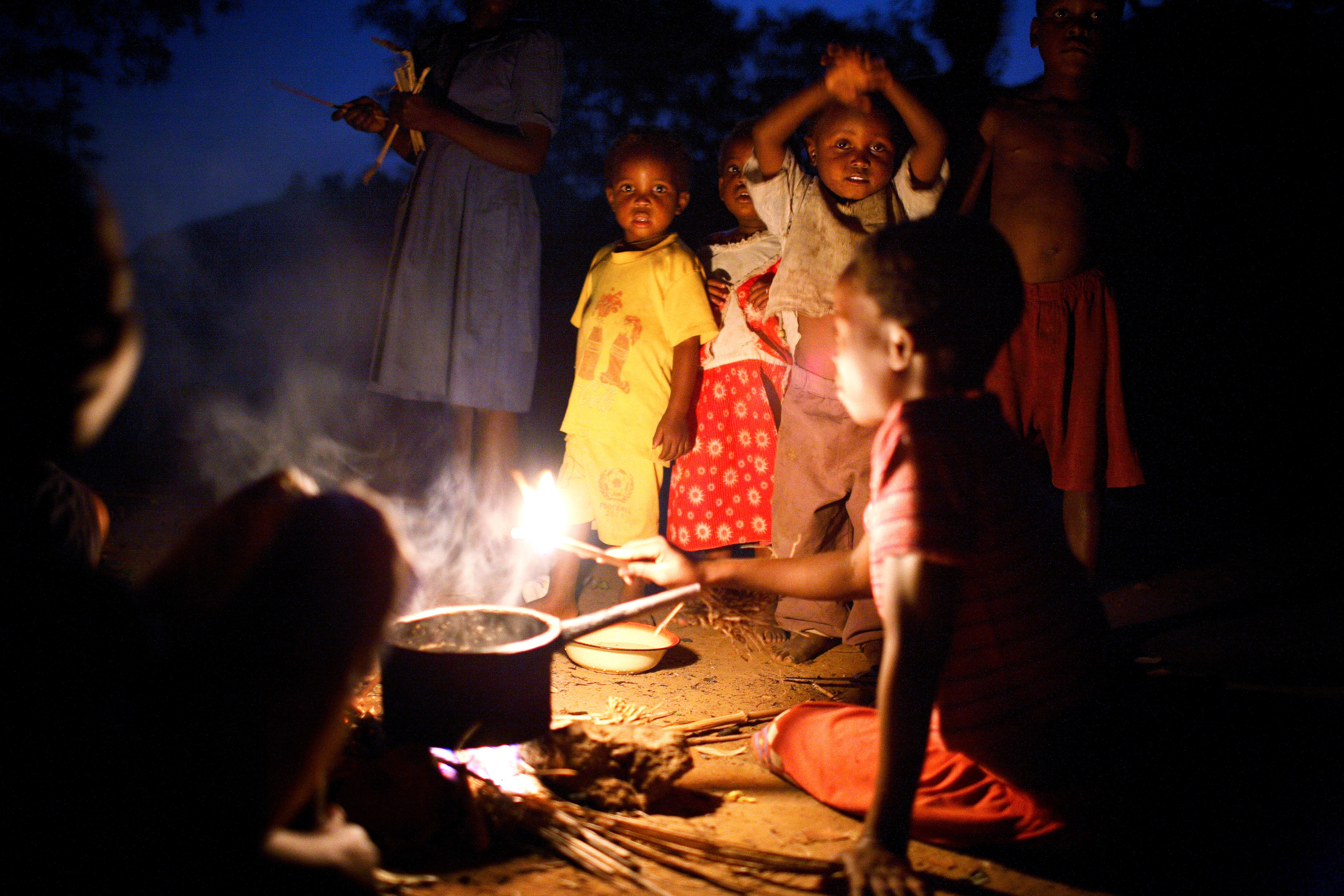
 Children watch as their older sister cooks porridge after sunset. (Photo: Per-Anders Pettersson / Getty Images)
 /file/dailymaverick/wp-content/uploads/2025/10/label-Op-Ed.jpg)
In the mountains around Mokhotlong in northern Lesotho, many villages are so remote they can be reached only on foot or by donkey. Almost all have no electricity. Winters are brutally cold – Lesotho is the highest low‑point country in the world – and snow is a common sight.
The landscape is strikingly barren. There are many reasons for the lack of trees, but the biggest is the demand for firewood for cooking and winter warmth. As a result, vast swathes of the country have been denuded of firewood. With wood gone, families have turned to what remains: dried cow dung.
Picture a one-room home, surrounded by snow, a temperature of -5˚C outside and the smoke of burning cow dung filling the house, stinging eyes and burning lungs. This fire keeps the children warm. It also steadily increases the risk of pneumonia, asthma and early death.
Energy poverty and weak health systems
This is what the climate crisis looks like when it meets energy poverty and weak health systems. It is not theoretical. It is already harming children in Africa – the continent that has contributed least to the problem.
As global health leaders gather this month for the World Health Assembly in Geneva, the question is no longer whether climate change threatens health.
The question today is how the global health community can build leadership and consensus to confront climate change as a current driver of preventable illness and mortality, particularly in Africa – and to demand action accordingly.
Nearly 50 years ago, scientists had already laid out the basic evidence explaining how and why the planet was heating. Yet global emissions have continued to rise. In July 2023, the world recorded its hottest day in more than a century – only to break that record the following day. In 2024, temperatures reached 48.5°C in Mali, while large parts of southern and eastern Africa experienced severe drought. In Mozambique, some farming families were reduced to digging for roots to survive.
Indeed, we have known how and why the earth is heating for decades, and 10 years of evidence generated by the Lancet Countdown on Health and Climate Change has documented the cascading consequent health harms – felt as heat stress, food insecurity, overwhelmed health systems and lives lost – overwhelmingly in places that played little role in causing the crisis.
And still, the emissions continue.
Dangerous logic
At the same time, global climate politics has begun to normalise the idea of “overshoot”: the notion that breaching the 1.5°C warming threshold is acceptable because future technologies will somehow pull temperatures back down.
From a health perspective, this logic is dangerously detached from reality. Even if such technologies eventually materialise at scale, millions of people will have died in the meantime, and vast areas will become increasingly difficult to inhabit.
The result of this thinking is a quiet shift from mitigation and toward adaptation alone – a false choice that puts the burden of adjustment on those least able to bear it. But last month, 57 countries convened in Santa Marta, Colombia, for the First International Conference to Transition Away from Fossil Fuels – thereby demonstrating political momentum for mitigation to remain front and centre on the climate negotiations agenda.
While the Santa Marta conference set the political direction for transitioning away from fossil fuels, the World Health Assembly reminds us why that transition cannot wait – as air pollution and climate impacts continue to drive a global health crisis.
Nowhere is this clearer than in household energy use. The Lancet Countdown on Health and Climate Change estimates that in 2022 alone, failure to transition away from dirty fuels contributed to 2.3 million deaths globally from household air pollution. Pneumonia remains the leading infectious cause of death in children under five, and roughly half of these deaths are linked to air pollution. Infants, with developing lungs and immune systems, are especially vulnerable.
When a child in Lesotho inhales smoke from burning dung, this is not simply a household issue. It is the result of intersecting policy failures – in climate mitigation, energy access, and health planning.
Combating climate change health effects
This is why the launch of the Lancet Countdown Africa Regional Centre matters. Hosted on the continent and led by African institutions and scholars, the centre is mandated to track how climate change is already affecting health across Africa, using evidence grounded in local realities rather than imported assumptions.
Through dedicated working groups on health impacts, adaptation, mitigation and its health co-benefits, economics and public engagement, it aims to support governments with relevant African-led data.
At the World Health Assembly, where child mortality, universal health coverage and health system resilience dominate discussions, this framing is essential. The 79th World Health Assembly will assess implementation of the Global Action Plan on Climate Change and Health, with implications for African health systems facing rising pollution and heat stress. It is crucial that change is not treated as a competing priority – it is a risk multiplier undermining progress on every major health goal.
Path to a brighter future
Conversely, health-centred climate change action offers a pathway for a brighter future. Equipping households with solar energy would reduce emissions from dirty fuels while providing energy for heating and cooking. It would also eliminate indoor smoke, lowering the rates of childhood pneumonia and reducing asthma and cardiovascular disease across the life-course, and allow families to boil water, cutting rates of diarrhoeal disease.
As ministers of health take the floor in Geneva, climate change mitigation must be treated as a core public health intervention, not a future aspiration.
They should insist that African evidence shapes global priorities, and they should reject narratives that ask Africans to pay today for political convenience elsewhere.
The climate crisis is already a health crisis. The evidence is clear and the solutions are known. What remains – and what the World Health Assembly must confront – is whether there is finally the will to act. DM
Prof Mark Tomlinson is co-director of the Institute for Life Course Health Development in the Department of Global Health at Stellenbosch University, and the incoming Co-Lead for Working Group 3 of the Lancet Countdown Africa Regional Centre.
Prof Tafadzwanashe Mabhaudhi is a Professor of Climate Change, Food Systems and Health at the London School of Hygiene & Tropical Medicine and Director of the Lancet Countdown Africa Regional Centre based at the University of Pretoria.