




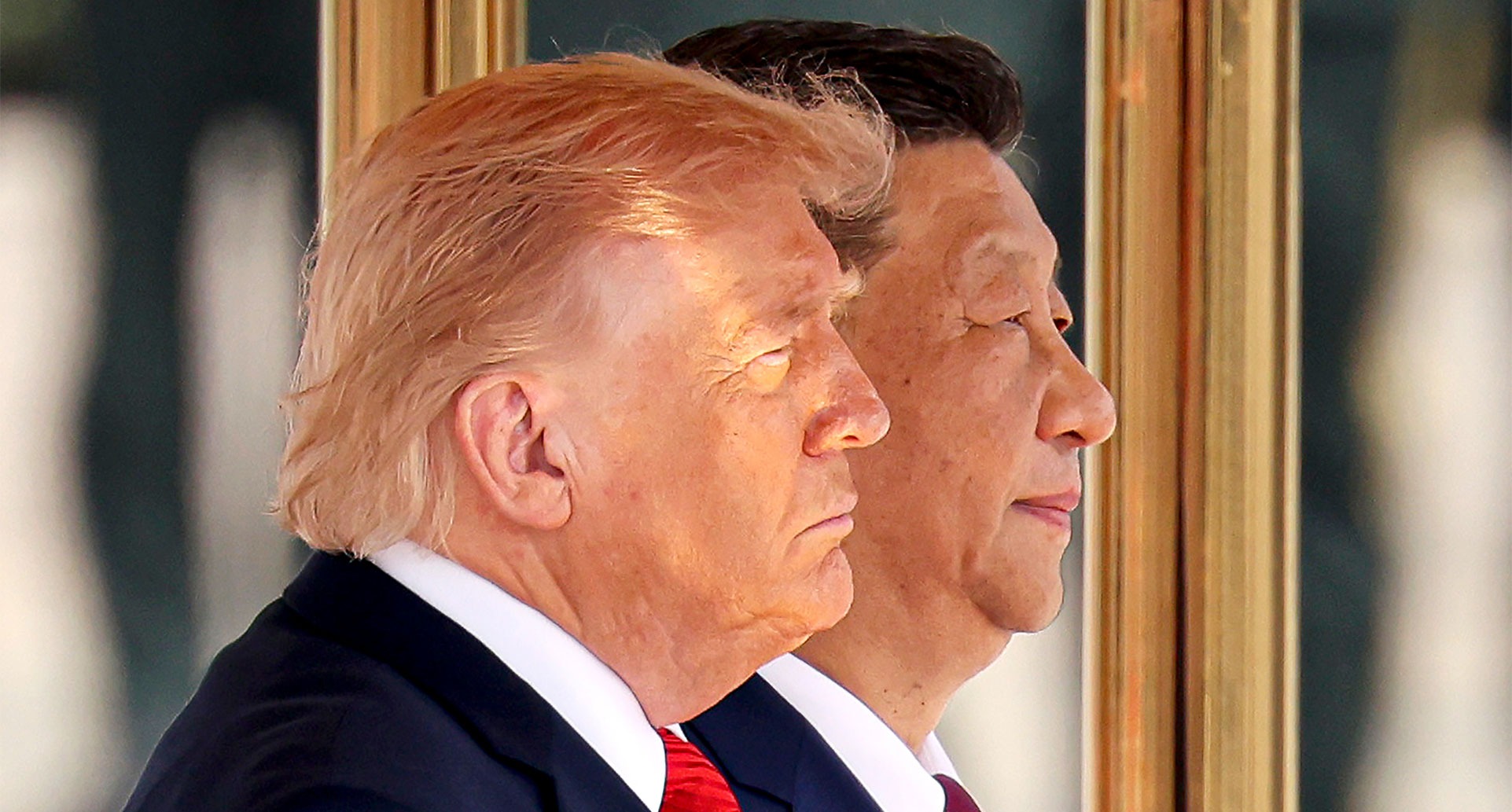
 Chinese President Xi Jinping (right) and US President Donald Trump attend a welcoming ceremony at the Great Hall of the People in Beijing, China, on 14 May 2026. (Photo: EPA / Maxim Shemetov / Pool)
Who doesn’t love a parade, a celebration of victory, or a VIP arrival with its massive pomp and ceremony?
Foreign visitors to China have been on the receiving end of such things for millennia, as part of Chinese efforts to show the majesty and power of its rulers. And we certainly know President Donald Trump is America’s biggest, bestest lover of parades and ceremonies.
Thus, it was only natural that he just loved his welcome in Beijing, gushing about it effusively for the media. For some observers, his arrival for his summit with Chinese President Xi Jinping had overtones of that magical Air Force One arrival in John Adams’ opera Nixon in China, although Trump’s arrival went one better with hundreds of children waving the flags of both nations.
The next day, at the opening ceremonies at the Great Hall of the People for the leaders’ talks, might have had echoes of the finale of Giacomo Puccini’s last opera, Turandot, melded with ceremonies celebrating China’s Victory Day.
China probably knows how to put on welcome ceremonies better than anyone else on the planet, but they have a purpose, of course. The displays are designed to generate awe in the minds of visitors. This one certainly did not fail in that regard.
The latest visitor to receive this lavish treatment — the US President, who had arrived in Beijing for talks with Chinese President Xi Jinping — embraces such displays precisely because they feed an already superabundant sense of self. We can be referring to no one other than…
And so, by the end of the visit, was President Donald J Trump able to return to Washington victorious, with an all-encompassing trade treaty in hand? No. Or, did he receive assurances that China would support the US in its conflict with Iran and, crucially, in its demands for the reopening of the Strait of Hormuz? No. But, did he gain agreement that the recent vitriol over the two nations’ economic (and strategic) competition was at an end? No, not exactly.
What Trump did receive was a kind of tacit agreement that China would not interrupt the flow of those strategically and industrially crucial rare earths to the US and — presumably — understandings that the Chinese would place orders for a new fleet of US-built commercial aircraft and maintain major purchases of US soya beans and beef.
Midterm elections
Keep in mind the US midterm elections are increasingly close at hand — less than six months away.
Trump increasingly needs some sort of win economically that he can point to, to give Republican congressional candidates a boost. This is especially the case, given the increasing unpopularity of, and discontent about, his economic policies and those sharp rises in the price of petrol, not to mention the ongoing flailing over the Iran conflict.
/file/attachments/orphans/13977436_470451.jpg "US President Donald Trump participates in a welcome ceremony with Chinese President Xi Jinping at the Great Hall of the People in Beijing, China, on 14 May 2026. (Photo: EPA / Maxim Shemetov / Pool)")
If one looked at the delegation brought by the US president to China, it seems it was primarily about business and trade, and rather less about national security or the longer prospects of the future of the bilateral relationship.
As best as journalists could tell, there effectively were no US strategic or diplomatic experts on China in the mix, although the soon-to-be-moving-along from being Apple CEO Tim Cook had joined the visit. (To be fair, Cook probably knows as much about US business relations with China as anyone else, given Apple’s massive sales presence in China and a supply chain reliant on Foxconn and its plants in China.)
Following the summit, the Economist observed:
“Donald Trump said he would soon ‘make a determination’ regarding American arms sales to Taiwan, but ‘made no commitment either way’ when discussing the island’s defence with Xi Jinping. China earlier warned America that the issue could result in ‘conflict’ if ‘mishandled’. America’s president also said he might lift sanctions on Chinese oil refiners that purchased Iranian oil. Few deals emerged from the two-day summit.”
Meanwhile, the New York Times noted:
“President Trump has described a potential multibillion-dollar weapons sale to Taiwan as a ‘negotiating chip’ with China, raising new doubts about the pace and scale of American military support for the island democracy.
Taiwan’s government has been waiting for months for Mr. Trump to sign off on a $14 billion package of missiles, anti-drone equipment and air-defense systems intended to fortify the island against Beijing’s military threats.”
The Taiwanese (and numbers of Republican congressmen) are probably unnerved as a major arms purchase deal is suddenly put in play by the US leader as an attempt to gain some leverage with China. There are mutterings that a hold on the sales would violate the Taiwan Relations Act of 1979 that had followed the US recognition of the Chinese government in Beijing.
Beijing’s warning
What appears to have transpired in the summit was Xi Jinping delivering an admonishment over the “Thucydides Trap”, offering a warning about the US upsetting the relationship by arms sales to the government of Taiwan, and providing a homily on the need for the two nations to strengthen a relationship that he termed constructive strategic stability.
These are some fascinating arguments to have been made by a Chinese president. Take the Thucydides Trap. In brief, this analysis was first explained in its contemporary application by Harvard University professor Graham Allison.
Allison had referred to the historical contest between Athens and Sparta — and the eventual humbling defeat of Athens. He extrapolated that style of rivalry between a status quo power and a rising one to the early 20th-century contestation between Britain and an increasingly ambitious, Wilhelmine Germany. Further, he offered a cautionary note on the current competition between the US and China.
Central to these rivalries is the way a rising power challenges a status quo nation and — unless serious diplomacy and thoughtful policies are pursued — leads to an arms race and, potentially, actual conflict.
One can wonder if Donald Trump fully understood the thrust of that metaphor, and thus the challenge (and an implicit threat) contained in Xi’s admonition.
China’s strategic counter
Similarly, Xi’s stress on the model of “constructive strategic stability” can be read as a counter to the decades-long American emphasis on “strategic ambiguity” as a way of signalling that an attack on Taiwan might well be met by some serious — although not spelt out — responses from the US. For decades, this approach encouraged flexibility in action even as it reassured the Taiwanese government and citizens — and US-aligned nations in East and Southeast Asia.
Now, combining the idea of constructive strategic stability with a Chinese concern that the US might go ahead with that massive arms deal with Taiwan allows one to glimpse an emerging Chinese “red line” America must not cross regarding an island the Chinese government insists is a breakaway province of the motherland.
As Global Times (usually seen as a reliable gauge of Chinese government thinking) editorialised after the visit wrapped up:
“During this historic and landmark visit, mutual respect, valuing peace, and exploring cooperation were the overarching themes of the summit.
“The agreement reached by the two heads of state to build ‘a constructive China-US relationship of strategic stability’ is the most important political consensus and has attracted widespread attention from the outside world.
“An editorial in the South China Morning Post said this is ‘a realisation that the China-US relationship is so complex and consequential that they need to keep it stable – not only for the sake of the two peoples, but also for the international community.’ The article said that the summit in Beijing ‘heralds the start of constructive, stable relations’.
“Chinese President Xi Jinping used ‘four stabilities’ to elaborate on the core essence of ‘a constructive relationship of strategic stability’: a positive stability with cooperation as the mainstay, a sound stability with moderate competition, a constant stability with manageable differences, and an enduring stability with promises of peace…”
China holds the better cards
Adopting the now-popular Trumpian measuring stick, in this summit, despite that wondrous pageantry meant to flatter Trump, the Chinese were holding higher-value cards, setting the architecture of the discussion and their softly voiced but clear warnings about Thucydides and constructive stability. Donald Trump too easily slipped into the role of supplicant — and of holding the weaker hand.
As historian and commentator Heather Cox Richardson wrote as the summit ended, “Isaac Arnsdorf, Michael Birnbaum and Michelle Ye Hee Lee of the Washington Post note that the summit with Chinese leader Xi Jinping yielded ‘exactly what Xi aimed to achieve with the visit’. Its pageantry and Trump’s gestures of friendship and admiration showed the US and China as peers, something previous US leaders have rejected.” Score a win for Xi.
On the why of such an outcome, the Guardian’s David Smith could ruminate:
“Why does Donald Trump look so at home in China? The US president spent day one of his summit in Beijing basking in rigid pageantry, heroically managing not to offend his hosts and offering the verdict: ‘China is beautiful’.
“A man who has shown authoritarian yearnings in his own country – discrediting elections, cowing universities, accusing journalists of treason – visibly delighted in one where the strongman fantasy is made flesh. Not for the first time, he was far better behaved in one of the world’s most repressive regimes than when he shows up in Europe’s democracies like a human wrecking ball.”
/file/attachments/orphans/13977318_261646.jpg "Chinese President Xi Jinping greets US President Donald Trump during a welcome ceremony at the Great Hall of the People in Beijing, China, on 14 May 2026. (Photo: EPA / Maxim Shemetov / Pool)")
Clearly, Donald Trump loved the staged adulation even as he undoubtedly wondered why he did not receive similar awe and respect at home, and so his natural inclination was to pay a bit of obeisance to Xi Jinping. The Chinese, by contrast, are playing the long game. Xi has shown that he can wait, given the Chinese belief that it is America that is in decline.
Just ahead, the next supplicant, Vladimir Putin — another man leading a nation deeply embroiled in its own war of choice in Ukraine — is soon to arrive in China. It will be fascinating to see how Putin’s welcome compares to the one accorded Donald Trump, as well as the outcomes from the next set of talks. DM
Comments
Scroll down to load comments...