



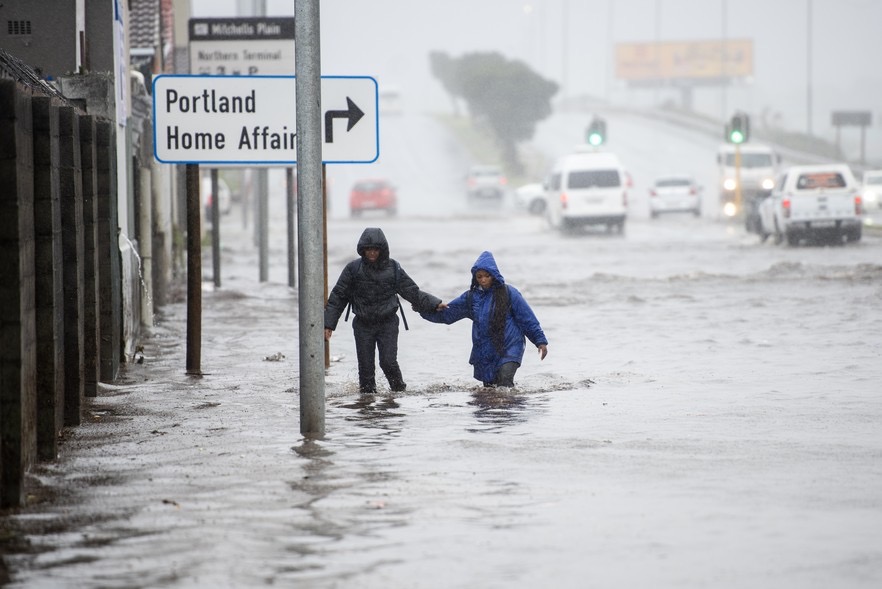
 Two primary school learners wade through the flooded Westpoort Road on their way to school in Mitchells Plain, Cape Town, on Monday morning. (Photo: David Harrison)
South Africa is currently grappling with a season of extremes, from devastating flooding in Limpopo and Mpumalanga, and most recently Western Cape and Eastern Cape, to severe drought-induced water shortages along the Garden Route.
Eastern Cape is also being battered by disruptive snowfall, unusual this early in the season.
There is little question that these extremes are linked to the climate crisis.
/file/attachments/orphans/G-eG_tBWkAAPjCL_560001.jpeg "Heavy rain caused flooding in Venda, Limpopo, in January 2026, cutting off transport routes. (Photo: Artist Trevor / X)")
As the nation weathers these extremes – along with many countries around the world, particularly in the Global South – a group of scientists has warned that the climate and biodiversity models used to predict how environmental changes affect ecosystems, species and human well-being are no longer fit for purpose. These are the same models used largely to craft policy.
In a new paper published in the sustainability journal One Earth on Friday, 15 May, scientists warned that global climate scenarios were built on the same assumptions that helped create the world’s current problems, making current models too narrow to address the scale and complexity of the crises that lie before us.
The group of researchers argued that the current models rely on existing economic systems, governance structures and social norms, which has resulted in a focus on incremental change rather than more radical transformations needed to achieve a safe and just future.
Disconnected models and Western paradigms
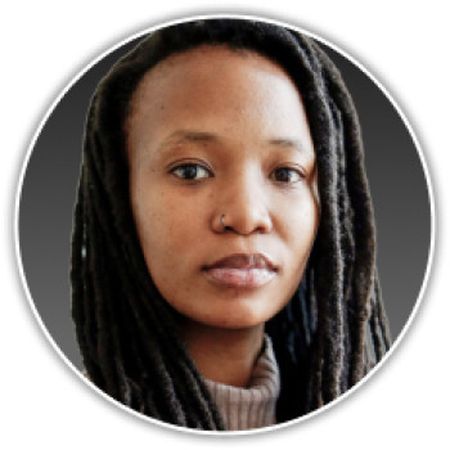
Earth Commission researcher and the lead author on the paper, Professor Laura Pereira from the Global Change Institute at Wits University and the Stockholm Resilience Centre, told Daily Maverick that while the establishment of the Intergovernmental Panel on Climate Change (IPCC) was vital for alerting the world to the climate crisis, the models and scenarios used to navigate challenges have become a bottleneck for real-world solutions.
/file/attachments/orphans/ProfessorLauraPereira_728578.jpg "Professor Laura Pereira. (Photo: Inside Education / Wikipedia)")
“What we actually need now are the range of preferable futures that we actually want to start achieving. And that’s a lot harder because it is context specific,” Pereira said.
She added that current models are too narrow, primarily focused on mitigation from an energy perspective, and rooted in Western assumptions that do not offer transformative solutions for diverse global contexts, especially in Africa, where many countries are dealing with a polycrisis rather than a singular one.
“We have development [and] inequality concerns that we need to be addressing very strongly, while we’re addressing the climate crisis,” Pereira said, adding that addressing the polycrisis is not a simple task.
“Right now, many of our global scenarios are effectively asking how to fix the future without really changing the present. If we want pathways that work, we need tools that can explore different economic models, different power structures and different relationships between people and nature, not just different technologies,” she noted.
“There are many parts of the world that can offer us better solutions, alternatives, different ways of living on the planet, […] but they’re sidelined. They aren’t making it into these bigger decision-making processes.”
One of the key drivers of this exclusion, particularly solutions from the Global South, is that the African continent, despite being particularly vulnerable to climate shocks, does not have its own Integrated Assessment Model (IAM), unlike other major regions such as the US, Japan, Europe and Brazil.
This is primarily owing to a gap created by the substantial long-term funding and specialised expertise required to build one from scratch.
IAMs are complex, multidisciplinary frameworks that simulate the interactions between human systems (economy, energy, land use) and natural systems (climate, biosphere). They are instrumental in weighing the efficacy of climate mitigation efforts, including net-zero trajectories, by navigating the intersection of policy, technological innovation and environmental consequences over the long term.
Pereira said that existing IAMs were historically developed around energy systems and mitigation, which haven’t been Africa’s primary climate concerns outside South Africa. This means their embedded assumptions are not aligned with African development and adaptation priorities.
“I’m not saying they’re completely useless, but their initial job wasn’t to set up different economic model assumptions or understanding of how the world works. There are embedded assumptions that, because of where they come from and what they were set up to do, get perpetuated in the model runs and the outcomes that don’t necessarily offer us the kind of transformative solutions that we might be needing,” Pereira said.
The cause of the mismatch between existing IAMs and what is actually needed on the ground in Africa is a lack of political will and misdirected internal funding, which frequently favours narrow national energy models over a broader continental paradigm.
As a consequence, Pereira said this gap leaves Africa treated as a “black hole” in global climate modelling, where unique regional data is smoothed over by global outputs. Without a tailored model, African decision-makers are left without the nuanced, numerical insights necessary to validate and advocate for context-specific climate solutions.
This gap has been noted within the Wits-led Future Ecosystems for Africa programme, and the team, of which Pereira is a member, hopes to address it if their funding is renewed.
The solution: Integrated Transformative Scenarios
To bridge the gap between the current models and scenarios and what is actually needed in the Global South, Pereira and her co-authors are calling for Integrated Transformative Scenarios – a new generation of models that put justice, diverse knowledge and systemic change at the centre.
Unlike the old approach of “tech fixes and existing economics”, this new framework would integrate equity, biodiversity and local voices from the start.
Rather than merely forecasting the impending fallout of the climate crisis, Integrated Transformative Scenarios shift the narrative towards how a desirable future should unfold. While traditional climate modelling, such as the IPCC frameworks, focus on diagnosing the scale of the problem to alert the world, these transformative models actively map out proactive solution pathways.
They break away from the narrow, energy-and-mitigation lens of legacy frameworks, integrating broader socio-ecological complexities such as systemic inequality, development needs, biodiversity and local value systems.
Key pillars of this new research agenda include:
- A Global South-led “scenarios secretariat” to ensure vulnerable regions lead the conversation;
- The co-creation of models alongside indigenous peoples and local communities to capture diverse value systems; and
- Alternative economic thinking, such as post-growth models, that move beyond “neoclassical, liberal economic extractivism”.
Ultimately, the paper argues that for science to be effective, it must be “embedded within the ground”. Without this shift, the very models designed to save the future will continue to perpetuate the injustices of the present. DM


Comments
Scroll down to load comments...