



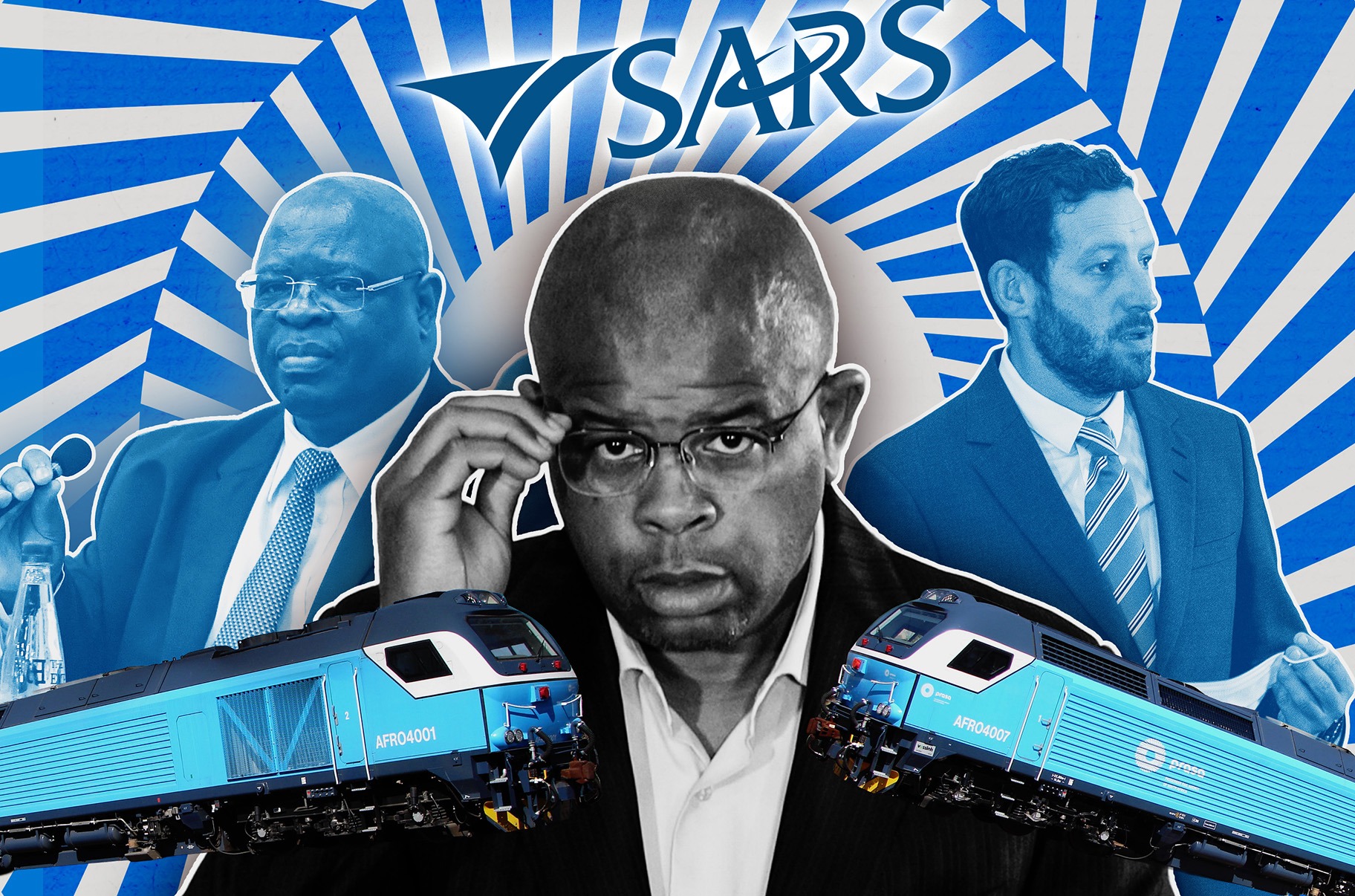
 Illustrative image: (From left) Justice Raymond Zondo. (Photo: Deaan Vivier / Netwerk24 / Gallo) | Lucky Montana. (Photo: Luba Lesolle / Gallo Images) | Ryan Marc Sacks. (Photo: Papi Morake / Gallo Images) | Afro4000 locomotives. (Photo: Wikipedia) | Prasa logo. (Source: prasa.com) | SARS logo. (Source: sars.gov.za)
Records related to a tax battle between former Passenger Rail Agency of South African (Prasa) boss Lucky Montana and the South African Revenue Service (SARS) offer compelling clues that link Montana financially to an entity that received more than R30-million from the main contractor in Prasa’s infamous R3.5-billion “too tall” locomotives debacle.
SARS in October 2025 publicly released Montana’s tax records following a longstanding legal fight over his tax returns.
The revenue collector slapped Montana with a R55-million tax bill over income the former Prasa boss had allegedly failed to declare.
A previous Daily Maverick analysis unpacked the SARS records in relation to Montana’s questionable property dealings, an endeavour aided by documents collected over almost a decade. The records suggested that Montana substantially benefited from property dealings involving a Prasa contractor that clinched contentious security infrastructure contracts worth R4.5-billion.

Our focus now shifts to certain bank transfers into Montana’s accounts, flagged by SARS as taxable income that the former Prasa boss allegedly failed to declare.
While the revenue collector’s audits had the sole purpose of clawing back taxes based on Montana’s alleged undeclared income, the broader set of records at our disposal raise questions regarding payments Montana received from a recipient of funds directly linked to the failed trains deal.
“Like I said many times before, I do not take you or Daily Maverick seriously. You are simply agents or barking dogs of vested political and economic interests, which some of us will continue to challenge and fight.”
Montana strongly denied any impropriety. He insisted that the bank transfers in question were effected on the back of legitimate agreements for bridging finance and that they in no way related to the Prasa locomotive contract.
“Like I said many times before, I do not take you or Daily Maverick seriously. You are simply agents or barking dogs of vested political and economic interests, which some of us will continue to challenge and fight,” Montana stated in an emailed response.
The former Prasa boss provided Daily Maverick with documents that purported to show the legitimacy of the loan transfers. The documents, however, raised further questions, many of which remain unanswered.
Montana maintains that SARS is unfairly targeting him.
“I am on record as having said [that] SARS is a law unto itself. There are loans amounting to over R5-million which the tax authorities chose to treat as income and not loans. The SARS strategy has always been to inflate my tax liability and thereafter pursue me through sequestration,” stated Montana.
He hopes to be vindicated in his ongoing legal battle with the tax man.
Battle with SARS
Montana’s tax troubles started in November 2020, when SARS’ Criminal and Illicit Economic Activities Division (since rebranded as the Syndicated Tax and Customs Crime Division) informed him that they would audit his tax affairs for the 2009–2019 period.
According to a letter SARS later sent Montana, the former Prasa boss was “identified for [an] audit after various reports in the public domain implicated the taxpayer of benefiting from unlawful gains due to his position of office held in the national government structures”.
At the time of issuing the notice, SARS would have had plenty of information at its disposal regarding Montana’s questionable financial dealings.
This reporter in 2015 exposed property dealings that tied Montana to a lawyer of Siyangena Technologies, a Pretoria-based company that had bagged Prasa contracts worth R4.5-billion for installing security infrastructure at train stations across the country
The ‘tall trains’ exposés followed suit. The reports first detailed how the state-owned rail operator awarded a R3.5-billion contract to Swifambo Rail Leasing, an apparent shell company that imported unsuitable locomotives from a Spanish manufacturer. Later reports detailed suspicious transactions related to the contract, including payments to an Angolan businesswoman with close ties to then-president Jacob Zuma.
The Siyangena and Swifambo contracts were subjected to further scrutiny in 2020, when the Zondo Commission heard witness testimony and considered evidence from a forensic report.
The report, penned by forensic auditor Ryan Sacks, included bombshell findings that cast further doubt over Montana’s property dealings. Sacks established that Siyangena’s holding company, TMM, together with individuals linked to the group, had channelled a staggering R45-million towards property transactions for Montana’s benefit.
The transactions had all the makings of alleged bribes, prompting Justice Raymond Zondo to recommend in his final report that Montana be subjected to criminal investigations.
What the Sacks report did not traverse, however, was Montana’s financial dealings with a major recipient of funds directly linked to the much-maligned Swifambo “tall trains” deal.
Thanks to the newly released tax records, Daily Maverick can now financially tie Montana to an auditing firm that received more than R30-million from the company at the centre of the botched locomotives project.
Suspicious transfers
By far the largest portion of the funds SARS flagged in its Montana audit related to undeclared capital gains tax that accrued on the back of his suspicious property deals.
But the revenue collector also identified certain direct transfers into Montana’s bank accounts.
In the 2018 and 2019 tax years, for instance, Montana received payments totalling R285,000 that bore the reference “WKH Landgrebe & Co”.
What’s more, a payment of R400,000, with the reference “El Shaddai Investments”, was made into one of Montana’s bank accounts in the 2018 tax year.
When SARS queried Montana over the payments, he explained that he had received “bridging finance” from WKH Landgrebe and El Shaddai. In other words, he claimed that he’d received loans from the two entities.
But SARS did not buy Montana’s explanation. The Criminal and Illicit Economic Activities Division did a due diligence on both entities and found that neither was in the business of granting bridging finance.
In addition, Montana failed to provide SARS with the necessary loan agreements to verify his claim.
“Due to the inadequacies found in the taxpayer’s submissions, SARS is unable to accept the taxpayer’s explanations,” reads one of the audit notices the revenue collector sent to Montana.
As far as SARS was concerned, this was the end of the matter. Montana had received income that he’d failed to declare. The revenue collector could now press ahead and recoup the tax on this undeclared income.
But other government bodies in the broader law enforcement space would do well to take a very close look at both WKH Landgrebe and El Shaddai, seeing as Montana’s two beneficiaries are financially linked to the contractor in Prasa’s infamous “tall trains” tender.
Enter Landgrebe
In 2013, Prasa began transferring eye-watering sums of money to Swifambo Rail Leasing. The initial payment, transferred to Swifambo in April of that year, amounted to R460-million. By mid-2015, Prasa’s transfers to Swifambo totalled R2.6-billion. Instead of utilising the bulk of these funds to pay for the Spanish-made locomotives, Swifambo director Auswell Mashaba instead channelled hundreds of millions of rands to entities that had nothing to do with the Prasa contract.
The Zondo Commission would later find that the contract amounted to one of the State Capture era’s most egregious corruption schemes. Similar sentiments are found in earlier High Court and Supreme Court of Appeal decisions.
Among the myriad entities Swifambo paid upon receiving funds from Prasa was WKH Landgrebe, a small, obscure accounting firm based in Randburg, Johannesburg. Named for its founder, one Wolfram Landgrebe, the firm also provides tax consultancy and secretarial services, according to its website.
Swifambo ended up transferring a total of R32-million to WKH Landgrebe from 2013 to 2018, according to one of the audit reports Daily Maverick has studied. The payments consisted purely of funds Swifambo had received from Prasa.
WKH Landgrebe’s namesake founder, meanwhile, is also listed as the sole director of an entity called El Shaddai Investments. An earlier Daily Maverick article detailed how Landgrebe’s accounting firm had channeled R24.5-million towards a property transaction involving Swifambo’s director, Mashaba. The money was used to acquire El Shaddai’s stake in a Western Cape farm. It is a complex chain of transactions. The net outcome, however, boiled down to this: Prasa funds flowed through Swifambo to WKH Landgrebe and then to El Shaddai.
And here, then, is the nub of it. SARS determined that WKH Landgrebe and El Shaddai later transferred nearly R700,000 to Lucky Montana. There appears to be a chain of transactions starting with Prasa’s botched trains deal and ending with the rail entity’s former CEO.
Could these payments constitute alleged bribes stemming from the Swifambo contract? Or were they legitimate loans, as Montana has repeatedly claimed? The SARS audit certainly doesn’t put much stock in the latter explanation.
‘Salacious speculation’
Daily Maverick put detailed queries to Wolfram Landgrebe regarding the payments his two entities had made to Montana.
Landgrebe did not substantively deal with any of our queries.
“My client does not intend to subject himself to your speculative interrogatories and/or allegations, and it is quite impertinent to expect him to do so,” said Jonathan Stephens, Landgrebe’s attorney.
Stephens was more concerned with the manner in which Daily Maverick had obtained the tax records. This while SARS had publicly disclosed Montana’s records, as the revenue collector was wont to do in accordance with the Tax Administration Act.
“One becomes quite alarmed to consider how it is that the alleged ‘records’ to which you refer, may have come into your possession, if indeed same exist,” wrote Stephens.
“The publication of salacious speculation, aimed at the sale of advertising or to import ‘donations’, would also be regrettable,” the lawyer added.
Montana’s version
Montana remained adamant that the payments from WKH Landgrebe and El Shaddai were made on the back of legitimate agreements for bridging finance.
What follows is the ex-Prasa boss’s version of events.
In 2016, a year after he’d left Prasa, Montana was introduced to WKH Landgrebe. Montana had been invited by the auditing firm’s legal team to assist with questions regarding an investigation into Prasa conducted by Werksmans, a well-known law firm.
“I was more than willing to help,” Montana told Daily Maverick. “This is how I came to meet Mr Landgrebe and some members of the management team at WKH Landgrebe.”
According to Montana, he only learnt at this point that WKH Landgrebe happened to be the auditor for Swifambo Rail Leasing. The timing of the introduction is noteworthy. Only the previous year Swifambo was still pocketing hundreds of millions of rands from Prasa on the back of the locomotives contract Montana had presided over.
Montana’s dealings with WKH Landgrebe somehow went far beyond merely assisting the company in the Werksmans probe. In 2016, Montana secured R1-million in “bridging finance” from the auditing firm. He would later secure additional “bridging finance” to the tune of R1.2-million.
The plan was for Montana to settle the loans when he sold two properties he owned in Gauteng. He provided us with several letters of undertaking and final statements for the property transactions. These purported to show that Montana was indeed at one point indebted to WKH Landgrebe, and that the loans were later settled through the sale of the properties.
But why would SARS not consider these documents when it made its adverse audit findings?
According to Montana, SARS was “a law onto itself”.
“The SARS strategy has always been to inflate my tax liability and thereafter pursue me through sequestration.”
We pointed out to Montana that none of the figures mentioned in the SARS audit were reflected in the documents he gave us. In other words, the letters of undertaking did not seem to account for the payments from WKH Landgrebe and El Shaddai, as flagged by SARS.
“The letters of undertaking may not add up because they simply reflect consolidated amounts. The payments were not made in one instance but spread over a period of time depending on my cash position,” explained Montana.
But the largest transfer flagged by SARS had come from El Shaddai, not WKH Landgrebe. This while all the letters of undertaking mentioned only WKH Landgrebe.
“The acknowledgements of debt in my possession are in the name of El Shaddai and not WKH Landgrebe,” claimed Montana. He did not provide us with these documents.
He said he did not know why the “bridging finance” had come from two different entities, but he ventured a guess. “I assume this may have been a matter of cash availability or cash management at the time. Sister companies do this all the time, pay from a different sister company’s account and then re-allocates the amounts accordingly when they do weekly or monthly reconciliations. Those of us privileged enough to run large entities will have direct knowledge of this. There is simply no conflict.”
And what of the loan agreements? Couldn’t he simply produce those in order to settle the matter?
“I have loan agreements which form part of my fight with SARS in court. I will not share these with you. You will have to wait for when the matter is argued in the high court.”
But surely Montana could have just filed the loan agreements with SARS, rendering a burdensome and costly court case unnecessary? Montana did not respond to this question.
Another possible problem arising from Montana’s account is this: Montana’s documents indicate that the final round of “bridging finance” had all been settled in the 2018 tax year. This while one of the payments from WKH Landgrebe identified by SARS had been paid to Montana in the 2019 tax year. It therefore appears that Montana was still receiving monies from the auditing firm even after the “bridging finance” had supposedly been settled.
“There are no contradictions,” stated Montana. “The Letter of Undertaking would reflect the full agreement on the amounts but payments were not made at the same time. Sometimes, I would not receive the funds because I would be told there is was cash [sic] to pay immediately and this will be done much later. This is how business is done.”
We asked Montana if it wasn’t an incredible coincidence that he ended up taking “bridging finance” from an entity that had pocketed so much money linked to one of the major Prasa procurement scandals from his time in charge of the state-owned enterprise. Also, given the benefit of hindsight, would he at least admit that the optics weren’t ideal?
“No,” said Montana. “WKH Landgrebe is not Swifambo nor was it part of Swifambo. WKH Landgrebe was not part of the Swifambo bid to Prasa. These are independent auditors appointed by [the] Swifambo directors. I am not aware how much WKH Landgrebe was paid for their professional services. As stated above, I came to know of WKH Landgrebe and El Shaddai Investment only in 2016, a year after I left Prasa.” DM
/file/dailymaverick/wp-content/uploads/Scorpio-Logo.jpg)
Comments
Scroll down to load comments...