



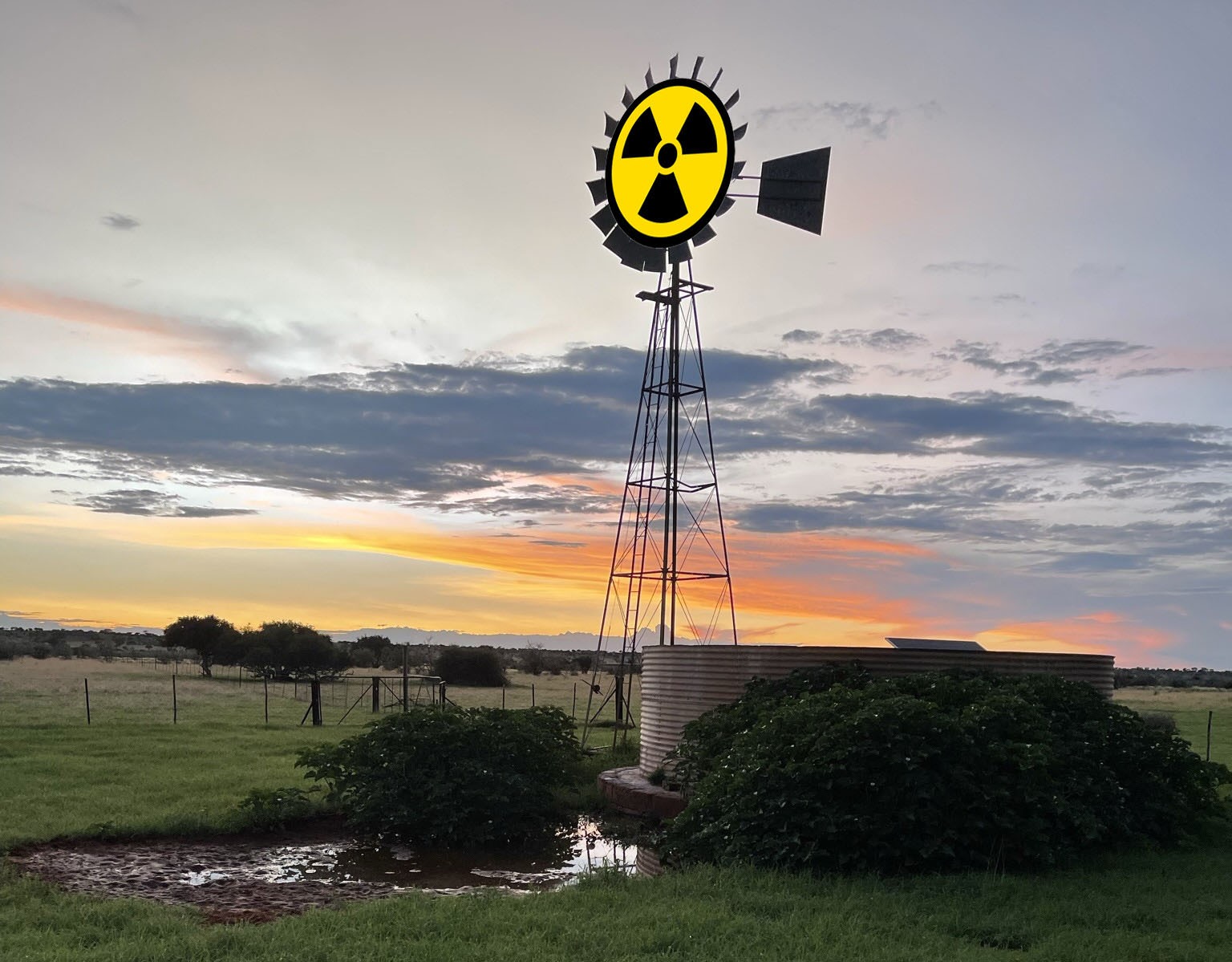
 Illustrative image: The potential for water contamination by radioactive decay products such as radon and radium – along with toxic heavy metals – have heightened concerns about uranium leach mining plans in an arid region where aquifers are the primary source of water for people, livestock and crops. (Supplied / Sheena Carnie)
Stretching across three countries, the Stampriet Artesian Basin is one of the largest aquifers in southern Africa and the only permanent source of drinking water and farm irrigation in one of the driest parts of the sub-continent. This is an area characterised by several dry river beds that only flow briefly during heavy rainstorms. Underground water is the lifeblood of the region, with water extracted from more than 7,000 boreholes to sustain people, animals and crops.
/file/attachments/orphans/tonylemon4mapofstamprietaquifersourceconservationnamibiacom_314023.jpg "The giant Stampriet Artesian Basin stretches across three nations, from central Namibia, the southwestern part of Botswana and into South Africa’s Northern Cape. (Map: conservationnamibia.com)")
It is here that the Rosatom subsidiary companies Headspring Investments/Uranium One have drilled several exploration wells near the town of Leonardville as a precursor to a much larger mining proposal named Project Wings.
Rather than digging it out, Rosatom plans to liberate the uranium from buried sandstone deposits by pumping large volumes of sulphuric acid and other chemical agents deep into the ground to dissolve the uranium into a solution that is then sucked up to the surface for processing into yellowcake.
/file/attachments/orphans/tonylemon5aspoonfulofyellowcakesourceKATCO_131027.jpg "Yellowcake is a powdered concentrate of uranium that can be enriched for use in nuclear power reactors, or weaponry. (Photo: Katco)")
The company claims that the process is environmentally benign and that the chemicals used are “very weak, with an acidity (pH) similar to red wine or lemon juice”.
Other seemingly magical aspects of Rosatom’s in-situ leaching (ISL) mining process, the company avers, are that polluted aquifers are “self-restoring” once mining ends and the Namibian geological environment will also be “purified” from natural radioactivity.
“The Wings project takes its name from the metaphor of wings, symbolising the country’s aspirations for economic flight. […] The project itself will act as a catalyst for the take-off of the Namibian economy, enabling it to soar to new heights of development and prosperity,” Headspring/Rosatom proclaim in the Frequently Asked Questions section of their project website.
But these sunny sentiments do not square with the experience of several former Soviet bloc nations, where extensive uranium extraction (using both ISL and conventional mining) led to significant water pollution during the Cold War era.
/file/attachments/orphans/tonylemon3ISLwellsimageheadspringinvestmentscom_110577.jpg "Leach mining in Kazakhstan and other countries involves pumping sulphuric acid and other chemical agents into underground aquifers to dissolve and extract buried uranium deposits. (Photo: Headspring Investments)")
Case study of uranium in-situ leach mine pollution
One of the most notable examples of long-lasting water pollution comes from the town of Stráž pod Ralskem in the Czech Republic, where in situ uranium leach mining took place from 1967 – 1996.
According to researchers at the Czech State Office for Nuclear Safety, a massive pollution rehabilitation operation is still underway – and is set to continue until at least 2042, at a cost of more than 2 billion euros.
The researchers report that chemical processing of uranium at Stráž led to the contamination of nearly 186 million cubic metres of water in the Cenomanian aquifer and another 80 million in the Turonian aquifer.
More than 4 million tonnes of sulphuric acid and other chemicals were pumped underground here, leaving behind around 800 000 tonnes below ground, along with high levels of radioactive uranium, radon, thorium and several heavy metals.
Drawing lessons from this historic pollution legacy, Czech researchers Miroslav Jurda and Miloslav Němec warn that rehabilitation can be both costly and long-lasting and that “there is a need to ensure that mineral extraction by chemical processes such as in-situ leaching should not be near drinking water reservoirs or in the same areas as underground mining”.
Opposition to Rosatom plans
So, it is not surprising that many Namibian farmers, residents, geologists and international groundwater experts are not buying Rosatom’s story – despite a concerted public relations campaign by the company that has included shuttling Namibian journalists, politicians and farmers to Kazakhstan and Russia to witness the company’s extraction process at first hand.
Unfortunately, noted Namibia Broadcasting Corporation journalist Emil Seibeb, the reporters were prohibited from making any audio or visual recordings at the Kazakhstan mining operations and had to make do with handouts from the Rosatom PR team.
(Kazakhstan, now the world’s largest uranium producer, also served as the Soviet Union’s first atomic bomb test site back in 1949.)
A small group of farmers from the Stampriet Aquifer Uranium Mining Association (Sauma) was also flown to Russia in August 2023 but ended up spending just two-and-a-half hours at the Dalur Mine in Chelyabinsk region. They reported that their questions were answered “evasively, superficially or not at all”, and that the tour had not allayed any of their concerns about ISL mining threats to drinking water in central Namibia.
/file/attachments/orphans/tonylemon6stamprietboreholessourceGGRETA_538899.jpg "There are believed to be more than 7,000 boreholes scattered across the artesian basin, mainly in the Namibian section. (Map: GGRETA 2015)")
Dr Roy Miller, a retired geologist and former director of the Namibia Geological Survey has also spoken out strongly against the Rosatom plan, noting that conventional open-pit or underground mining is not possible at Stampriet. This is because the uranium is located in water-saturated sandstone that is under high artesian pressure. Any excavation into this sandstone using conventional methods would flood owing to the high water table
In a presentation to the Southern African Development Community (SADC) Groundwater Conference in Windhoek in November 2022, Miller said the ISL mining method in other countries involved injecting thousands of tons of acids and reagents into groundwater up to 100 times for up to five years.
Miller says the ISL process also releases radioactive decay products such as radon and radium into aquifer water, along with toxic heavy metals such as copper, chrome or arsenic.
He told Daily Maverick that there are vertical fractures in the sedimentary rock that could allow contamination to spread well beyond the mining well fields. The high water pressure also creates a risk of contaminated water rising to overlying aquifers that are used extensively by farmers.
/file/attachments/orphans/tonylemon7ISLconceptsourceHeadspringInvestments_952838.jpg "While Rosatom argues that uranium extraction is confined to a single geological layer (the Auob Aquifer), geologists say natural rock fractures and other factors could lead to contamination of drinking water in other aquifers. (Graphic: Headspring Investments)")
Miller has appealed to the Namibian government to cancel all mine exploration licences and drilling permits in the Stampriet basin.
“Groundwater is a critical and sustainable commodity and must be protected for present and future generations. Development of uranium (extraction) in any drinking water aquifer must be prevented.”
In fact, Namibia did cancel Rosatom’s permit to drill nearly 40 boreholes after government inspectors found several “gross violations” by the company in October 2021.
This included failing to adhere to the special drilling conditions that were intended to prevent contamination between the Kalahari and Auob aquifers; drilling at least 70 more boreholes than authorised in the permits and operations that could allow underground contamination or endanger livestock and wildlife.
Politician pushing for Rosatom project
Despite these concerns, however, several local politicians are now pushing the government to re-issue exploration permits to Rosatom – and also clear the path for full-scale commercial mining as a matter of “urgency”.
Tobie Aupindi, the flamboyant Namibian MP who chairs the standing committee on natural resources, has gone as far as to suggest that the Rosatom project is being “sabotaged”.
/file/attachments/orphans/tonylemon8tobieaupindiimagsefromhisfacebookpage_703990.jpg "Namibian MP Tobie Aupindi claims that the multibillion-dollar investment plan by Rosatom is being ‘sabotaged’. (Photo: Facebook profile)")
Aupindi, who lists himself as former president and CEO of HC Oil and Gas in Texas and Abu Dhabi, claimed that “divergent views” opposing the Rosatom mining plan were “mostly not based on any specific scientific data”.
“For four years, the Ministry of Agriculture, Water and Land Reform has held a multibillion-dollar investment hostage, a project promising thousands of jobs and significant revenue for the Namibian people. Why do the Ministry of Mines and the Ministry of Environment continue to fold their hands and allow this travesty to persist?”
He said that it seemed to his committee that the ministry was applying “outdated” borehole drilling and water extraction policies to block Rosatom’s “sophisticated, technologically advanced in-situ recovery (ISR) mining process”.
/file/attachments/orphans/tonylemon9farmwaterreservoirimagesupplied_485008.jpeg "Large volumes of high-quality groundwater are extracted from the aquifer to provide water for people, animals and agriculture. (Photo: Supplied)")
Though his committee report contains 20 references to the word “scientific”, the conclusions appear to be almost wholly reliant on information provided by Rosatom/Headspring – with no apparent input from independent geologists, groundwater experts and other interest groups.
Case against Rosatom
This includes the International Groundwater Resources Assessment Centre (IGRAC), which wrote to Namibia’s environmental commissioner Timoteus Mufeti, urging him to not issue an environmental clearance certificate to Rosatom.
IGRAC director Dr Elisabeth Lictevout said: “This extraction method is well known for its negative impact on groundwater quality. Groundwater contamination through the in-situ leaching uranium extraction method will be irreversible (on a human scale). There is no remediation method successful to date. Therefore, groundwater will become unusable, not only for Namibia but also most probably for the neighbouring countries sharing the resource, namely Botswana and South Africa.”
IGRAC, a Netherlands-based body that specialises in groundwater and transboundary aquifer research, also called on Mufeti to appoint an independent external review for the Rosatom proposal.
In response to queries from Daily Maverick, Lictevout said that the proposed Rosatom mining exploration sites had been identified as an aquifer recharge area, with groundwater flowing in the direction of Botswana and South Africa.
Because of underground geological faults and flows between aquifer layers, there was a high risk of water inter-mixing, she said. A third concern was the high rate of groundwater abstraction by irrigation farmers in this part of Namibia.
“Whenever abstraction is high, this increases the natural groundwater flow in and between the different aquifer layers. This accelerated flow further increases the risk of contaminant diffusion and spread. This also means that Botswana and South Africa could be affected earlier than under ‘normal’ circumstances.”
/file/attachments/orphans/tonylemon10sheeppicsupplied_803082.jpeg "Domestic sheep, goats and other livestock depend on the aquifer for survival. (Photo: Supplied)")
Department of Water and Sanitation comments
The department told Daily Maverick: “The DWS position is that relevant Namibian studies, including Environmental Impact Assessment and mitigation processes, must be undertaken to inform a way forward on the proposed developments; and the outcomes must be shared via the Orasecom [Orange-Senqu River Commission] platform.
“Notification on developments in the member states that have transboundary implications are done through the Orasecom platform. No such notification had been received at the time of the most recent round of Orasecom meetings (November 2025).”
Orasecom, an intergovernmental consultation forum that includes senior water officials from South Africa, Namibia and Botswana, confirmed that it is “aware of concerns” raised about the potential impacts of ISL mining on shared groundwater resources.
“Orasecom recognises the strategic importance and sensitivity of shared groundwater resources and the need to ensure that any development activities are undertaken in a manner that safeguards the long-term sustainability of the aquifers and prevents adverse transboundary impacts. The matter is currently being addressed through the appropriate Orasecom structures and engagement processes involving the concerned state parties.”
Rosatom responds
In response to our queries, Rosatom said that no current geological exploration activities are being conducted in its Namibia mining licence areas. The company was “awaiting the receipt of a drilling Permit from the Ministry of Agriculture and an environmental clearance certificate from the Ministry of Environment”.
Having characterised ISL mining as an environmentally friendly mining method of extracting mining, the company was also asked to comment on evidence of significant groundwater pollution at Stráž pod Ralskem and other mining sites in Central Europe.
Rosatom said: “The development of the deposit in Czechoslovakia began in the late 1960s. At that time, research on the application of the ISL method had only just begun. Many issues were insufficiently studied at the time, which could lead to an underestimation of several factors.
/file/attachments/orphans/tonylemon11kirillegorovkirillovmanagingdirectorsourceHeadspring_852625.jpg "Kirill Egorov-Kirillov, director of mining projects of Rosatom’s JSC Uranium One Group. (Photo: Headspring Investments)")
“It should be noted that this deposit differs significantly in its geological structure from the well-known deposits of Kazakhstan, Uzbekistan and Russia, which have been successfully mined for decades. Technologies have advanced significantly and offer a modern and safe model for developing subsurface resources, built on the principles of preserving natural ecosystems, utilising scientific achievements and ensuring environmental safety.”
It further asserts that, in Kazakhstan, more than 430 000 tonnes of uranium had been extracted using the ISL method over five decades “without documented cases of drinking water source contamination”.
Elsewhere in its responses, however, the company cites a study which confirms that the ISL method has led to historic contamination of underground water in the Kanzhugan deposit in Kazakhstan.
Rosatom further states that at Russian ISL operations, uranium is extracted from the subsoil with “minimal environmental impact, surrounded by untouched wheat fields, flowering gardens and wild animals freely inhabiting their natural environment”.
“A modern mine employs multi-stage monitoring systems and barriers that prevent the possibility of solutions spreading beyond the deposit boundaries.”
Asked to provide references to scientific studies demonstrating that “natural attenuation of aquifers occurs within 10 years” after mining ends, the company provided four references, including an industry-led study from Kazakhstan suggesting that underground sulphur plumes were “shrinking” and that a contaminated aquifer was “returning to a state close to its original condition” some 30 years after leach mining ended.
It also cites a study by researchers from Kazakhstan’s national atomic company, which states that: “Based on experience gained during post-leach monitoring, it has been found that in properly selected sites, the impact following leaching is greatly reduced because of the process of self-restoration, otherwise known as natural attenuation.”
Regarding concerns about potential transboundary pollution of the Stampriet aquifer, Rosatom said that it “fully supports the position on the need for a comprehensive, independent and competent assessment of facilities, processes and technologies in the implementation of geological exploration projects in Namibia”.
/file/attachments/orphans/tonylemon12yuritrutnevatnamrusbusweeksourceHeadspring_918125.jpg "Russia's Deputy Prime Minister, Yuri Trutnev, visited Windhoek in March as part of the Russia-Namibia Business Forum, where he also held talks with Namibian President Netumbo Nandi-Ndaitwah. (Photo: Headspring Investments)")
In light of previous “gross violations” of Rosatom/Headspring permit requirements reported by the Namibian government in 2021, we asked the company what faith the public could have that such violations would not be repeated?
The company said: “Headspring Investments operates strictly within the framework of issued permits, under the supervision of relevant regulatory authorities. Representatives of these authorities have repeatedly visited the project site and confirm that all company activities are carried out responsibly and in full compliance with Namibia’s environmental, water and mining legislation. […] Since November 2021, no violations or prohibited activities have been recorded at the site.” DM


Comments
Scroll down to load comments...