




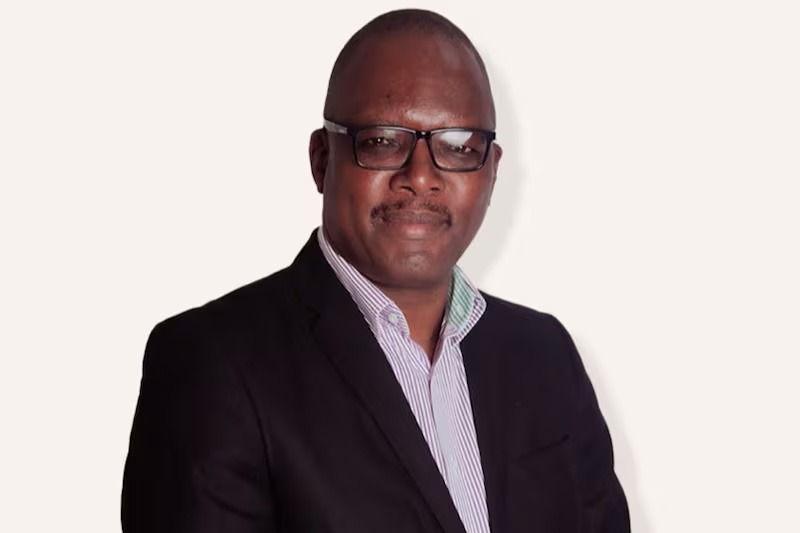
 Matshela Seshibe, the acting CEO of SAA, is in the hot seat. (Photo: Supplied)
 It’s a little unsettling to refer to someone as an acting CEO when he was the one who had to answer to Parliament for what happened under his predecessor and now needs to start swinging the sword of justice for indiscretions. But this is what happened when Daily Maverick interviewed acting SAA group CEO Matshela Seshibe (you can watch it on the Daily Maverick YouTube channel).
Explaining why the board chose the leader of a catering subsidiary to run the entire national carrier, he was careful to reflect his full merits: “I was doing two roles... I was a member of ExCo at SAA, and at the same time I was running Air Chefs as its CEO.”
It’s this measuredness that makes Seshibe an interesting interview subject. Full credit must of course go to the team who did his media training, but there is also a fair bit of natural calm.
When he says support from the stakeholder – South African taxpayers via the government, alongside whatever lines of credit or funding the Treasury can get – is needed, “not to bail out the airline for financial and operating losses, but to drive the growth of the airline so that it can fulfil its mandate”, it is a very controlled dance with an interesting pivot.
SAA’s integrated report confirms that the national carrier is operating without interest-bearing borrowings, but it explicitly notes that management is “actively working on acquiring a R300-million facility” to provide a working capital buffer. So no, SAA is not asking for a bailout per se; instead, it has a strategic funding facility baked into its turnaround plan.
However, SAA is now under the stewardship of the Department of Transport, and Minister Barbara Creecy’s budget vote speech – delivered a day after Seshibe was on his unexpected media tour (it was understood that the airline would be in the quiet period before the July audit report) – makes it clear that future shareholder support will not be a blank cheque.
/file/attachments/orphans/ED_550495_179204.jpg "Minister of Transport Barbara Creecy. (Photo: OJ Koloti / Gallo Images)")
Creecy went as far as saying that SAA must ensure “disciplined implementation of our approved plans, sound governance, operational performance and a sustainable operating profit”.
Turning a new leaf
Good governance is at the top of the (acting) CEO’s priority list.
“For me, governance is a non-negotiable... It gives us a licence to engage with our stakeholders, our lenders, as well as our suppliers. They expect an SAA that is run professionally with clean books and clean records that are credible.”
His aspirational stance on governance is strong, but the evidence shows SAA is lacking this licence of credibility. The Auditor-General issued a disclaimer of opinion, the worst possible audit outcome, on SAA’s financial statements precisely because the carrier did not have “clean books and clean records”.
The Auditor-General found that management “did not implement proper record keeping”, had outdated policies and incurred R504.4-million in irregular expenditure through contraventions of supply chain legislation.
However, the integrated report does acknowledge that to secure future funding from financial institutions, the airline’s board is actively working to establish what it calls “favourable creditworthiness to strengthen the company’s balance sheet”.
Pressed for a metric by which to judge his tenure, Seshibe singled out operational reliability and service.
“If you are a passenger, you are looking for on-time arrival and you are looking for good service. South Africans can continue to expect that SAA will continuously improve on service and on its on-time performance,” he said.
/file/dailymaverick/wp-content/uploads/BM-Ray-SAEliquidation-option-2.jpg "Acting SAA group CEO Matshela Seshibe says the airline is performing well in terms of operational reliability and service. (Photo: Guillem Sartorio / Bloomberg via Getty Images)")
And he is right. The national carrier is performing exceptionally well on this specific operational metric. For the FY2024/25, it successfully operated 18,282 flights and achieved an impressive 99.6% flight schedule completion ratio.
The board’s confidence is also backed by the stellar performance of SAA subsidiary Air Chefs. Under Seshibe’s leadership, it generated a total revenue of R372-million and a net profit of R111-million for FY2024/25, successfully rolling out smart catering and automation projects. This is, of course, according to the integrated report.
Conflicting narratives
However, the confidence of the citizen shareholders is harder to come by, especially with the measured statement in response to questions about poor audit outcomes – which admittedly were not in his hands.
“Finance people will tell you that when you are having to do so many audits in one year, you hardly have the space to take corrective actions... The situation was not completely bleak because the Auditor-General did acknowledge that there were improvements at the SAA airline,” Seshibe said.
This is a fair comment from a new CEO who, weeks into his tenure, is keeping with the standard SAA company line that attempts to downplay the horrific audit outcomes as a mere consequence of a compressed timeline (those back-to-back audits).
The cause for concern? Systemic, deep-rooted internal control failures, not just a lack of time. The Auditor-General could not verify R896-million in maintenance costs or find supporting documentation for R59.3-billion in accumulated loss restatements, and flagged SAA for artificially inflating its assets by incorrectly capitalising maintenance provisions.
And that “sustainable operation” has a massive asterisk: despite the narrative of a self-funding, sustainable turnaround, SAA’s own board officially acknowledges “material uncertainties” regarding the airline’s ability to operate as a going concern, admitting that “historical operating profits and operating cash flows remain below sustainable levels”.
Thankfully, the Department of Transport has asked SAA to reformulate its corporate plan specifically to address, at least in the immediate short term, the exponential increase in aviation fuel costs. The goal is to ensure it remains a going concern through careful route rationalisation and disciplined fleet expansion.
Creecy is also implementing consequence management and getting the Auditor-General involved to probe the books after any large contracts are awarded. She will also introduce a shareholder-led evaluation system in the 2026/27 financial year. This will directly link the assessment of the SAA board’s performance to the airline’s actual performance outcomes, audit results and service delivery impact.
The new pilot at the business wheel will at least have better guardrails to keep the turnaround flight on path. DM
This story first appeared in our weekly DM168 newspaper, available countrywide for R35.
/file/attachments/2992/DM-150526_262380.jpg)