




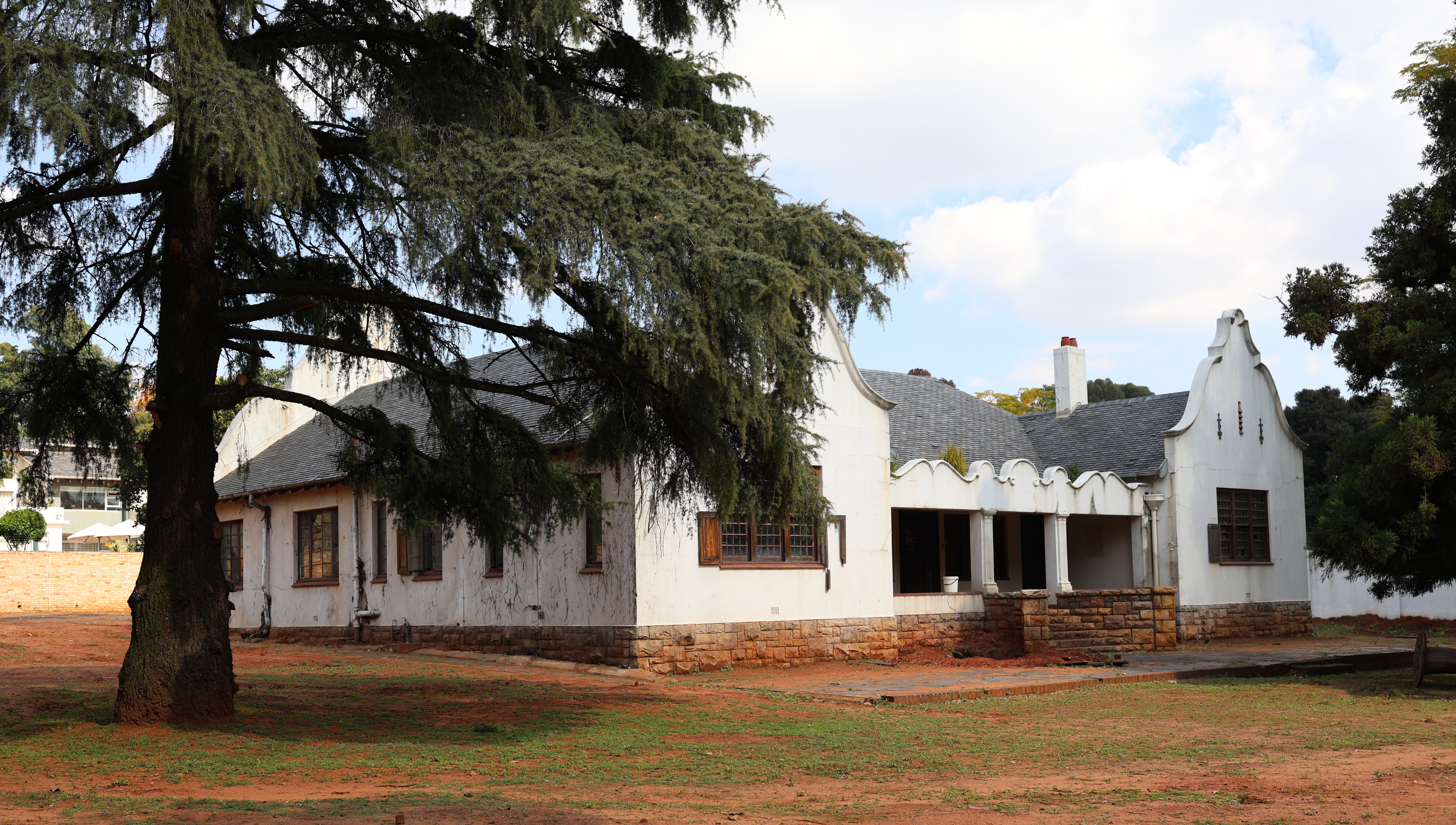
 Abandoned properties in Lower Houghton, Johannesburg, have become a growing concern for residents, attracting vagrants, illegal dumping and posing ongoing safety risks to the surrounding community on 15 May 2026. (Photo: Felix Dlangamandla)
Lower Houghton, home to four properties associated with Nelson Mandela and long a symbol of exclusivity, is showing signs of structural decline.
About 50 properties — in a suburb of roughly 3,000 homes — are now vacant, neglected or otherwise vulnerable.
/file/attachments/orphans/WFD_2767_461886.jpg "Vacant land in a suburb that was once the refuge of Johannesburg's elite. (Photo: Felix Dlangamandla)")
Absentee ownership, abandoned properties, little or no service delivery, delayed town planning decisions and weak municipal enforcement are contributing to this, according to residents.
The shift is not widespread yet, but it is no longer isolated. Residents say the properties are beginning to cluster, creating pockets of overgrowth, limited oversight and increased exposure to vagrancy and opportunistic occupation.
/file/attachments/orphans/WFD_2816_451615.jpg "Abandoned properties in Houghton have become a growing concern for residents. (Photo: Felix Dlangamandla)")
/file/attachments/orphans/WFD_2789_127067.jpg "Overgrown vacant land in Lower Houghton. (Photo: Felix Dlangamandla)")
Amanda Fleming, chairperson of the Lower Houghton Residents Association, says the concern is about what is already happening nearby in Upper Houghton, where once-stable homes have been converted into high-density rentals, with three large state-owned properties having fallen into disrepair — patterns that followed similar delays in enforcement and oversight.
Lower Houghton, they warn, is not there yet, but the early indicators are comparable.
Large residential stands, once a defining feature, are increasingly sitting idle — tied up in estates, held by absentee owners, abandoned by owners who have relocated or downsized, or sold for redevelopment that is delayed by objections and protracted planning processes, she adds.
/file/attachments/orphans/WFD_2796_896116.jpg "Another abandoned property in Lower Houghton. (Photo: Felix Dlangamandla)")
Lower Houghton was never meant for the masses; founded in 1904 by Barney Barnato’s JCI, it was designed as a fortress of prestige for mining magnates on land that had failed to yield gold.
By the 1990s, Mandela had moved into this “Randlord” legacy suburb for his own security and privacy, but those same sprawling plots have now become a liability.
These huge properties that once signalled wealth and power now facilitate a managed decline, as stalled planning and municipal neglect transform the former bastion of the elite into a target for urban decay.
/file/attachments/orphans/WFD_2861_296810.jpg "The Lower Houghton Residents Association believes that properties such as this are affecting the suburb's footprint. (Photo: Felix Dlangamandla)")
It is not a sudden collapse, but a combination of municipal inaction, delayed planning processes and a growing number of neglected properties now affecting the suburb’s footprint, says Fleming.
“While we accept that densification has to happen, we are wary about how it is going to happen. It needs to be controlled and managed,” she said, adding that the suburb should still serve as a “green belt buffer”.
Mandela-linked properties
The four properties associated with Mandela in and around Houghton Estate now serve as a barometer for the suburb’s condition.
The Nelson Mandela Foundation offices on Central Street in the Houghton/Riviera precinct remain a stable institutional anchor for his intellectual legacy.
Sanctuary Mandela on 13th Avenue — a former private residence — has been restored and repurposed as a boutique hotel, reflecting a shift from residential use to commercial viability.
By contrast, the 12th Avenue property where Mandela spent his final years is caught in uncertainty. Family trust disputes have resulted in the house being linked in recent reporting to allegations involving suspected hijacked vehicles found on or near the premises and the subletting of rooms. The property is overgrown and unkempt.
A separate property associated with Winnie Madikizela-Mandela in Houghton Estate has also been abandoned and has drawn concern from residents, who say its condition reflects the same patterns of neglect seen in other parts of the suburb.
Shadow municipality
With the City of Johannesburg essentially missing in action, the Lower Houghton Residents Association says it has evolved into a “shadow municipality”. Only 58 households of the 3,000 fund the gardeners who cut the verges weekly — especially those of abandoned properties — remove rubbish and maintain public spaces, including a strip on Oxford Road which borders the area.
Fleming is blunt about the reality on the ground.
/file/attachments/orphans/WFD_2833_224858.jpg "There are currently about 50 properties that are now vacant, neglected or otherwise vulnerable in Lower Houghton. (Photo: Felix Dlangamandla)")
“It is a handful of residents keeping this suburb intact. We are paying private gardeners to clean pavements of houses we don’t own and removing rubbish from overrun stands just to prevent the rot from spreading. We are effectively doing the City’s job.”
Fleming points to a Catch-22 situation where residents’ attempts to save the suburb’s character through the planning process actually accelerate its decay:
“We object to developments that are too dense or inappropriate. But that stalls approvals for years — and in that time, the properties deteriorate further. They become overgrown, attract vagrancy and create security risks.”
Residents also monitor vacant properties, track building activity and, in some cases, extend maintenance beyond their own properties to prevent visible decline from spreading street by street. They have successfully stopped some illegal building in the past.
The nodal review: Councillor’s warning
The pressure is not just coming from neglected gardens, but from a shifting policy landscape that many residents feel they are fighting alone.
Ward 73 councillor Eleanor Huggett warns that the City’s new nodal spatial review is a double-edged sword. While it encourages densification, it lacks the enforcement necessary to prevent that density from turning into disorder.
“There is almost zero enforcement,” Huggett says. “The City has the policy, but where enforcement is weak and processes are slow, you create gaps. And those gaps are where decline sets in.”
She notes that the residents’ association is doing “sterling work”, but it is battling a municipal system that is increasingly unresponsive.
“Densification is part of the City’s policy, but it must be managed.
Without enforcement, you aren’t building a city; you’re just managing a collapse.”
She slammed the City and the Johannesburg Property Company for allowing Bleloch House to fall into disrepair.
Bleloch House, at 106 Houghton Drive, is a recognised heritage property marked by a Johannesburg Heritage Foundation blue plaque.
Designed in 1938 by architect Theophile Schaerer in a Cape Dutch Revival style, the house is associated with geologist William Edwin Bleloch, a key figure in early Witwatersrand gold exploration and a contributor to the understanding of the region’s geology.
Originally part of the low-density, high-value residential fabric of Lower Houghton, the property later transitioned into state use, including association with the South African Police Service reservist structures.
Now owned by the Johannesburg Property Company, Huggett says the building has been allowed to deteriorate, standing unused, vandalised and often occupied by vagrants. The condition, says Huggett, reflects the City’s broader failure to maintain and manage its own heritage assets.
The Upper Houghton mirror
The fear in Lower Houghton is grounded in the reality of its neighbouring suburb.
In Upper Houghton, residents complain of slumlord activity and the decay of state-owned properties that Lower Houghton is trying to avoid. Once-stable homes there have been repurposed into high- density, unregulated rentals.
Lower Houghton, residents say, is following the same trajectory — just more slowly.
The institutional squeeze
The urbanisation of Lower Houghton is accelerating.
The Masjid ul Furqaan mosque has brought additional localised pressure, with chronic parking congestion and limited traffic enforcement during peak periods. Residents say the issue is not the institution itself, but the absence of consistent by-law enforcement to manage the volume of activity.
The most significant looming shift in the suburb’s character is the Thabo Mbeki Presidential Centre (TMPC). Located in Riviera on the edge of Lower Houghton, the R950-million development is intended as a major cultural and research hub.
Designed by Sir David Adjaye, the 5,400m² facility will include a museum, research centre and presidential archives.
For residents, however, the project represents a decisive shift in land use. It introduces a large-scale institutional presence — including increased traffic, staff and public access — into an area already experiencing strain on roads, parking and basic infrastructure.
The concern, again, is not with the project itself, but with the City’s ability to manage its impact.
Lower Houghton stands at a crossroads, said Fleming.
Individually, a neglected property or a delayed development is manageable. Together, she says, they form a pattern — one that has played out before in other parts of Johannesburg.
“For now, the suburb is still holding. But the work of holding it together is increasingly being done by residents themselves. And without intervention — faster planning decisions, consistent enforcement and action on neglected properties — the suburb risks shifting from managed stability to entrenched decline,” she adds. DM
Comments
Scroll down to load comments...