





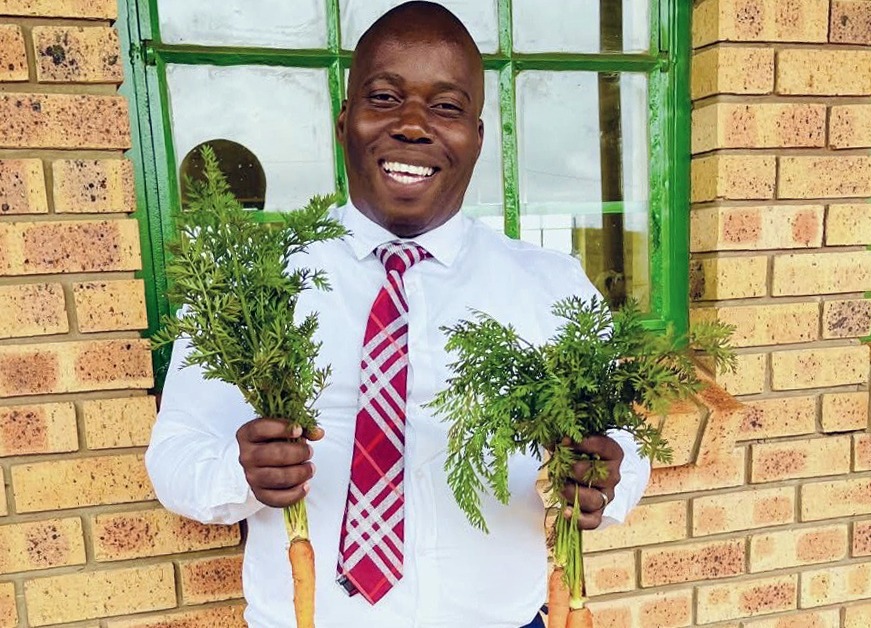
 Principal Zakhele Xulu holds the organic produce that is currently helping to feed his 53 learners and providing a vital lifeline to the surrounding Louwsburg community. (Photo: Zakhele Xulu)
 When Zakhele Xulu walked through the gates of Nkwamabzi Primary School in January 2024, the community’s daily struggles commanded his attention long before any lesson plan.
Tucked away in the deep rural pockets of Louwsburg, KwaZulu-Natal, the no-fee school had just 53 learners, two teachers, and no running water on the grounds. The children relied on dilapidated pit latrines, and part of the daily routine involved walking to a nearby stream with buckets just to fetch enough water to get through the day.
At home, the situation was even bleaker. Xulu found himself looking at classrooms full of children coming from households crippled by unemployment. Many were raised by grandmothers who could only afford the arduous trip into town once every three months.
“The situation is not normal. Parents are not working, and learners are coming from households where there is nothing at all,” he said.
Planting the seeds of change
Xulu, a former School Environmental Education Programme coordinator with the Department of Basic Education, knew he had to feed his school before he could teach it. When he arrived, there was already a small, rudimentary vegetable patch on the property overseen by a school governing body member. Drawing on his background, Xulu immediately formalised the space into the Nkwamabzi Garden Club, bringing together learners, teachers and members of the surrounding community to work the soil.
In those early days, driven by the goal to tackle the area's food security challenges and empower his learners, Xulu kept the initiative afloat by buying seeds and seedlings out of his own pocket.
The turning point came when Food & Trees for Africa, a non-profit organisation focused on food security, urban greening and environmental sustainability, recognised the school’s potential and stepped in to sponsor the club.
“That is where all the magic started,” Xulu recalled. The organisation provided the exact resources the school needed to scale up, including seeds, seedlings and organic manure, alongside critical agricultural training.
This training aligned perfectly with Xulu’s vision for the land.
“It was so convenient because in our school we are promoting permaculture,” he said. “We are saying that we want our product to be strictly organic.”
Today, the garden club is not just a school project; it plays a vital, daily role in enhancing local food security while equipping learners with the practical skills they need to survive and thrive.
From buckets to boreholes
Planting the seeds was only half the battle – keeping them alive exposed another critical flaw in the school’s infrastructure.
“When you have a garden, there must be a system for how to water the plants,” Xulu said. Initially, the school was entirely at the mercy of the weather. It relied on a rainwater harvesting setup, capturing whatever runoff managed to trickle down the gutters and into its storage tanks.
/file/attachments/orphans/Xuluschool_352457.jpeg "Sprinklers provide a steady supply to the Nkwamabzi Garden Club, a massive leap forward from the school's previous reliance on rainwater. (Photo: Zakhele Xulu)")
Food & Trees for Africa has since intervened, reviving a dormant borehole.
“It is working very nicely to have water coming from a borehole. We now have an irrigation system working in our garden. We are no longer using cans to water the plants. Now, we are using sprinklers,” Xulu said.
A harvest of hope
Xulu’s vision of feeding his learners soon became a tangible reality, and the proof is in the harvest. In 2025, the club pulled 98kg of fresh produce from the soil, harvesting healthy crops of beetroot, cabbage, maize, carrots and Swiss chard.
/file/attachments/orphans/388d98d4-4850-4745-8ddc-19455aabd087_817412.jpg "Nkwamabzi learners proudly display a fresh harvest of carrots destined for the school’s daily feeding scheme. (Photo: Zakhele Xulu)")
The school’s kitchen used 32kg to supplement the learners’ daily meals, while the remaining 66kg was donated directly to vulnerable families in the surrounding community.
The project’s impact has quickly outgrown the school’s fences, and the school now gives seedlings to parents free of charge so that they can grow their own food at home.
A living classroom
The permaculture garden doubles as a living classroom, and Xulu isn’t afraid to let the learners experience real-world business failures.
Recently, the school yielded a massive harvest of aubergines. The problem? No one in the deep rural community knew what an aubergine was, let alone how to cook it. Xulu turned it into a masterclass on supply and demand.
“We told the learners, if you want to sell a product, first you must identify your market,” Xulu said.
Now, the nursery focuses on spinach, cabbage and tomatoes, crops the community recognises and wants.
/file/attachments/orphans/WhatsAppImage2026-05-13at060952_121898.jpeg "Xulu and his learners show off a successful crop of tomatoes. (Photo: Zakhele Xulu)")
“We want to create entrepreneurs. We want to give them the background to say, you can become an entrepreneur using your own hands, but you must be able to understand the market,” he said.
Xulu’s relentless drive recently earned him national recognition, winning first place at the South African Principals Association awards in Gqeberha, Eastern Cape.
But for Xulu, the awards are secondary to the mindset-shift happening in his classrooms.
“These learners didn’t choose to stay in this deep rural area. But as a school, what do we do? We want to teach them to say: regardless of the situation we are facing, you can make it. You can prosper.” DM