




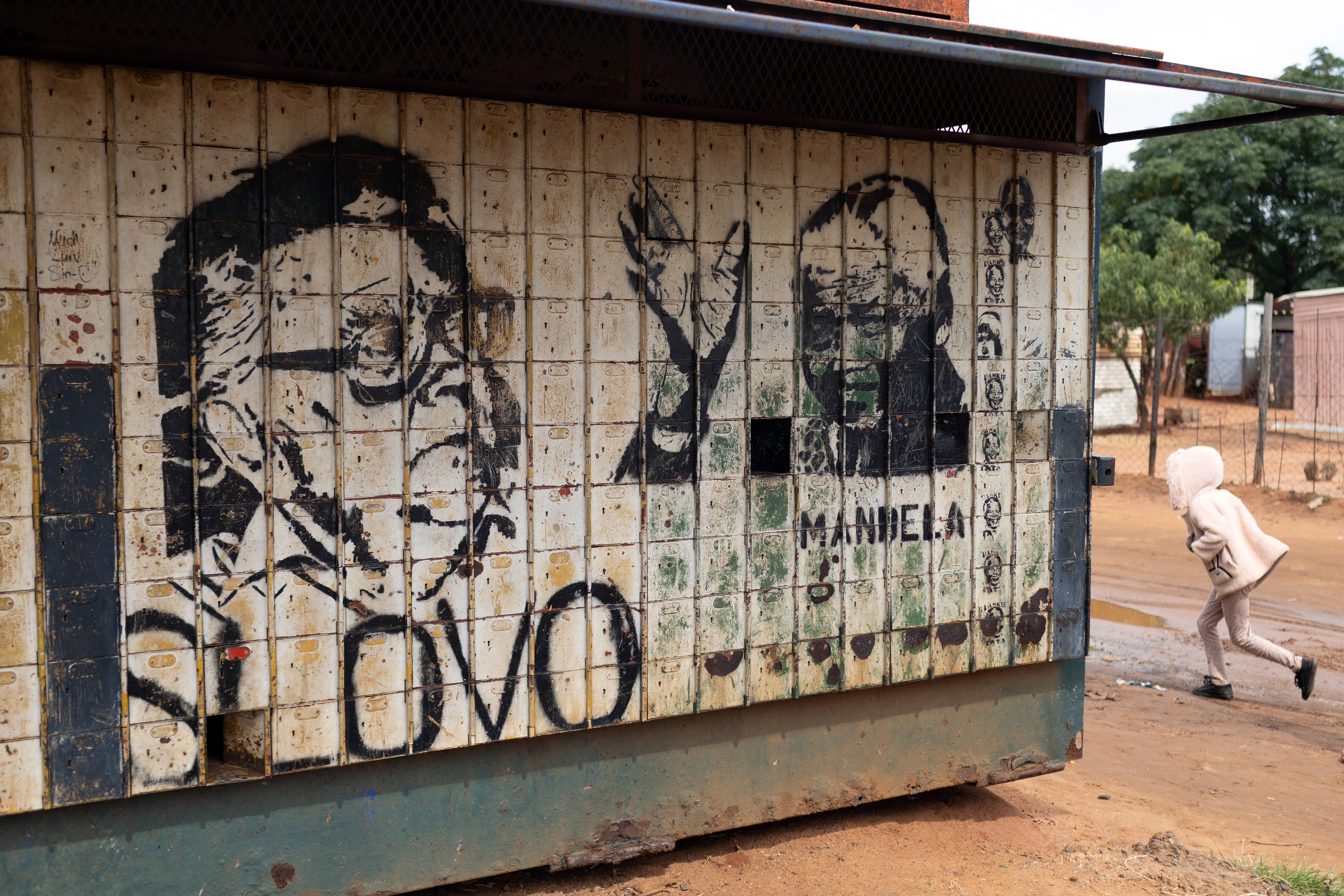
 Graffiti depicting former SACP leader Joe Slovo and Nelson Mandela on old post boxes in the Slovo Park informal settlement in Johannesburg on 9 April 2026. (Photo: Our City News / Alaister Russell)
 A recent Business Day editorial, “The Rupture of the ANC-SACP Alliance”, raises issues this article seeks to address more extensively. The editorial’s focus is the ANC; ours is the South African Communist Party. The editorial sees the ANC’s “deafness” to SACP cries over the years for equal status in the alliance as integral to the ANC’s “fail[ure] to renew itself”. Our focus is the SACP’s renewal failure, particularly “in the marketplace of ideas”.
Business Day, perfectly reasonably, affirms it will “never support the SACP’s socialism agenda”. This is why our response appears in Daily Maverick, with its much broader readership than expected of a business-oriented daily.
1 Other than using its name, the SACP has been wanting in how it differs from the ANC
The SACP was initially ambivalent about its decision to contest elections in its own name. It justified this as seeking the long-desired “renewal” of the Tripartite Alliance rather than as a hostile split. Being cornered by the ANC’s non-responsiveness, it is now resolute in respecting its congress’s decision, already contesting several municipal by-elections. Its best result has been in the Eastern Cape, where it won 12% of the vote, with lows elsewhere of 1% and an overall average of 3.52%. These results reflect the SACP’s chosen submergence into the ANC – its disappearance from general public consciousness is the outcome.
2 Renewal that erases its own history is not renewal
Having recognised these realities, it is encouraging that the SACP is organising a potentially significant Conference of the Left, for “Building a Left Movement for Working-Class and Popular Power”. But this acknowledgement comes with foreboding, and the SACP’s Draft Framework for the Conference is replete with concerns that go to the heart of its credibility as a movement of renewal.
The Business Day editorial identifies the ANC’s failure to renew itself. But the deeper issue, which the editorial does not pursue, is this: the SACP was not a bystander to that failure. For three decades the Communist Party was embedded in the ANC government – in Parliament, in Cabinet, with some of its Central Committee members serving as ministers and deputy ministers. The framework document for the Conference of the Left now critiques, with considerable force, the record of post-1994 governance. Yet that very document systematically omits the SACP from its account of what went wrong.
Consider what the framework document says about the post-1994 period:
- “Political democracy and expanded social provision were not accompanied by decisive restructuring of economic power. Ownership patterns remained concentrated. Financial dominance deepened. Neoliberal-centred policy frameworks expanded into key areas of economic governance”;
- “Neoliberal-centred policy frameworks have consolidated themselves as the dominant language of governance”; and
- “Concentrated ownership, capital mobility and integration into global financial circuits limit the policy space available to democratic institutions. The result is a narrowing of economic alternatives within formal political debate.”
These are correct. But who oversaw that narrowing? Who sat in the Cabinet that adopted GEAR – the neoliberal policy document the SACP itself euphemistically calls the “1996 class project” – and did not resign in protest? Who provided parliamentary votes for the budget frameworks that locked in austerity? The SACP’s own self-exclusion from this history is not a minor omission; it is a structural denial that will haunt the Conference of the Left and invite disruption from precisely the formations the party needs as partners.
Anticipating that these omissions will be raised – and they will be – the SACP needs to own up to its previous mistakes before it can credibly stand with others towards a different future. Renewal that erases its own complicity is not renewal; it is rebranding.
3 The SACP has still to reject the National Democratic Revolution
The SACP conceived the original National Democratic Revolution (NDR) as a unifying policy, in a joint national struggle with the ANC, for the overthrow of apartheid. From 1969 to roughly the mid-1980s, the programme of the NDR, it could be argued, was suited to that task. This assessment rests on the following main considerations:
- The SACP, banned in 1950 and withholding public announcement of its existence until mid-1961, was without the mass base needed for national liberation;
- uMkhonto weSizwe (MK), a joint SACP/ANC initiative, was launched in December 1961 as the armed wing of the national struggle;
- MK facilitated SACP leaders – including Joe Slovo, also a leading MK member – being invited by the ANC to its Morogoro Conference in 1969. That conference adopted the NDR in all but name, characterising it as the struggle for “national liberation” with strong class content, and emphasising the complete political and economic emancipation of the African people;
- Of special importance to the SACP was the priority given to class. The working class was recognised as “doubly oppressed and doubly exploited” and the driving force of the revolution; and
- This class-based NDR harmonised with the SACP’s “two-stage” theory of socialist revolution: first, seizure of state power to create the democratic state envisaged by the Freedom Charter; second, the transition to a socialist society.
Unfolding events, however, invited a receptive ANC to bury this understanding of the NDR – a death the SACP is still unable to recognise after more than 32 years. It hasn’t even begun mourning.
Most ANC leaders – beginning with Nelson Mandela – implicitly agreed with one of its leaders who, in 2004, was honest enough to admit: “I didn’t join the struggle to be poor.” This was five years after President Thabo Mbeki, having committed the ANC to the creation of a “black bourgeoisie”, assured the Annual National Conference of the Black Management Forum that it was their patriotic duty to get rich without shame. And get rich many did – like billionaire and current President Cyril Ramaphosa [Pieter du Toit, The ANC Billionaires, 2022].
Moving on from the burial of the original NDR is a necessity – if a difficult one – for the SACP to accept. Building a Left movement leaves the party with no other choice, because few if any of the Left movements it wishes to draw into its implicit United Front ignore the evidence that the ANC has led anything other than still more neoliberalism.
4 A framework document that dares not name the system
The core intellectual problem with the SACP’s Conference of the Left Framework Document – now in its fourth version – is that it is, in essence, little different from any ANC or government policy document produced since 1994, save for the disappearance of any mention of the Tripartite Alliance or its partners. Despite 17 pages of diagnosis, the document does not adopt an explicitly anti-capitalist programme. It does not name capitalism as the system to be overcome. It speaks of “structural transformation” while carefully avoiding commitment to the structural break that transformation would require.
The framework document warns against being “declaratory”. Yet its fourth version remains precisely that. There is no specific identification of the priority changes needed to South African neoliberalism, no concrete options for how to effect those changes and no programme of action capable of grounding mass mobilisation.
Compare its language on economic ownership with what a serious anti-capitalist programme would require:
- The framework speaks of “democratic oversight of economic power” and “public investment” linked to domestic industrial capacity. These are not nothing. But they are not a programme for dismantling concentrated capital. They are the language of social democracy – the management of capitalism, not its transformation;
- The framework’s section on employment, for instance, calls for “public investment programmes linked to domestic industrial capacity and public ownership” and “macroeconomic policy that supports expansion of production and employment”. These proposals would be welcomed by a Keynesian economist, not just a communist. The same is true of its cautious language on land, services and local government; and
- Nowhere does the framework commit to socialising the commanding heights of the economy – finance, mining, energy. Nowhere does it propose a wealth tax or the expropriation of concentrated landholdings. Nowhere does it advance a universal basic income as a matter of right. Nowhere does it articulate a break from export-led growth. The word “capitalism” appears in the document mainly as a descriptive noun, not as the name of a system to be abolished.
This timidity is not incidental. It reflects the SACP’s continued deference to a political world in which it has been a governing partner – and in which its members’ careers, networks and interests have been forged. An organisation that has spent three decades inside a capitalist state finds it difficult to speak plainly about overthrowing capitalism.
5 What a genuinely radical programme looks like
A programme of action for the Conference of the Left should demonstrate what an explicitly anti-capitalist framework would look like – and shows, by contrast, how far the SACP’s own Framework Document falls short.
Where the framework speaks of “coordinated Left intervention”, the programme would begin from a clear political position: South Africa faces a systemic crisis rooted in neoliberal policy choices, and the programme must reject austerity, privatisation and market-led development. It would advance “a public, democratic, redistributive and feminist alternative”. That is a political commitment, not a facilitated process.
On immediate demands directed at addressing the current state of the working class, the programme would propose:
- Increased tax on the top 1% to 10% of taxpayers;
- A Universal Basic Income Grant consistent with the “dignity” constitutionally guaranteed to everyone;
- A National Public Job Guarantee Programme as a legal right, with immediate job creation in housing, community health, ecological restoration, public transport and rail;
- Free basic electricity, water, sanitation and transport – with “basic” being a truthful measure of expectation in a rich country like South African in the 21st century and with prioritised roll-out; and
- Emergency funding to fill all vacant public sector posts and insource local government functions.
On structural transformation, the programme would do what the SACP’s framework will not:
- It would explicitly call for reversing all budget cuts in health, education and local government – naming austerity as a political choice, not a technical necessity;
- It would demand the reversal of privatisation of SOEs – Eskom, Transnet, Prasa – and the rebuilding of public sector capacity; and
- It would call for placing strategic sectors under public and social ownership, including energy, transport and finance, with worker-community control boards.
On land, the programme would call for expropriation – with criteria – of underutilised land, speculative holdings and large-scale commercial monopolies, with priority allocation to women, young people, farmworkers and the rural poor. It would link this to a food sovereignty system that shifts from corporate food structures to local and community-based production.
On feminist transformation, the programme would make explicit what the framework only gestures towards: “No transformation without dismantling patriarchy.” It would call for the socialisation of care work, equal pay and access to employment, and priority access to land and resources for women.
On democratic renewal, the programme would call for community assemblies in every locality, participatory budgeting and a broad popular united front of trade unions, unemployed formations, women’s movements, young people, students and rural organisations.
The contrast is not one of tone or ambition. It is one of political clarity. The SACP’s framework remains inside the framework of managed capitalism. The programme of action names capitalism as the problem and proposes concrete instruments for confronting it.
6 Towards a Socialist Democratic Revolution: Reversing neoliberalism
The Socialist Democratic Revolution (SDR) we propose as an alternative to the SACP’s residual NDR begins with a specific rather than general critique of neoliberalism. Neoliberalism shapes much of our lives, even when we are not aware of its comprehensive reach. The SDR transforms the neoliberal premise of investment→growth→jobs into a different logic: wealth redistribution→economic development→jobs.
6.1 Export-led growth must be reversed. The logic of the export focus rests on the perceived limits of domestic demand – but demand is here different from domestic need. Most South Africans cannot afford to buy in the quantities they produce. This makes large-scale production uneconomic for profit-maximising businesses without the primary export focus. Consider the following:
- 40% of domestic workers earned less than the legal national minimum wage (NMW) in September 2025;
- About 5.4 million workers – 32% of the employed workforce – earn below the NMW (December 2025);
- A minimum monthly living wage is R15,000 (August 2025); and
- More than 50% of employed South Africans earn less than R15,000 per month (2026).
The government itself recognises that its NMW has little to do with a living wage. Most South Africans have large unmet basic needs. Providing a living wage to the more than 50% in paid employment would expand the domestic market enormously and simultaneously reduce poverty and inequality.
6.2 Financing a living wage. The Marikana Massacre for a wage of R12,500 a month took place almost 14 years ago. It took the murder of 34 miners to achieve that wage. Platinum mining continues to thrive despite the claimed fantasy of R12,500. It still thrives despite the wage now being R17,000. This makes financing R15,000 even more viable than what neoliberal orthodoxy would dismiss as a fantasy. Consider:
- A wealth tax so small as not to be noticed by the rich would immediately yield billions of rands;
- A reduction in the salaries paid to elected officials and – more severely in the perks they receive – would amount to billions over the life of an election period;
- BEE continues not only being exempt from austerity but becomes increasingly expensive – running into hundreds of billions, possibly trillions, of rands – while being integral to the very inequality the government and Parliament claim to find shameful; and
- Increased corporate tax, a financial transaction tax and the closing of tax loopholes enabling illicit financial flows.
6.3 Other near-immediate reversals required include:
- A reprioritisation that better balances meeting the needs of the neglected majority while addressing the national debt, reversing the privileged position of “the economy” (i.e. the rich) and imposing cuts on manufactured austerity rather than on public services;
- Measuring productive efficiency by maximising the number of workers rather than output per worker, with tax benefits for extra jobs created;
- Ending outsourcing unless it can be proved that all reasonable steps have been taken to (re)insource – outsourcing hugely facilitates corruption;
- Abandoning the “user pays” principle and the “full cost recovery” mandate on large public services, which makes essential services unavailable to large numbers of people; and
- Eliminating means tests for basic essentials such as water and electricity, which should be provided free to all households in amounts long overdue for increase.
7 Building the broad-based United Front for a Socialist Democratic Revolution
The reversal of neoliberalism outlined above provides the basis for a programme of action involving a broad range of people with different skills and experiences. This organic yet flexible division of labour necessarily involves mostly technically trained people in advocacy and campaigns on wages, taxation and financing. People’s organisations, shop floor workers and some shop stewards would primarily be responsible for mobilisation around services, labour rights and community issues. Everyone would be involved in workshops and campaigns in one form or another.
The ideas presented here are likely to be challenging, with their implicit call for a decisive break from the ANC. The SACP faces the largest challenge of all. It is being asked to exchange its longstanding commitment to the NDR for a new orientation, provisionally called the Socialist Democratic Revolution.
It will not be surprising if sections of the SACP’s membership – particularly its leadership, many of whom have grown accustomed to the privileges of the ruling class – do not accept this analysis. But the openness of the Framework for the Conference of the Left, now in its fourth draft, is cause for hope. What is beyond doubt is the need for a non-sectarian United Front sufficiently appealing to draw in a wide range of organisations, including as many trade unions as possible, together with a large number of unattached individuals.
The SACP cannot build a left movement on a foundation of selective memory. It cannot call for structural transformation while exempting itself from accounting for three decades of structural conservatism inside the government. And it cannot lead a Conference of the Left towards a genuinely radical programme if it remains unwilling to name capitalism as the system to be overcome, and to commit to the specific instruments – wealth redistribution, public ownership, universal basic income, the right to work – that confronting it requires.
The genuine anti-capitalist Programme of Action for the Conference of the Left can demonstrate that a more radical, honest and actionable framework is not just available but is capable of uniting the millions of working people abandoned by the ANC government. Whether the SACP has the political courage to adopt it is the real test of its renewal. DM
Brian Ashley, director, and Jeff Rudin, research associate, at the Alternative Information and Development Centre.