




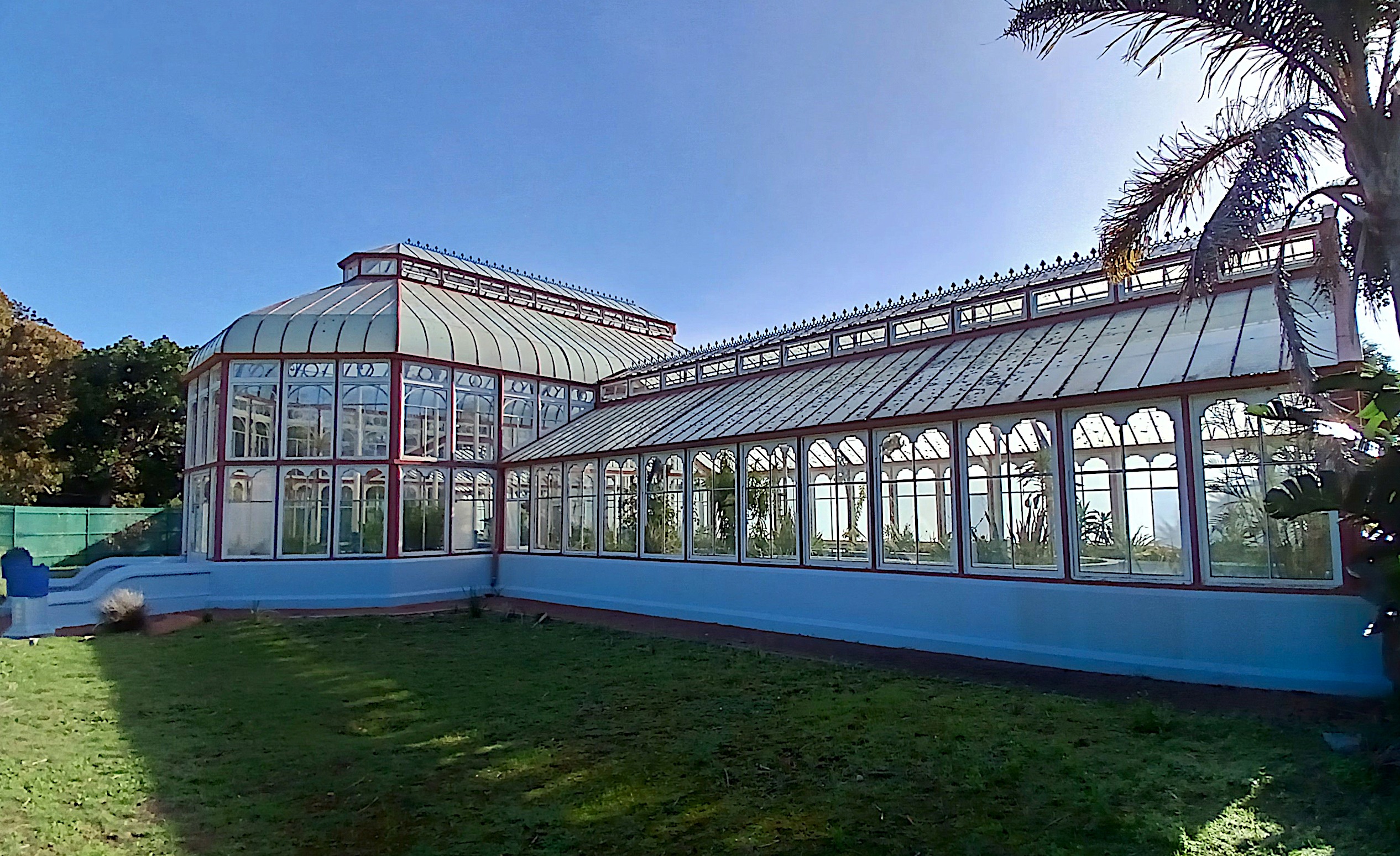
 Erected in 1882, the Pearson Conservatory in St George’s Park was constructed in the UK before being disassembled and shipped to Nelson Mandela Bay in prefabricated sections. (Photo : Riaan Marais)
The term “hidden gem” is often bandied around to the point where it has lost much of its meaning.
I say this knowing that I called a certain historic church in Central Gqeberha a hidden gem not so long ago…
But if you take a walk around Nelson Mandela Bay’s landmark St George’s Park, you may come across a sight that appears to have come off the pages of an old fairy tale.
Dating back more than 140 years, the Pearson Conservatory is a glimpse into the distant past, with its roots not only firmly planted in Gqeberha, but stretching back to its original makers in Paisley, Scotland.
“In recent years we have been trying to revive St George’s Park to its former glory, inviting people to enjoy this historic landmark as much as possible, and the Pearson Conservatory has been one of the crucial assets that has helped us on this mission,” Andre Theron, of the Friends of St George’s, said.
The structure is in essence a large greenhouse, built to house indoor gardens for no other reason but the enjoyment of visitors. But over the years it has become something of a symbol of resilience, standing the test of time despite its fragility and efforts to have it demolished.
/file/attachments/orphans/Pearson6_634209.jpg "Since its completion in 1882, several of the glass panels have been replaced, but the bulk of the steel structure, which was manufactured in the UK before being shipping to Nelson Mandela Bay, remains intact. (Photo: Riaan Marais)")
Before it even had a name, the conservatory was designed and built by Scottish construction firm Boyd & Sons, based in Paisley. It was subsequently disassembled, packed on a boat and shipped to Nelson Mandela Bay.
Under the careful supervision of a representative from the original manufacturer, the steel and glass structure was re-erected, and the erstwhile Commissioner of Works for the Cape Colony, John X Merriman, officially opened the conservatory on 12 September 1882.
It was named after Henry W Pearson, who held many notable political positions in the late 1800s, including mayor of Port Elizabeth (now Gqeberha) from 1871 to 1896.
Despite its whimsical appearance, the structure seems to be fairly simple. It mainly consists of numerous glass panels set into a large steel framework with wooden window panes. But upon closer inspection, the structure is filled with subtle intricate design traits.
/file/attachments/orphans/Pearson2_931594.jpg "After being revamped, the interior of the Pearson Conservatory is being maintained by volunteers. Despite being more than 140 years old, the structure remains intact, a clear representation of greenhouse construction from the 1880s. (Photo: Riaan Marais)")
At the centre of the structure stands a pool which once served as the base of an almost gaudy fountain, with intertwining fishes holding up what looks like a clam shell. It is up for debate whether this would have matched the initial flora planted inside the conservatory, which is said to have consisted mainly of exotic flowers, water lilies and an array of orchids.
On several of the central masts that support the roof of the steel structure there are wheels attached to moving arms that open and close sections of small windows that run along the length of the conservatory.
Where the masts meet the roof, swirls of bent steel were installed for further decoration.
/file/attachments/orphans/Pearson3_338839.jpg "The central masts of the revamped Pearson Conservatory feature decorative swirls. (Photo: Riaan Marais)")
And on the outside, along the ridge of the roof, a series of ornate cast-iron spikes serve as a decorative topping, as well as a deterrent for birds looking for a nesting space.
Through the late 1800s and into the mid-1900s, the conservatory and surrounding lawn were used for public events, family picnics and music performances, and served as the unofficial centre of the park, which was surrounded by the stately manor homes of Port Elizabeth’s business leaders of the time.
However, as time took its toll, the structure started to deteriorate, and in 1972 the city council considered demolishing it. However, arguments against it prevailed and over the following decades it received sporadic attention to keep it intact.
In 2009, architect and design firm The Matrix was contracted to revamp the conservatory and to restore it as close to its original condition as possible. Certain materials were replaced with modern alternatives, and the paint selection was modelled on the original colour schemes as documented in newspaper clippings from the 1880s.
While many of the windows have been replaced over time, it is said that some of them are still the original panes of glass from 1882.
/file/attachments/orphans/Pearson1_423225.jpg "After years of neglect, the Pearson Conservatory reopened to the public in recent years, attracting various groups for tours and special events. (Photo: Andre Theron)<br>")
Most recently, the conservatory was surrounded by a modern fence, and while it unfortunately detracts from the structure’s old charm, it became a necessary addition to keep thieves, vandals and vagrants out of the historic site.
Theron and Friends of St George’s have noted the benefit of having such a unique and charming asset and have used it to attract more people to the park they are trying to preserve.
One of their members, Penny Mowbray, has taken to maintaining the plants inside the greenhouse. Another member, John Whitfield, with the help of residents from the MES homeless shelter, have taken up the task of maintaining the gardens around the conservatory and the broader park.
“On Saturdays we have weekly parkruns and the route is designed to go past the conservatory, and I was surprised by how many people have never seen it before. We’ve also had several local businesses contact us for access to the structure to host meetings and walkabouts.”
But their biggest success came in December 2025 when the Friend of St George’s invited artist Wessel Kotzee to exhibit a collection of his work inside the conservatory.
“We were hoping to get about 300 people at the exhibition, but we eventually stopped counting after 1,500 people showed up. It was such a resounding success and created so much more interest in the park, and specifically in the conservatory,” Theron said.
/file/attachments/orphans/Pearson8_824930.jpg "The Friends of St George’s hosted artist Wessel Kotzee at the Pearson Conservatory in December 2025 to showcase the potential uses of the structure. (Photo : Andre Theron)")
Since then, he said, gardening clubs, book clubs, walking tours and picnics have become a regular occurrence.
“It remains an ongoing project, but the important thing is that the public learns about this beautiful historic site and know that is accessible to everyone,” Theron added. DM
Comments
Scroll down to load comments...