



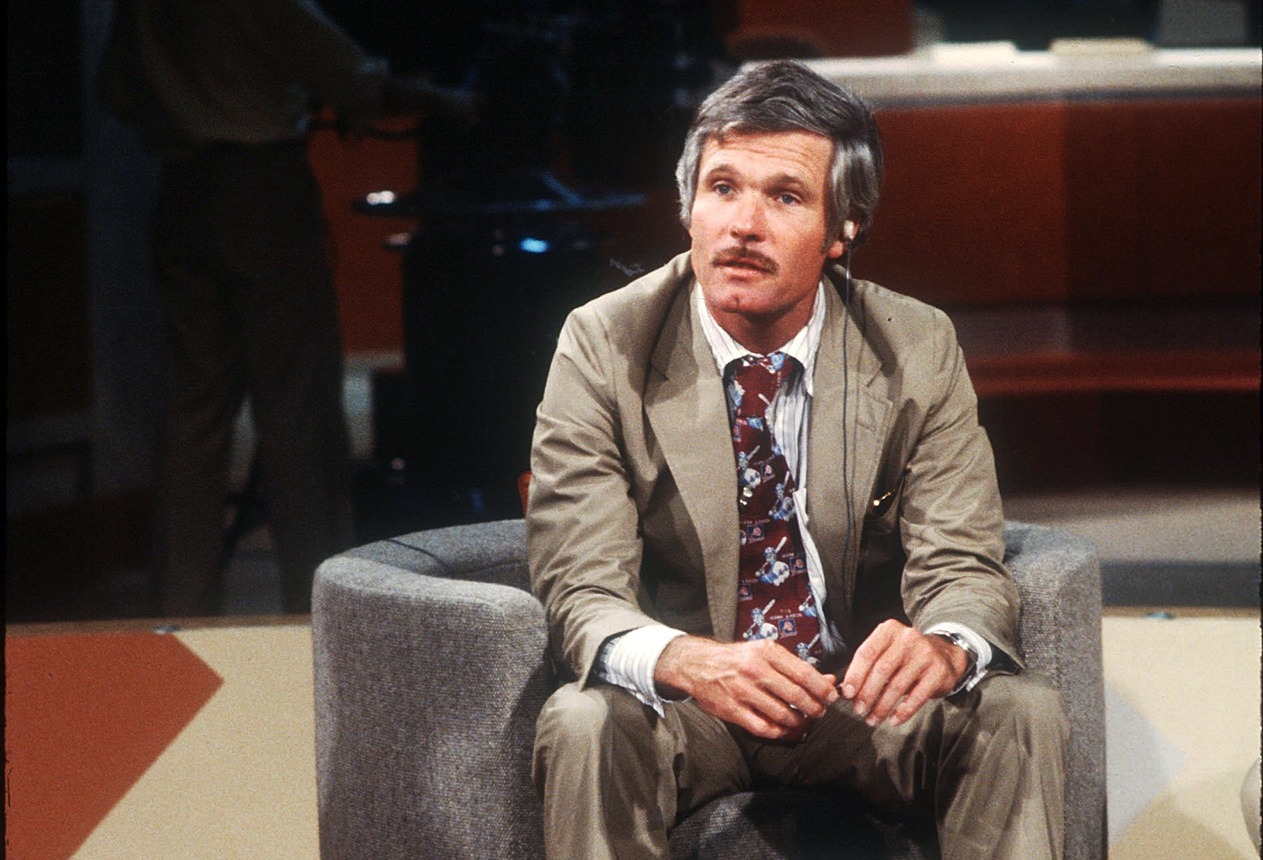
 Ted Turner is interviewed in Atlanta ahead of debuting his 24-hour news channel the Cable News Network in 1980. (Photo: Cynthia Johnson / Liaison)
There are those revolutionary moments in how people receive and process information – and even what that information comprises. Ted Turner’s creation of 24/7 all-news television is one of those key moments that should be grouped with other consequential changes.
Begin with the way a printing press that uses moveable type fundamentally changed the world. Almost 600 ago, in 1455, Johannes Gutenberg, a German craftsman in Mainz, brought together the key parts of a wine press and small, reusable blocks each of which was carved with individual letters that could be reassembled, ad infinitum, to spell different words for different pages. With this, Gutenberg suddenly made redundant those wood blocks of entire pages painfully carved onto the surface of one block.
/file/attachments/orphans/GettyImages-961398236_237761.jpg "Johannes Gutenberg depicted in his workshop with the first printing press. Private Collection. (Photo: Fine Art Images / Heritage Images / Getty Images)")
/file/attachments/orphans/GettyImages-2155185168_559813.jpg "The movable letterpress type A is positioned on the composing table at an antique printing workshop on 5 March 2024 in Cali, Colombia. Gutenberg’s process of letterpress printing involved composing movable types into the bed of a press, inking them and pressing paper against them to create an impression. (Photo: Jan Sochor / Getty Images)")
Woodblock printing had, of course, been in use for centuries throughout Asia to produce volumes of prayers, poetry, guidebooks, pictures and illustrated stories. But with his innovation, Gutenberg launched the printing and sale of books that, until then, had been copied laboriously by hand by monks or scribes.
The near-universal spread of printing also became an important factor in the evolution of nationalism in Europe, Asia and beyond. As anthropologist Benedict Anderson described it, vernacular language newspapers and magazines became crucial in what he termed the birth of the “imagined communities” of modern nationalism.
Some 400 years later there was another major development. In 1844, Samuel FB Morse sent the first telegram – between Baltimore and Washington, DC – which read “What hath God wrought.” Morse’s equipment (and the semaphoric language of dots and dashes he devised) quickly spread telegraphic communication across the US and then internationally, including the laying of a successful trans-Atlantic cable in 1866.
Naturally, not everyone was convinced about the utility of this seismic shift in communication. Essayist and philosopher Henry David Thoreau famously mused: “We are in great haste to construct a magnetic telegraph from Maine to Texas; but Maine and Texas, it may be, have nothing important to communicate…” Clearly not a fan of fast news, was Thoreau.
Despite Thoreau’s demurral, advances in mass communication kept coming. The first glimmers of instant news came in 1883 when the entire world learnt about the massive volcanic eruption of Krakatoa – in the strait between Sumatra and Java – via an international telegraphic cable network. This was the first time a news story went global simultaneously with the event. Krakatoa’s eruption was what economist Frances Cairncross has described as “the death of distance”.
By 1940, the extraordinary live radio broadcasts during Battle of Britain further underscored the implications of the death of distance. In a way no published newspaper could do, CBS Radio correspondent Edward R Murrow delivered broadcasts, live, from London in the midst of the Blitz — sometimes even as he stood in the city’s streets or on a rooftop, observing aerial dog fights and the German bombing of London.
/file/attachments/orphans/GettyImages-73493569_531341.jpg "US broadcast journalist Edward R Murrow and his wife, Janet Huntington Brewster Murrow, covered World War 2 from the CBS wartime office in London. (Photo: CBS Photo Archive / Getty Images)")
Veteran radio journalist, Bob Edwards, later described the impact this way: “Murrow brought World War 2 into the living rooms of American homes [and] it established radio’s place as a legitimate source of journalism.”
But radio – and later, television’s – delivery of news was limited to specific, scheduled times. If you were not home (or in a car if it was via radio) for its apportioned time, you missed it.
Ted Turner — The gambles begin
Turner had grown up in an affluent family; his father owned a successful billboard-advertising company. Turner entered the Ivy League school Brown University but was expelled before graduation. His major was the classics and years later, in interviews, he might quote one of the Roman or Greek writers he had studied. He joined the family business in Atlanta and after his father’s suicide, Turner took over and restored the company to profitability.
Here is where Ted Turner’s great gambles began when he took over the billboard business of his father. But Turner began to move beyond that business and acquired a UHF-TV station in Atlanta with a weak signal and a weaker balance sheet. Ever the gambler, he purchased the floundering Atlanta Braves baseball team and then turned his TV station into a way to broadcast his baseball team’s games nationally as part of a unique sports channel, using the new cable networks reaching American homes.
He obtained control of the entire MGM/UA film library for his Turner Classic Movies channel as well. (He once evoked a storm of protest by colourising several movie classics such as Casablanca.) Early on, he was using satellite communications to beam his programmes to cable companies across the country.
His next big move – or gamble – was creating a 24/7 news channel that remade broadcasting, reportedly taking the leap precisely because more experienced media professionals told him it couldn’t be done.
/file/attachments/orphans/GettyImages-81500812_631355.jpg "Atlanta Braves owner Ted Turner (centre) speaks while former Braves star Hank Aaron looks on during the retirement ceremony for Aaron's Number 44 Jersey at Atlanta-Fulton County Stadium in Atlanta, Georgia, in 1977. (Photo: Tom Hill / WireImage)")
/file/attachments/orphans/GettyImages-90040010_715685.jpg "Ted Turner at his desk in his office at Turner Broadcasting System in Atlanta, Georgia, in 1977. (Photo: Tom Hill / WireImage)")
/file/attachments/orphans/GettyImages-169240155_381286.jpg "Ted Turner ahead of his planned purchase of the entire MGM film library in New York City in 1985. (Photo: Yvonne Hemsey / Getty Images)")
After four years in development, CNN signed on the air on 1 June 1980, with a news telecast anchored by the husband-and-wife team of Dave Walker and Lois Hart. Its mantra was “Go live, stay with it, and make it important”. To demonstrate, the infant network’s intention to reach audiences throughout the world, CNN’s policy was to ban exclusionary words and phrases such as “foreign” and “here at home” from its newscasts.
The world of cable
A word of explanation about cable may be useful. Television cable systems were rapidly proliferating across the US, piggybacking on those utility poles already in place (as opposed to the satellite dishes that became ubiquitous throughout Africa more recently).
US cable companies were aggressively connecting homes into their networks and those companies were teaming up with larger communications companies to deliver products to consumers, bypassing the limitations of the broadcast networks. Turner’s sports channel, his classic films channel and his cartoon channel eventually were on cable systems everywhere in the country.
Turner’s offerings became part of a growing roster proposing dozens, even hundreds, of channels and a variety of content, including everything from the regularly broadcast television networks, to never-ending religious sermons, to fringe political diatribes, to repeats of classic television shows, to hobbyist channels and shows teaching how to prepare signature dishes from foreign cuisines.
/file/attachments/orphans/GettyImages-781744_553250.jpg "Ted Turner risked everything throughout his career: once to start a UHF channel in 1970, again to start CNN in 1980 and then in 1985 to buy the entire MGM film library at a price exceeding its value. (Photo: Yvonne Hemsey / Liaison)")
Turner’s great loves seemed to be taking big business risks to make money, promoting sports, and the news business (besides his well-known love of women and alcohol). Beyond moulding his baseball team into a winning dynasty, training a crew to win the America’s Cup sailing championship and acquiring an expansive library of classic films and cartoons to be shown on cable, his masterstroke became a news channel that would operate, non-stop, twenty-four hours a day.
Turner’s Cable News Network, now universally known as CNN, was not an immediate financial success (or even a journalistic one). It took some years before it actually became profitable, but the idea of bringing live TV news broadcasts to audiences 24/7, 365 days of the year, was unique.
‘Chicken noodle network’
CNN’s media competitors and media critics delighted in calling CNN the “chicken noodle network”, but Turner and his broadcasters had the last laugh.
In 1986, CNN scooped its competitors with live, wall-to-wall coverage of the Challenger space shuttle disaster. And in 1991, CNN again was ahead of the pack with live “in-country” telecasts of the Gulf War.
Covering the battle from both sides of the conflict, CNN’s correspondents – Bernard Shaw, Peter Arnett and John Holliman – became familiar faces on television screens in the US and abroad. CNN actually had the only professional television news team in Baghdad – becoming a live, televised echo of Murrow’s London at Night reports from 1940.
/file/attachments/orphans/GettyImages-1320474_937874.jpg "CNN political anchorman Bernard Shaw became a familiar face on TV in the US and abroad during coverage of the Gulf War. (Photo: Erik S. Lesser / Liaison)")
/file/attachments/orphans/GettyImages-1290485515_444570.jpg "Veteran US journalist Peter Arnett during a live feed for CNN from hotel Al Rashhed during the Gulf War in 1991. (Photo: Kaveh Kazemi / Getty Images)")
CNN’s team in Baghdad was sending live updates from their hotel rooms amid the bombing and strafing of targets in the city as well as reporting on the increasingly unmoored by reality of Iraqi government pronouncements on the war. President George HW Bush later said he had learnt more about what was happening in the war from CNN than from the CIA.
(We should add that in parallel with the development of CNN, the creation of the internet, its TCP/IP standards and the World Wide Web – largely by engineers and computer scientists such as Vint Cerf, Bob Kahn and Tim Berners-Lee – produced the revolutionary technology by which CNN would reach millions more viewers freed from any dependence on cable.)
By now, CNN had been hiring veteran reporters (as well as nurturing a growing cadre of savvy correspondents and presenters) such as Daniel Schorr, Wolf Blitzer, Catherine Crier, Mary Alice Williams, Christiane Amanpour and Paula Zahn. These were people who could be assigned globally or ready to be deployed in a metaphorical heartbeat to a natural disaster or conflict – and their standing gave CNN increasing credibility.
/file/attachments/orphans/GettyImages-461749653_896979.jpg "CNN journalist Christiane Amanpour in 2014. (Photo: Michael Kovac / WireImage)")
Then there was that famous station ID voiceover – “This is CNN” – intoned by James Earl Jones with his sonorous voice. CNN also snared Larry King to do a daily interview show with the fascinating, the rich, the famous, and the infamous. In 2013 the channel started adding documentary and reality television programmes to its schedule, notably Anthony Bourdain: Parts Unknown (2013–18), an award-winning travel show hosted by the late chef.
As home and hotel satellite dishes spread around the world, millions of people beyond America were finding CNN to be a go-to source of news as well. Over the years, a whole raft of competitors in the all-news space have become available, including the BBC, Al Jazeera, Russia Today (now RT), China Global TV, NHK International and various European news channels, among others.
The bouquet of news media by satellite, cable and online is now a vast landscape of possibilities, but it is a landscape born of Turner’s inspiration in creating CNN. CNN was the model – with its flashy graphics, and the periodic repetition of material with additional content added in a continuing flow as events develop.
/file/attachments/orphans/GettyImages-1682421_592381.jpg "Ted Turner, chairman of the board of the United Nations Foundation, at UN headquarters in 2022 to celebrate the five-year anniversary of his $1-billion pledge to support the foundation. (Photo: Spencer Platt / Getty Images)")
/file/attachments/orphans/GettyImages-1543540_706173.jpg "Ted Turner receives an honorary degree from Morehouse College in Atlanta in 2002. (Photo: Erik S Lesser / Getty Images)")
/file/attachments/orphans/GettyImages-3255830_285931.jpg "Ted Turner (third from left) is surrounded by his family at a ceremony honouring him with a star on the Hollywood Walk of Fame in Hollywood in 2004 (Photo: Vince Bucci / Getty Images)")
CNN’s never-ending cycle
The key attribute of CNN’s style, content and what Turner demanded of it has been to make news immediate, compelling and intense – with breaking news feeds addressing that FOMO on the part of many viewers.
An unintended result of this unending news stream makes everything seem immediate, urgent – and addictive. A drum beat of wars, invasions, famines, pestilences, fires, floods, tsunamis, riots, killings, presidential decrees and miscues or worse are delivered without let-up.
They are reinforced by those chyrons crawling across the bottoms of screens and frequent breaking-news crossovers. Collectively, 24/7 all-news broadcasts can contribute to a sense the world is aflame as we are perched precariously upon the lip of a volcano. Maybe Thoreau was on to something after all?
Regardless, though, this is the world we live in, and there is no turning back unless we escape into the contemporary version of Thoreau’s Walden Pond and woods.
Turner was fond of saying CNN would be on the air unless the satellites fell out of the skies or the world comes to an end, and then CNN would be there to report that.
CNN’s language versions – in English, Spanish, and Arabic – now come to viewers by cable, satellite dish or online streaming, and it is virtually impossible to calculate the cumulative impact of CNN, as well as all the other news channels and, now, social media in all its forms – all of them competing for viewers’ time and attention, but delivering constant mental body blows.
This is the world Ted Turner was midwife to. Eventually, though, his attention (and his control over CNN) turned from the media empire he had willed into being, as CNN became an element in increasingly larger corporate structures.
Ted Turner turns to peacemaking
/file/attachments/orphans/GettyImages-143581283_314950.jpg "(From left) Executive producer Sir Jeremy Isaacs, Ted Turner and former president of the Soviet Union Mikhail Gorbachev attend a screening of Cold War: The Complete Series in New York City in 2012. (Photo: Matthew Eisman / WireImage)")
/file/attachments/orphans/GettyImages-458304216_578195.jpg "Ted Turner at the 2014 Global Leadership Dinner in New York City in 2014. (Photo: Jemal Countess / Getty Images)")
/file/attachments/orphans/GettyImages-518297804_503999.jpg "Ted Turner was honoured at Unicef's Evening for Children First in Atlanta, Georgia, in 2016. (Photo: Ben Rose / Getty Images for Unicef)")
Instead, he turned his abundant energies towards encouraging global peace, conservation and environmental defence. He donated a billion dollars of his own fortune to the UN Foundation in support of global peace initiatives such as the Nuclear Threat Initiative. He consolidated vast holdings of open land in the state of Montana, where he nurtured a herd of 50,000 American bison, a species that was close to extinction despite being the iconic Great Plains animal species.
And, reaching back to sports, for a decade, he sponsored the international Goodwill Games to address the divisions of the Cold War. He even co-created and co-wrote an animated children’s series, Captain Planet and the Planeteers, centring on teenaged environmental activists.
And lest we forget – how could we forget – he courted and married actress Jane Fonda as his third wife, after a lifetime of polyamorous behaviour, some serious drinking and often outrageous public behaviour. Amazingly, his and Fonda’s connection remained even after their marriage ended after a decade and despite their ostensibly diametrically opposing political views.
Ted Turner was a one-of-a-kind modern media pioneer. He created a new way we would come to engage with events in the world – and the reality of global all-news television is his undisputed legacy. DM
Comments
Scroll down to load comments...