




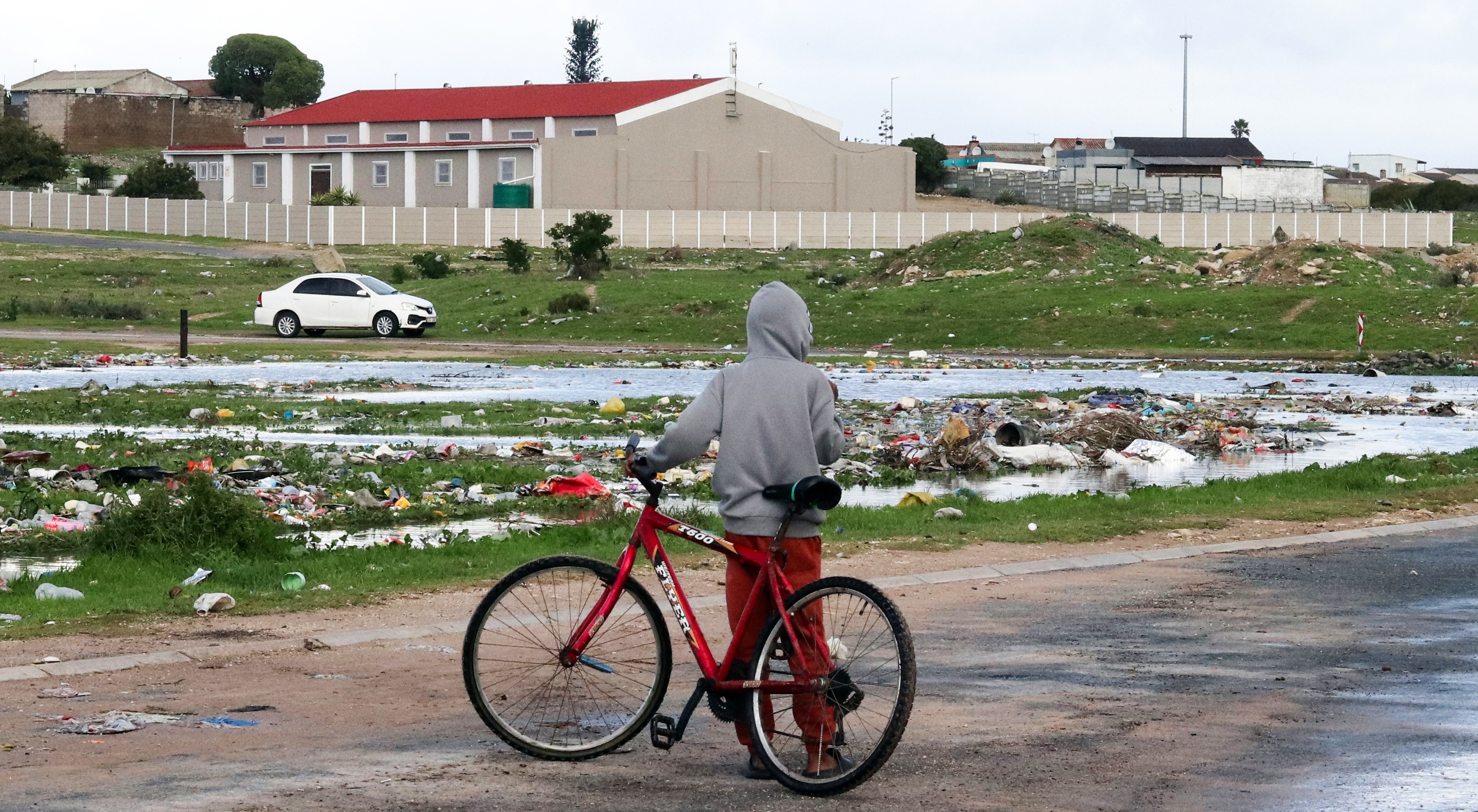
 A young boy looks at the flooding in the Middlepos informal settlement in Saldanha, Western Cape, on 26 June 2025. (Photo: Kristin Engel)
 /file/dailymaverick/wp-content/uploads/2025/10/label-Op-Ed.jpg)
The claim that “the boy child is being left behind” has gained increasing traction in public discourse. Yet, as it is currently used, the phrase obscures more than it reveals. It suggests a passive process of exclusion, without naming the systems, norms and institutional design choices that actively produce that exclusion.
The question is not whether boys are being left behind. The question is: Left behind by what, and by whom?
Practical evidence, particularly from the Nelson Mandela Children’s Fund’s multi-provincial programmes, reveals that boys do not disengage from support systems out of indifference or resistance. Instead, they are excluded because these systems are not designed to accommodate their vulnerability.
Across education, child protection and mental health services, boys are systematically socialised into forms of masculinity that demand silence, endurance and control. Emotional expression is framed as weakness. Help-seeking is stigmatised. Disclosure is rendered socially costly. In this context, the absence of boys from support services is not evidence of resilience. It is evidence of structural failure.
This failure is not incidental. It is produced at the intersection of patriarchy and institutional design. Boys are simultaneously positioned as potential perpetrators of violence and denied recognition as recipients of harm. As a result, interventions often engage boys only at the point of discipline or correction, rather than at the point of care, prevention or healing.
The consequences are predictable.
Boys who experience violence without access to safe processing spaces are more likely to externalise that harm through aggression, disengagement or self-destructive behaviour. In school this manifests in behavioural responses that are disciplined rather than understood. Boys are suspended, excluded or criminalised, effectively pushed out of systems that could have served as sites of intervention. The trajectory from unaddressed harm to reproduced violence is not inevitable, but it is structurally patterned.
Programme-level data disrupts the persistent myth that boys do not speak. Within gender-inclusive interventions, boys disclose at significant rates when conditions of trust, safety and non-judgement are intentionally constructed. In one such programme, 66 of 114 recorded child protection cases were reported by boys. This is not a marginal figure. It is a clear indication that the issue is not boys’ unwillingness to speak, but the absence of spaces that make speaking possible.
Silence, in this context, is not a personal choice. It is an institutional outcome.
What shifts this dynamic is not rhetoric, but programme architecture. Interventions that are effective do not treat boys as a homogeneous risk category. They engage masculinities as sites of intervention. They create structured, facilitated spaces in which boys can interrogate identity, emotion and power without punitive framing. They connect these spaces to psychosocial support systems, to community-level norm change and to co-educational engagement with girls.
This is not an additive exercise. It is a reconfiguration of how violence prevention is understood.
The evidence emerging from interventions such as O.U.T.T.R.A.G.E.D in Tembisa illustrates this clearly. Boys identified as perpetrators of bullying traced their behaviour to unresolved grief and exposure to violence. Within facilitated spaces, these same boys reported shifts towards nonviolent forms of expression. The outcome was not simply behavioural compliance, but a reorientation of identity. In one cohort, this translated into a measurable reduction in suicide attempts among participants.
What is being produced here is not only individual change. It is the disruption of a relational system in which harm circulates between boys, girls, families and communities.
This is why the framing of boys’ inclusion as a diversion from girls’ empowerment is analytically weak. It misunderstands the relational nature of gender-based violence. Girls’ safety cannot be secured in isolation from the socialisation of boys. Nor can boys’ wellbeing be addressed without engaging the structural conditions that shape gendered power.
A feminist approach to violence prevention does not rank whose suffering matters more. It interrogates the system that produces harm and asks what interventions are required to transform it.
From this perspective, engaging boys is not a concession. It is a necessary extension of gender justice work.
The implications for policy and programming are immediate. Investment must shift towards interventions that are multi-level and integrated: safe spaces for boys, co-educational programming, caregiver engagement and strengthened referral systems that recognise boys as legitimate recipients of care. Equally, institutional actors such as schools, social workers and law enforcement require training that is explicitly gender-responsive to boys’ experiences of violence.
Without this, the cycle remains intact: boys are harmed, unsupported, disciplined, and later reappear in systems as risks to be managed rather than children who were failed.
The language of “leaving boys behind” is therefore insufficient. It implies a gap that can be closed through inclusion alone. What is required is more fundamental. It is a rethinking of how child protection systems conceptualise vulnerability, how they engage power and how they allocate care.
Boys are not absent from these systems because they do not need them. They are absent because the systems have not been built to recognise them.
Until those changes are made, the question will persist, not as rhetoric, but as a structural indictment: who is being protected, and who remains invisible within the architecture of protection? DM
Aluta Sneke and C Anzio Jacobs are with the Nelson Mandela Children’s Fund’s Child Safety and Protection programme.
International Day of the Boy Child is on 16 May 2025.