



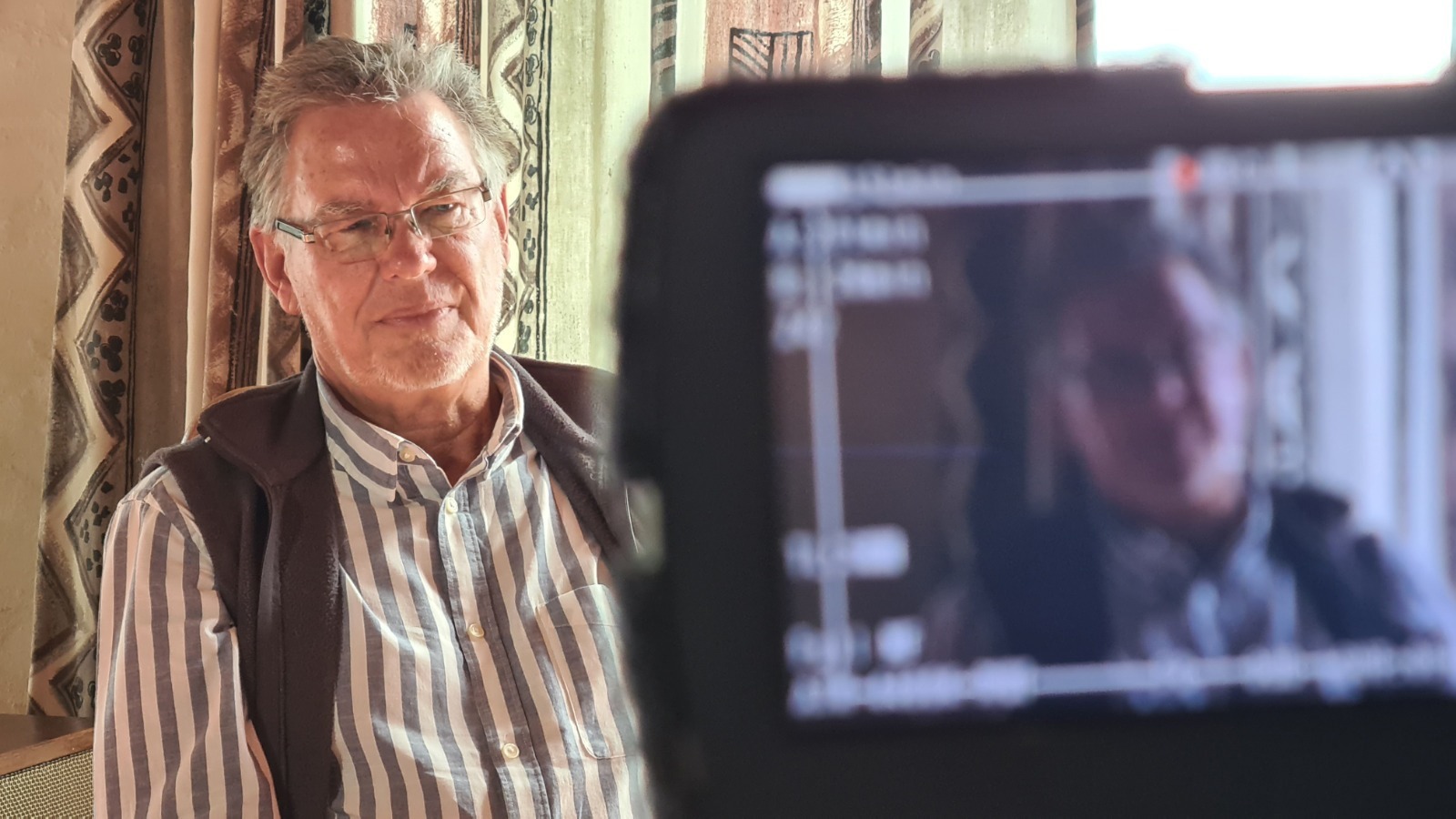
 Filming Horst Kleinschmidt for Mark Kaplan’s Untold Courage. (Photo: Grey Matter Media)
Kleinschmidt’s confession opens the film. It’s accompanied by a challenge from Mark Kaplan to open the archive box file that frightens Kleinschmidt the most, which turns out to be the box that contains information on his Nazi father.
Untold Courage is made up of interviews focusing on three political activists: the late Beyers Naudé, Cedric Mayson and the surviving Horst Kleinschmidt, all of whom were members of the Christian Institute of Southern Africa.
“It’s the story of three men who formed an underground group which provided a critical link between the internal resistance and the ANC in exile.”
Originally conceived as a single film, it developed into a four-part documentary series. “It’s a tale of secrets and sacrifice during the anti-apartheid struggle that reverberates into our present.”
Behind Untold Courage is Kaplan, an award-winning South African documentary filmmaker whose work is devoted to addressing social and political issues around human rights.
The approach – shrinking the distance
Filmmakers are often on the outside of the narrative looking in, operating as conduits for their subject matter. Kaplan is unusual in this regard. He is both a conduit and has had first-hand experience of his subject matter, having been detained in solitary confinement, interrogated and later deported from apartheid South Africa for his work supporting activist media training.
Untold Courage was almost six years in the making. The film represents a culmination of the gradual shift in Kaplan’s approach to filmmaking and interviewing. Originally, he was very reliant on a team, but out of necessity he has found himself filling numerous roles as opposed to just directing.
Another shift was freeing himself from what became the “restrictive” rigours of classical interviewing – the idea that you need to show two sides (à la the BBC template), which he likens to “an argument in a court case” and one he grew critical of.
“Supposedly in the name of balance in the early days we were expected to give two sides to every story, whereas, of course, there a multiple sides and complex layers to be explored and brought to light.”
Kaplan explains that the building of trust has meant “sharing who I was and why I was interested in that topic”. But, as important was an understanding of why someone was willing to go on camera at all. What was the motivation, for example, of a perpetrator in coming forward to admit to some atrocity or another?
“I’m comfortable in the grey areas,” Kaplan says. “And what I try and inject into my films is a kind of quietness, a gentleness.”
However, Kaplan’s approach “does not include any attempts to beguile”, especially given that some of his interviewees have been “apartheid killers, for example, or they’re right-wing fascists”.
“Untold Courage was an opportunity for me to use a more reflexive mode of storytelling and bring myself into the story, but I chose not to”, he said. “The temptation was there because Horst’s own journey had many features in common with my own.”
‘Uncovering things’
Regarding the intentions of Kaplan’s films: “It’s not healing,” he says of a term that has insinuated its sticky self into every cell of 21st-century living. Rather, Kaplan’s films are about “uncovering things” and working “with some sense of acknowledgment”, which may or may not lead to healing.
Kaplan’s filmmaking, like his activism, is intimately tied up with wanting to be on the “right side of history” and having a reason to get up in the morning.
Responses to his films included objections to Between Joyce and Remembrance around the death of a young black activist Siphiwo Mthimkhulu for being made by a white man, with the press accusing Kaplan of “reawakening old wounds”.
Ironically, “the family never questioned one thing that I did”, Kaplan points out. In fact, Joyce Mthimkhulu, Siphiwo’s mother, “took me on 100% trust”.
Kaplan firmly believes that films take on their own lives. The making of Between Joyce and Remembrance ultimately resulted in finding Siphiwo’s bones, allowing the family to mourn and lay him to rest.
When his film Betrayal came out in 2006, people questioned why he was calling the film Betrayal. His reply: “Because it is a story of multiple betrayals and cover-ups.”
Further criticism came in response to the text that appears right at the beginning of Untold Courage. It reads: “From the mid-1970s onward, hundreds of people from the perpetrator class joined the struggle to overthrow apartheid and help build a non-racial, more just South Africa.”
Some viewers who found the film powerful and pertinent rejected the idea of white people as coming from a “perpetrator class” outright. But Kaplan stands his ground on this.
Other criticisms were that Kaplan showcased exceptional whites but failed to do the same regarding their opposite, without acknowledging his inclusion of Security Policeman Paul Erasmus.
/file/attachments/orphans/BehindthescenesofPaulErasmusinUntoldCourage_GreyMatterMedia_476761.jpeg "Behind the scenes of Paul Erasmus in Untold Courage. (Photo: Grey Matter Media)")
Kleinschmidt and Erasmus
Of his relationship with Kleinschmidt, Kaplan says: “I’ve never worked with anyone who was so cooperative, open and trusting of me.”
The connection between the two men is profound. Both were incarcerated, Kaplan at Caledon Square in Cape Town, Kleinschmidt at John Vorster Square; both had the same brutal interrogator – Johannes Petrus “Spyker” van Wyk, a notorious South African Security Branch officer widely associated with the torture of anti-apartheid activists over 30 years. And although Kaplan is of a different generation to Kleinschmidt, both are outsiders.
The dark heart of Untold Courage is the chilling interview by Kleinschmidt with his previous tormentor, Paul Erasmus, a South African security police officer who was tasked with monitoring and harassing the White Left as well as being known for his work in “Stratcom” (Strategic Communications).
A tremor of discomfort seemed to pass through the audience when Erasmus came onto the screen and describes how he was given 15 names on a kill list, which included Beyers and another reverend, Frank Chikane.
The interview works as a powerful counterpoint to the empathy of the three other interviewees and Kaplan. You can’t help wondering about the cost to Kleinschmidt’s psyche of once again finding himself across the floor from his persecutor, and you marvel at his composure, given that there is not a hint of apology in sight from Erasmus.
Kaplan didn’t expect Kleinschmidt to get an apology. He ties Erasmus’s lack of apology to the man’s background: “This is what he was exposed to. This is what he believed. He didn’t question it. And all the people around him never questioned it either.”
You may also wonder what drove Erasmus to appear in the film. Kaplan’s explanation is that Erasmus’s agreement to be interviewed, like many of his ilk, “is often driven by some sense of pique, of being pissed off with their bosses… pissed off with the politicians whose bidding they did. And they got hung out to dry. They were used and discarded.”
That said, Kaplan reminds us that Erasmus brought about 500 different cases to the Truth and Reconciliation Commission, for which we do owe him an acknowledgment.
Making the film
There’s been an internal psychological shift from black-and-white thinking to areas of grey.
Of his younger self, Kaplan confesses: “While in exile I used to think, if I had the opportunity, I’d line these buggers up against a wall and shoot them.” But in the process of making films he’s had to “rethink… with a touch more kindness and humanity. They equally wanted to line me up against a wall and shoot me.”
This shows up in trying to understand Erasmus: “Whereas I was very fortunate, I had a very different kind of background. But how different would I have been if I had had his upbringing?” he asks. “The perpetrator is not just found in another, but also, at least potentially, inside of ourselves.”
Untold Courage is true to Kaplan’s modus operandi of making vivid, moving stories about the transmission of trauma from generation to generation.
That said, Untold Courage doesn’t provide neatly boxed answers. Instead, the film generates more questions. It is also a profound tribute to flawed and remarkable human beings who followed the call of their conscience and, in the process, made mistakes and paid a huge personal cost for their deep, unshakeable belief in Justice for All.
In addition to Kleinschmidt and Kaplan, the other key person who made the series as powerful as it is, is editor Tiny Laubscher, whose attention to detail is masterful.
The richness and variety of the archive, from apartheid-era propaganda footage, personal photographs, drawings, pamphlets and letters, as well as Kaplan’s own archive of filmed material dating back 30 years, have been skilfully woven into a rich and layered tapestry of images and sounds that catapult the viewer back into lived experiences.
For a younger audience, the archive brings the past into the present, providing continuity.
This is what lies at the core of Kaplan’s film, and it feels vitally important that it is seen, particularly by the younger generation, as a reminder of our shared history. Like many children of activists, Kleinschmidt’s and Mayson’s children were robbed of their childhood. Horst felt the theft acutely; he and his daughter were robbed of a real relationship, and its consequences continue to reverberate, as is evidenced when Janet Love’s daughter said: “Of course we feel angry, of course we feel betrayed.”
“I think there’s some degree of hope in the outrage,” says Kaplan.
Believing in its importance to younger generations, there is an initiative to pilot Untold Courage to government schools in the Western Cape. Westerford High School has taken up the offer under the guidance of history teacher Gordon Brookbanks, who is currently temping for a teacher on maternity leave. Interestingly, Brookbanks is an ex-spy whose handler was the infamous Craig Williamson.
Untold Courage speaks to the current generation, for as the Xhosa proverb says: “Umntu akazazi apho aya khona engazi apho aphuma khona.” Translated, it means: “A person cannot know where they are going without knowing where they come from.”
Untold Courage is a vital opportunity for all South Africans to revisit their history and be informed and guided by its consequences and perhaps to navigate a more informed future. DM
The next screening is on Sunday, 31 May at Urban Brew Studios, Gauteng. By invitation, with lunch and beverages provided. If interested, contact: mark@greymattermedia.co.za
Comments
Scroll down to load comments...