




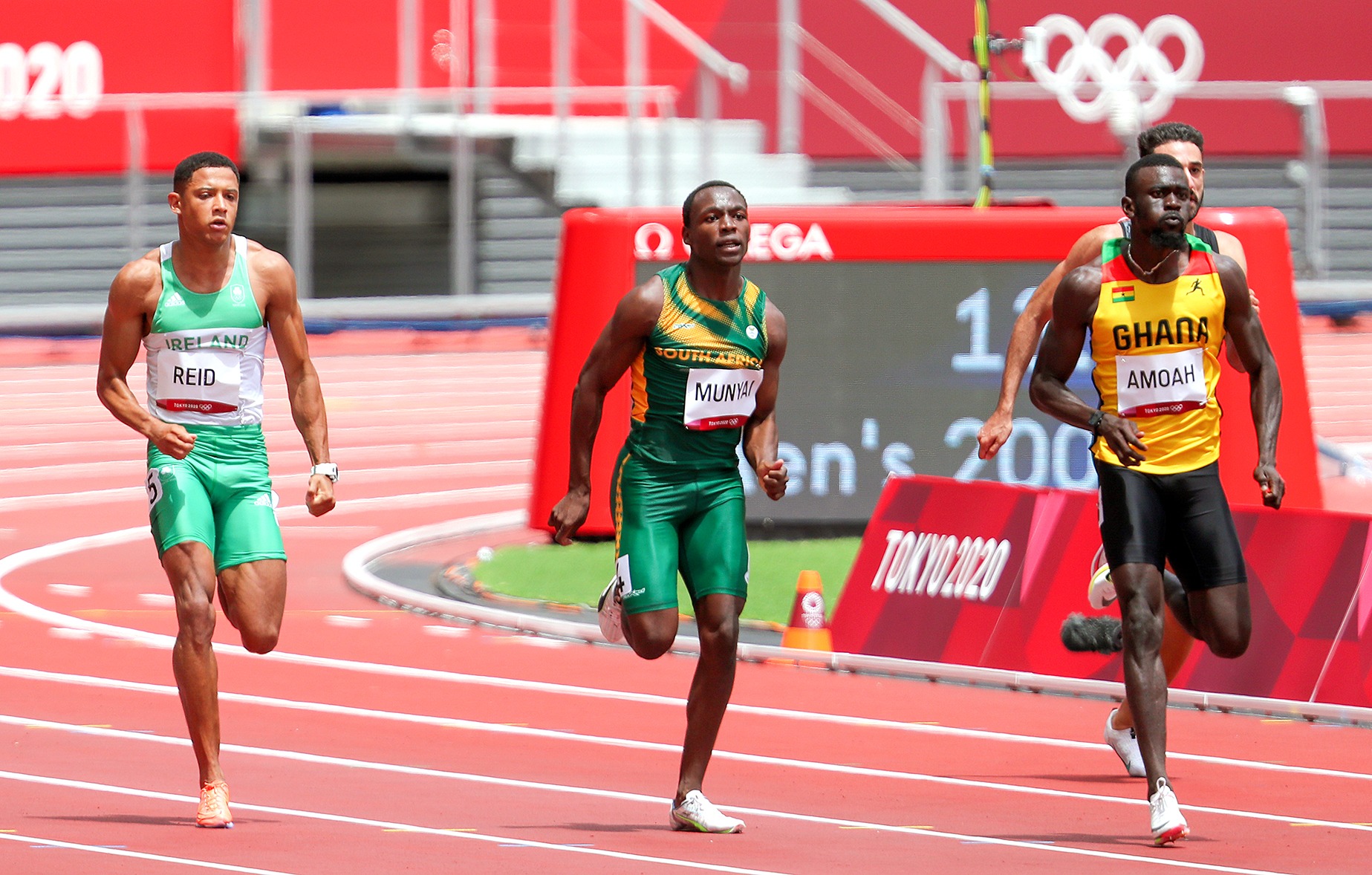
 Clarence Munyai of South Africa (centre) in the heats of the mens 200m during the Tokyo 2020 Olympic Games. In January 2026 Munyai announced his intention to participate in the Enhanced Games. (Photo: Roger Sedres / Gallo Images)
 From the 1950s to 1980s, East Germany and other Eastern Bloc nations ran systematic state-sponsored doping programmes designed to manufacture Olympic dominance.
Athletes were fed anabolic steroids under strict secrecy. Decades later, some of the clearest evidence of how those programmes operated emerged through documents uncovered and published by Brigitte Berendonk and her husband Werner Franke.
Even today, those records remain among the most detailed insights into the effects of systematic doping. While modern researchers do conduct some controlled studies on performance-enhancing drugs, they cannot ethically recreate the prolonged, high-dose regimens used during that era.
/file/attachments/orphans/GettyImages-2164772930_866184.jpg "Benjamin Proud of Great Britain (right) competes in the Men's 50m Freestyle Heats at the 2024 Paris Olympics. Proud is one of several high-profile athletes to have joined the Enhanced Games. (Photo : Quinn Rooney / Getty Images)")
Now, the controversial Enhanced Games could present an opportunity to expand on that body of knowledge, but its lack of transparency has reduced it to an entertainment and commercially driven event. This is according to Professor Ross Tucker, a renowned South African sports scientist.
“Ethically, morally and medically, there would be concerns at the best of times, but there would still be certain interesting things that you could learn from it,” Tucker told Daily Maverick.
The Enhanced Games is a competition designed to disrupt sport by pushing the limits of human performance with the aid of banned performance-enhancing drugs. These include testosterone, growth hormones, anabolic steroids and EPO.
According to Tucker, if the organisers were truly transparent, as they claimed to be, and were documenting very specifically what athletes were taking, in what quantities and how it affected performance, there could at least be an argument for the games’ scientific value.
But the organisers are not doing that. Therefore, it was “just a front for selling drugs to people who don’t need them”, said Tucker.
“It’s not even about sports,” he said. “It’s just a grift, and they’re using athletes to promote anti-aging drugs. That’s their objective.”
The Enhanced Games explained
The Enhanced Games were founded in 2023 by Australian entrepreneur Aron D’Souza and are backed by Donald Trump Jnr and billionaires Peter Thiel and Christian Angermayer.
On its website, the Enhanced Games called itself a “global movement” integrating “scientific advancement with elite athletic performance” to explore the possibilities when athletes are “supported by medical oversight and personalised protocols”.
The inaugural event takes place on 24 May in Las Vegas in a purpose-built arena, where 50 athletes will compete in front of a crowd of 2,500 invitation-only spectators.
Both enhanced and non-enhanced athletes will compete in weightlifting, swimming and track events for lucrative prize money.
Athletes can earn $250,000 (about R4.2-million) for winning an event, while bonuses of $1-million (roughly R16.5-million) have been promised for world records in events such as the 100m sprint and 50m freestyle.
The money is a major draw for athletes in sports where earnings are often limited.
Organisers say competitors will be medically monitored and may only use clinically approved substances.
Several high profile athletes have signed up to be guinea pigs, including British swimmer and Olympic silver medallist Ben Proud and multiple Olympic medallist Fred Kerley, one of the world’s top sprinters.
In January, SA was left reeling when one of its own, Clarence Munyai, signed up to compete. Munyai is a two-time Olympian and set the current 200m national record in 2018.
According to reports, Munyai will be participating as a “natural” or “clean” athlete.
A collective stance
Even so, international sporting bodies have taken a firm stance against the event.
In 2025, World Aquatics introduced a new bylaw stating that any individuals who “support, endorse or participate” in events by promoting and practising the use of prohibited substances would be ineligible to compete in or hold positions within World Aquatics.
Similarly, the World Anti-Doping Agency (Wada) condemned the Enhanced Games as a “dangerous and irresponsible concept” that jeopardises athlete wellbeing for entertainment and marketing purposes.
“Wada warns athletes and support personnel who wish to participate in sport regulated by the World Anti-Doping Code that if they were to take part in the Enhanced Games, they would risk committing anti-doping rule violations under the code,” said the organisation.
/file/attachments/orphans/GettyImages-2165291779_283444.jpg "Fred Kerley is one of the world's top sprinters. Kerley won silver and bronze medals in the 100m sprint at the Tokyo 2020 and Paris 2024 Olympic Games. (Photo: Andy Cheung / Getty Images)")
Daily Maverick asked Athletics South Africa (ASA) about its stance on the games and Munyai’s participation.
“Our stance is the same as that of our mother body, World Athletics,” said ASA spokesperson Sifiso Cele in a message.
Chief Executive of the South African Institute for Drug-Free Sport (Saids), Khalid Galant, said the Games appeared more focused on “shock value” than sport.
“It’s certainly bizarre and it goes against the grain of not only what Saids stands for, but also the spirit of sport and protecting the safety of the athlete,” said Galant. “From Saids’ perspective, we have voiced our concern and opposition against it. There’s no grey area; it’s a race to the bottom.”
Galant also warned about the message it could send to young athletes, especially in SA’s high-pressure school sports environment.
Outdated systems?
One of the Enhanced Games’ main claims is that anti-doping systems are outdated and ineffective.
“It’s analogous to the traffic department saying they can’t catch people speeding, so they’re taking away speeding limits,” said Tucker. “Anti-doping currently is the thing managing doping, because it puts constraints on athletes and limits as to how much they can get away with.
“Where it causes negative problems and confusion is when athletes get caught for things that you’re almost certain they didn’t take for performance enhancements. Accidental doping, contaminated supplements, stuff like that undermines anti-doping’s credibility because you’re catching the wrong people.
“But as I say, the anti-doping system, even if it doesn’t always catch dopers, it’s still regulating doping.”
Moreover, traditional sports are built on the ideal of fair competition, where victory is earned through natural talent, hard work and skill, not external chemical advantages.
The biohacking movement
So how much do performance-enhancing substances assist athletes anyway?
Well, according to Tucker, where dopers have been caught, the suggestion is a 1%-3% improvement. He gave the example of if an athlete ran the 1,500m event, 3% would equate to an approximately seven-second improvement.
“That’s the difference between not even going to the Olympics and winning the Olympics,” he said.
But those gains also come with risks.
Historically, there have been clusters of cycling deaths linked to EPO use, such as reports of 20 young Belgian and Dutch riders dying in unexplained circumstances between 1987 and 1990, and a further eight from 2003-2004.
Additionally, the autopsy of bodybuilder Rich Piana, who died at the age of 46 in 2017, showed that his heart and liver weighed twice the average amount, possibly caused by heavy steroid use.
“In the absence of a ceiling, these drugs can be very dangerous,” said Tucker.
/file/attachments/orphans/5557656_935506.jpg "James Magnussen was the first athlete to publicly sign up for the Enhanced Games. The Australian is a former Olympic swimmer, who holds some of the fastest 100m freestyle times in history. Magnussen retired in 2019 having won a silver and a bronze at the 2012 Olympics. (Photo: EPA / Patrick B Kraemer)")
From the start, D’Souza was transparent about the project’s ultimate goal, which was to “cheat death”.
“When an athlete breaks the 100m world record, demolishes it, openly using performance enhancements, the first question everyone is going to ask is what is he on? And how can I get it?” said D’Souza.
As Tucker said, this goes beyond the games. Organisers and investors see the biohacking movement as the business explosion of the next decade, with elite athletes acting as a concept of proof.
The Enhanced Games website already markets products including personalised testosterone therapy, sermorelin for sleep and low-dose tadalafil, the erectile dysfunction medication often playfully referred to as “the weekender” for a better pump at the gym.
Both Galant and Tucker warned that making such products commercially appealing to the public could be dangerous.
“Everybody is different. Everybody reacts to medication differently,” said Galant. “It all depends on your physiological profile and pre-existing conditions.”
Unlike Fred Kerley, a young, healthy, high-performance athlete who is likely to have several people advising, monitoring and scrutinising him, these are protections “ordinary” people might not have.
“If their subscription model works, and 1,000 people are motivated to buy testosterone, growth hormones and other drugs, among those thousands of people, there’s going to be people with heart problems, kidney issues, risks of problems developing,” said Tucker. “They’re not going to have the same quality of medical advice, and then the biohacking becomes dangerous to normal people.”
The Enhanced Games claims it does not disclose athletes’ exact drug regimens to prevent imitation. Arguably that falls flat with its broader marketing already encouraging experimentation far beyond elite sport.
Enhanced Games are nothing if not opportunistic, and they have seized the moment. Whether they ultimately reshape elite sport or collapse under the weight of controversy, only time will tell, but it has already created a stir that is too large to ignore. DM