



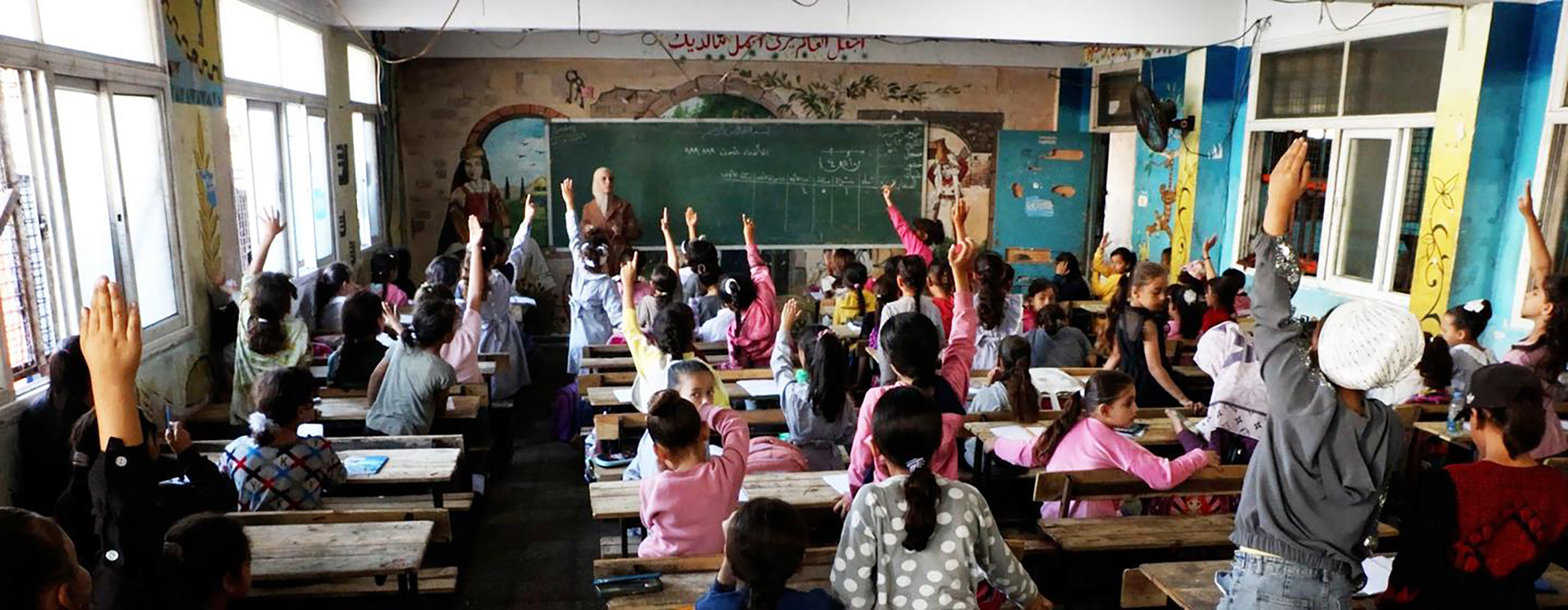
 A teacher engages with students in one of the few classrooms left intact in central Gaza. (Photo: UN News)
 /file/dailymaverick/wp-content/uploads/2025/10/label-Op-Ed.jpg)
The media’s silence on Gaza can lead you to think that all is now well. Even though the ceasefire between Israel and Hamas has stopped the worst of the bombardment, the suffering has not ended. Israeli military attacks are still killing Palestinians, including children, in numbers.
The recently released EU, World Bank and UN Final Gaza Rapid Damage and Needs Assessment observed that the population of the Gaza Strip is experiencing significant, direct and long-term impacts on their health, economic stability and psychosocial wellbeing. Nearly 1.9 million people have been displaced, many repeatedly. More than 1.2 million Palestinians in Gaza, about 60% of the population, have lost their housing.
Drone footage shows the extent of the devastation. The assessment notes that 24 months of escalated hostilities caused catastrophic levels of infrastructure damage and destruction, and the total recovery and reconstruction bill is estimated at $71-billion over the next decade.
Physical infrastructure damage is assessed at $35-billion, alongside $2-billion in economic and social losses, with housing, health, education, commerce and agriculture among the hardest-hit sectors.
More than 370,000 housing units and nearly all schools have been destroyed or damaged. More than half of the hospitals are not functional and the economy has contracted 84%. Human development in Gaza has been set back 77 years.
The UN Relief and Works Agency for Palestine Refugees in the Near East has also published its situation report. Its teams observed an increase in ectoparasitic infections and chickenpox, alongside challenges in securing medication and pesticides.
These risks have been exacerbated by overcrowding, deteriorating wastewater systems, shortages of hygiene supplies and restrictions on the entry of chemical products.
Throughout this war, the sound of children filing into classrooms has been absent. Formal schooling has largely ground to a halt, affecting an estimated 625,000 to 700,000 children. The reality is that an entire generation is facing an interrupted education, with no clear end in sight.
The scale of the disruption is staggering. The buildings that once served as centres of learning have been repurposed out of necessity. The agency reports that 83 of its school buildings are now functioning as collective shelters, housing about 75,000 displaced people.
Against this backdrop, the agency teachers have refused to abandon their students entirely. Since early 2026, they have been providing some form of instruction, online or other, to more than 68,000 children in makeshift and temporary spaces. It is a remarkable effort, but it represents only a fraction of the hundreds of thousands still left without access to any education.
Competing narratives
The debate over Israel’s military campaign in Gaza reveals a sharp divide between those who argue that it constitutes genocide or violates just war principles, and those who defend it as a legitimate act of self-defence.
On one side, UN Special Rapporteur Francesca Albanese concluded there were reasonable grounds to believe Israel’s campaign met the threshold for genocide. She points to the overwhelming death toll, systematic destruction and deliberate undermining of international humanitarian law.
This view is reinforced by just war analysis showing Israel failed key criteria such as disproportionate force, failure to exhaust diplomatic options and the dehumanisation of Palestinian civilians.
On the other side, Per Bauhn, a professor of practical philosophy at Linnaeus University in Sweden, firmly represents the Israeli position, arguing that the Israel Defense Forces acted in justified response to the 7 October 2023 massacres in which 1,200 Israelis were killed and 250 abducted, and that the military took reasonable precautions to minimise civilian deaths.
These different stances are not merely different interpretations of the same facts, but reflect a deeper difference about whether Palestinian life commands equal moral and legal protection.
Hannah Arendt’s political philosophy cuts through this impasse with unsettling clarity, reframing the conflict not as a legal dispute about proportionality, but as a crisis of political structure and human status.
Her concept of statelessness reveals that Palestinians in Gaza live in a condition of “rightlessness”, a term she used to describe those expelled from the political community, whose suffering registers not as crime, but as an administrative necessity.
Without recognised political membership, Palestinians are rendered invisible to the very legal frameworks invoked to protect them. This connects directly to Arendt’s concept of the “banality of evil”: the destruction of Gaza is managed through technical language, proportionality calculations and bureaucratic targeting systems, obscuring the moral weight of systemic violence behind the veneer of procedure.
Evil, Arendt reminds us, does not always announce itself, but hides in routine and in process.
Complicity by omission
What makes this analysis especially urgent is the failure of Western governments to act on the mounting evidence. That failure is not accidental; it is structured by a web of interests that consistently overrides principle.
In Britain, for example, despite widespread domestic protests, the government refused for months to call for a full ceasefire. Germany’s unconditional support for Israel faces an unprecedented domestic test as civil movements demand a halt to the country’s arms exports.
The competing narratives over intent and proportionality appear endless, but Arendt challenges us to see that both the overwhelming military force and the condition of Palestinian statelessness reflect a deeper, structural failure of genuine political power in which Western governments are implicated.
Her work demands that we move beyond the paralysis of competing truth claims and confront the underlying pathologies: the rightlessness that leaves an entire people without protection, the bureaucratic rationalisation that normalises their destruction and the geopolitical cowardice that mistakes self-interest for moral neutrality.
We must keep our eyes on Gaza and name the failure of Western governments for what it is: an abandonment of the international legal order they claim to uphold. DM
Mark Potterton is the editor of Loud Explosions, Silenced Cries: Reflections on the War in Gaza.
This story first appeared in our weekly DM168 newspaper, available countrywide for R35.
/file/attachments/orphans/DM-08052026001CPTJHB_501259.jpg "Scientist and deer mouse: iStock
<br>Ship and virus: Wikimedia commons")
Ship and virus: Wikimedia commons