




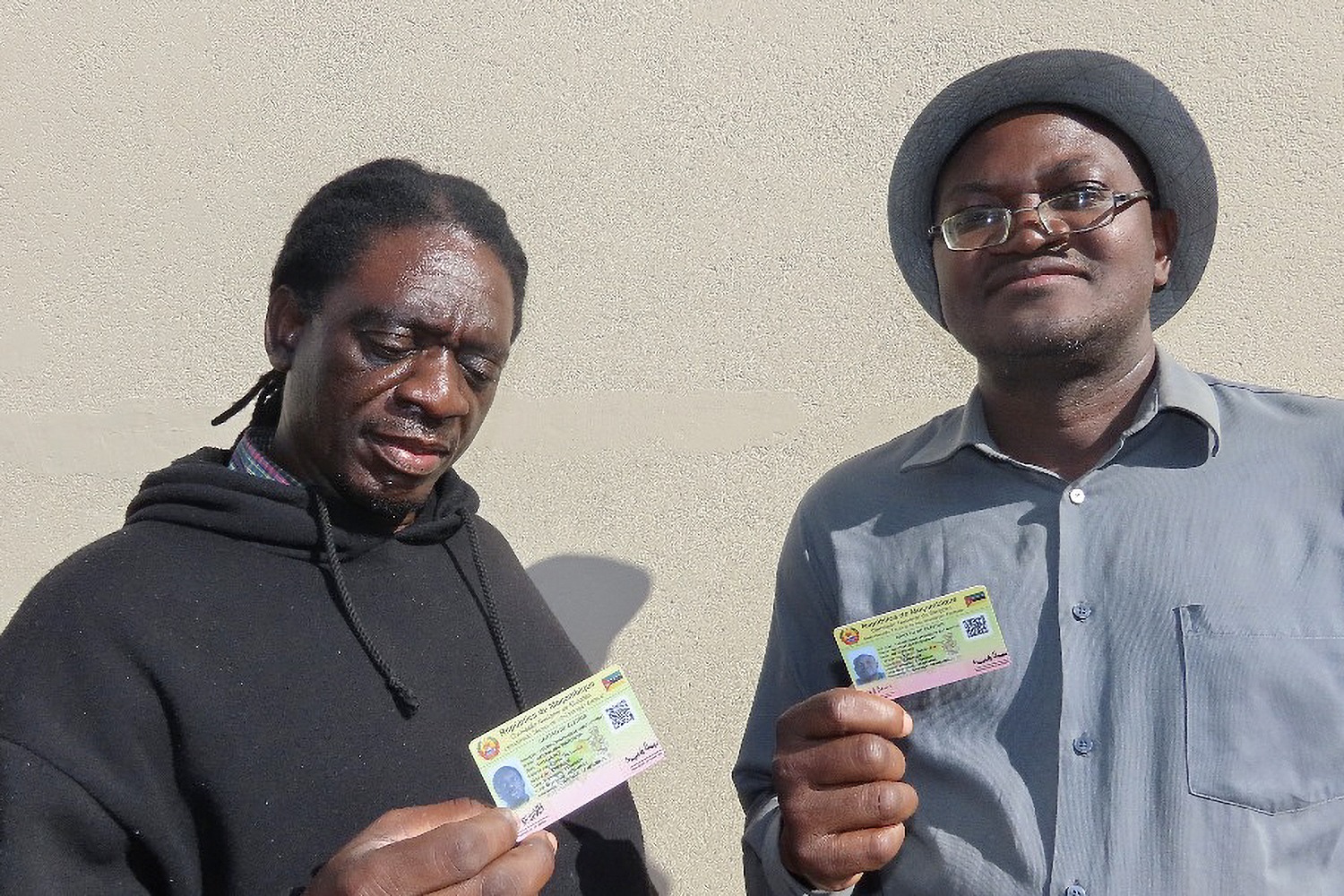
 Investigative journalist Garikai Mafirakureva and Walter Marwizi, who went undercover to register, show the voter cards they obtained during the registration process in Masvingo, Zimbabwe, on 20 May 2024.
(Photo: Nyasha Mariga / SA AJP)
Investigative journalist Garikai Mafirakureva and Walter Marwizi, who went undercover to register, show the voter cards they obtained during the registration process in Masvingo, Zimbabwe, on 20 May 2024.
(Photo: Nyasha Mariga / SA AJP) Official voters’ rolls from the 2024 Mozambican elections contain the names of two Zanu-PF activists and a number of Zimbabweans who do not hold Mozambican citizenship, and who had no legal right to vote in that country’s election.
Some of those Zimbabweans who registered went on to vote, fraudulently, in Mozambique’s 2024 elections.
Hundreds more names which appear on these Mozambican voters’ rolls are suspicious, because those names can be matched to Zimbabwean citizens residing in the same area where the registration of Mozambican diaspora voters on this roll took place: Zimbabwe’s Masvingo Province.
These findings build on a Southern Africa Accountability Journalism Project (SA AJP) exposé from May last year which showed that voter registration in Masvingo Urban and Nemanwa had likely been captured by Zanu-PF operatives working to drum up support for Frelimo, Mozambique’s ruling party and long-time ally of Zanu-PF.
The voters’ rolls, given to the SA AJP by the Pan-African Lawyers Union (Palu), contain the names of 2,475 people who were registered to vote in the elections from Masvingo Province.
Palu has formally challenged the outcomes of the 2024 Mozambican elections, in which Frelimo claimed victory, citing alleged human rights violations and electoral irregularities, including alleged fraudulent voting by Zimbabwean citizens. Palu has urged the African Union (AU) and the Southern African Development Community not to recognise the incoming government.
Voters’ rolls support previous findings of election fraud
In 2024, Mozambique allowed citizens who reside outside of the country to register and to vote, and several Mozambican voter registration stations were set up in Zimbabwe and other neighbouring countries.
/file/attachments/orphans/SAAJP-MozFraud-03_906586.jpg "Some of the Zanu-PF supporters waiting to<br>register to vote at Nemanwa Rural District <br>Council offices in Masvingo Province, <br>Zimbabwe, on 9 October 2024. <br>(Photo: Nyasha Mariga / SA AJP)")
register to vote at Nemanwa Rural District
Council offices in Masvingo Province,
Zimbabwe, on 9 October 2024.
(Photo: Nyasha Mariga / SA AJP)
/file/attachments/orphans/SAAJP-MozFraud-04_276175.jpg "Zanu-PF supporters check their names in the Mozambican elections before voting at the Roger Howman Training Centre in Mucheke, Masvingo, on 9 October 2024. (Photo: Nyasha Mariga / SA AJP)")
The exposé of last year outlined that Zanu-PF activists had mobilised supporters to report at stations and to register as Mozambican voters. The two reporters working on that investigation infiltrated this mobilisation drive. They registered along with Zanu-PF supporters and later posed for a photograph with their fraudulently acquired Mozambican voter identity cards in hand. One of those journalists went on to vote in the election. Neither are Mozambican citizens.
That story cited testimony from a further 20 Zimbabweans who all said they had illegally registered to vote in Mozambique’s election. Their reasons ranged from party loyalty to economic opportunism. Many believed that Mozambican voter identity cards would allow them to cross the border freely for business and trade. Many of the people interviewed allowed us to photograph the voter identity cards issued to them. Each confirmed that they held no dual Mozambican citizenship.
The leaked voters’ rolls now give further impetus to the claims those people made in interviews last year. Of the people featured in the first report, 11 could be matched to names on the election’s official voters’ roll. Included were the names of the two reporters.
Zanu-PF connection
In 2024, this investigation was triggered by reports that Zanu-PF activists in Masvingo Province were mobilising supporters to register for Mozambique’s election. One name that consistently came up in these rumours was that of local party activist Tracey Musakaruka.
The Masvingo Mirror reported from the site of the Roger Howman Training Centre in Mucheke, Masvingo, on 9 October 2024. It was the day of the Mozambican elections, and reporters were interviewing Zimbabweans who were suspected of having registered and then voted fraudulently. While they were doing so, they were confronted by Musakaruka who threw rocks at them.
The voters’ roll confirmed that a person by the name of “Tracey R Musakaruka” registered in Masvingo to vote in the Mozambican elections. The middle name of Tracey Musakaruka, of Zanu-PF, is Rambisayi.
/file/attachments/orphans/SAAJP-MozFraud-01_556341.jpg "A collection of voter cards showing Zanu-PF supporters who are Zimbabweans but <br>voted in the 9 October 2024, Mozambican <br>elections. (Image: Supplied)")
voted in the 9 October 2024, Mozambican
elections. (Image: Supplied)
/file/attachments/orphans/SAAJP-MozFraud-05_684778.jpg "A poster encouraging diaspora members in <br>Zimbabwe to register to vote in Zimbabwe’s Nemanwa Business Centre on 8 April 2024. <br>(Photo: Nyasha Mariga / SA AJP)")
Zimbabwe to register to vote in Zimbabwe’s Nemanwa Business Centre on 8 April 2024.
(Photo: Nyasha Mariga / SA AJP)
When called for her right of reply, Musakaruka hung up the moment this reporter identified himself. Repeated follow-up calls went unanswered.
The voters’ roll contained another name associated with a Zanu-PF leader in Masvingo: Mashingaidze Maguchu. Maguchu is the party’s district secretary for youth.
Maguchu was asked over the phone whether he participated in the elections.
“What I know (is that) it was our exercise. I registered because I just wanted to obtain a Mozambican national ID but I didn’t vote because I was not around at the time of voting. I know a lot of people voted,” he said, before declining further questions.
Another woman and Zanu-PF supporter from Nemamwa admitted, during an interview, that she fraudulently registered and voted in the election.
“Yes, I voted. I am hearing for the first time that the cards issued to us are not national IDs. I am shocked about that because I was preparing to travel to Mozambique using that card,” said the woman. She asked not to be named for fear of reprisal.
Another Zanu-PF supporter from Mashava, who also requested anonymity, said she was enticed by what she assumed to be benefits of obtaining a Mozambican voter identity card.
“All along, I was planning to travel to Mozambique, intending to use that card, so if you say it’s just a voter’s ID, I am disappointed. Those people lied to us. However, I am happy that I helped to defeat the opposition in Mozambique, even though I am not a Mozambican,” she said.
The misconception that a Mozambican voter identity card would endow the holder with citizenship rights and benefits – such as unencumbered travel across the border – was common among people interviewed for this and previous stories.
Matches with the Masvingo voters’ roll
Government insiders in Zimbabwe leaked a substantial portion of the Masvingo voters’ roll from Zimbabwe’s election in 2023. The databases received contained the names and details of more than 27,000 registered voters in Masvingo Province.
The SA AJP ran the 2,475 names on the Mozambican voters’ roll against this database for matches, and 579 names matched exactly with confirmed Zimbabwean citizens. While dual citizenship is not impossible, these matches still present a red flag. Our investigation has shown that Zimbabweans who do not hold dual citizenship easily registered and voted in Mozambique’s election.
/file/attachments/orphans/SAAJP-MozFraud-08_249134.jpg "Tracey Musakaruka, the Ward 1 Masvingo <br>Urban Zanu-PF chairperson, and one of the <br>activists who coordinated and mobilised <br>Zimbabweans to vote in the Mozambican <br>election, in Masvingo, on 13 February 2024. (Photo: Courtesy of ZimRights / SA AJP)")
Urban Zanu-PF chairperson, and one of the
activists who coordinated and mobilised
Zimbabweans to vote in the Mozambican
election, in Masvingo, on 13 February 2024. (Photo: Courtesy of ZimRights / SA AJP)
The names of the two Zanu-PF officials mentioned earlier in this story – Tracey Musakaruka and Mashingaidze Maguchu – were two that appeared on both voters’ rolls.
One of the people interviewed for last year’s story appeared on both voters’ rolls.
We located and interviewed a further four individuals who appeared on both rolls. They all admitted to registering fraudulently for Mozambique’s election. They all spoke on condition of anonymity, because they feared backlash for admitting to a crime.
One said she was misled by people who recruited her.
“We were promised a lot of things by those who were registering people, and our peers who were telling us about a lot of benefits of registering. The registration was open to anyone who wanted to,” she said.
Another man, a second-hand clothes vendor, said he knew about the mobilisation on the streets, and people were talking highly of the benefits of voting in the Mozambican election.
“You know, as vendors, we want anything that can benefit us. When I heard of the benefits, like being able to go and buy goods for resale, I fell for it. It was easy. No one asked inquisitive questions, and there was no strict vetting,” he said.
Zanu-PF’s response
Approached previously for comment, Zanu-PF spokesperson Chris Mutsvangwa said all people who voted at polling stations in Zimbabwe were, in fact, Mozambicans who had acquired dual citizenship.
When pushed that evidence pointed to the contrary, he remained dismissive.
“The Mozambican election is over. President Chapo is now recognised by the international community,” he said.
“Why do you always look in the rear-view mirror? Try to look in front of you.”
/file/attachments/orphans/SAAJP-MozFraud-07_957057.jpg "Mashingaidze Maguchu, the Zanu-PF <br>youth district chairperson who registered <br>and took part in mobilising other <br>supporters to register in the Mozambican <br>election, in Masvingo, Zimbabwe, on 13 July <br>2020. (Photo: Courtesy of Facebook / SA AJP)<br>")
youth district chairperson who registered
and took part in mobilising other
supporters to register in the Mozambican
election, in Masvingo, Zimbabwe, on 13 July
2020. (Photo: Courtesy of Facebook / SA AJP)
/file/attachments/orphans/SAAJP-MozFraud-06_828190.jpg "Mashingaidze Maguchu at the Great Zimbabwe Monument in February 2019. (Photo: Courtesy of Facebook / SA AJP)")
Mutsvangwa said that he would answer no further questions on this subject.
Zanu-PF director of information Farai Marapira denied any involvement in the fraud.
“I think the people you interviewed misunderstood your questions because there is no way a Zimbabwean can vote in a Mozambican election,” he said last year.
Attempts to reach Marapira on the phone to respond to the findings in this report were not successful, as he consistently dropped the call. DM
This report has been produced by the Southern Africa Accountability Journalism Project (SA AJP), an initiative of the Henry Nxumalo Foundation, with financial assistance from the European Union. It can under no circumstances be regarded as reflecting the position of the European Union.