




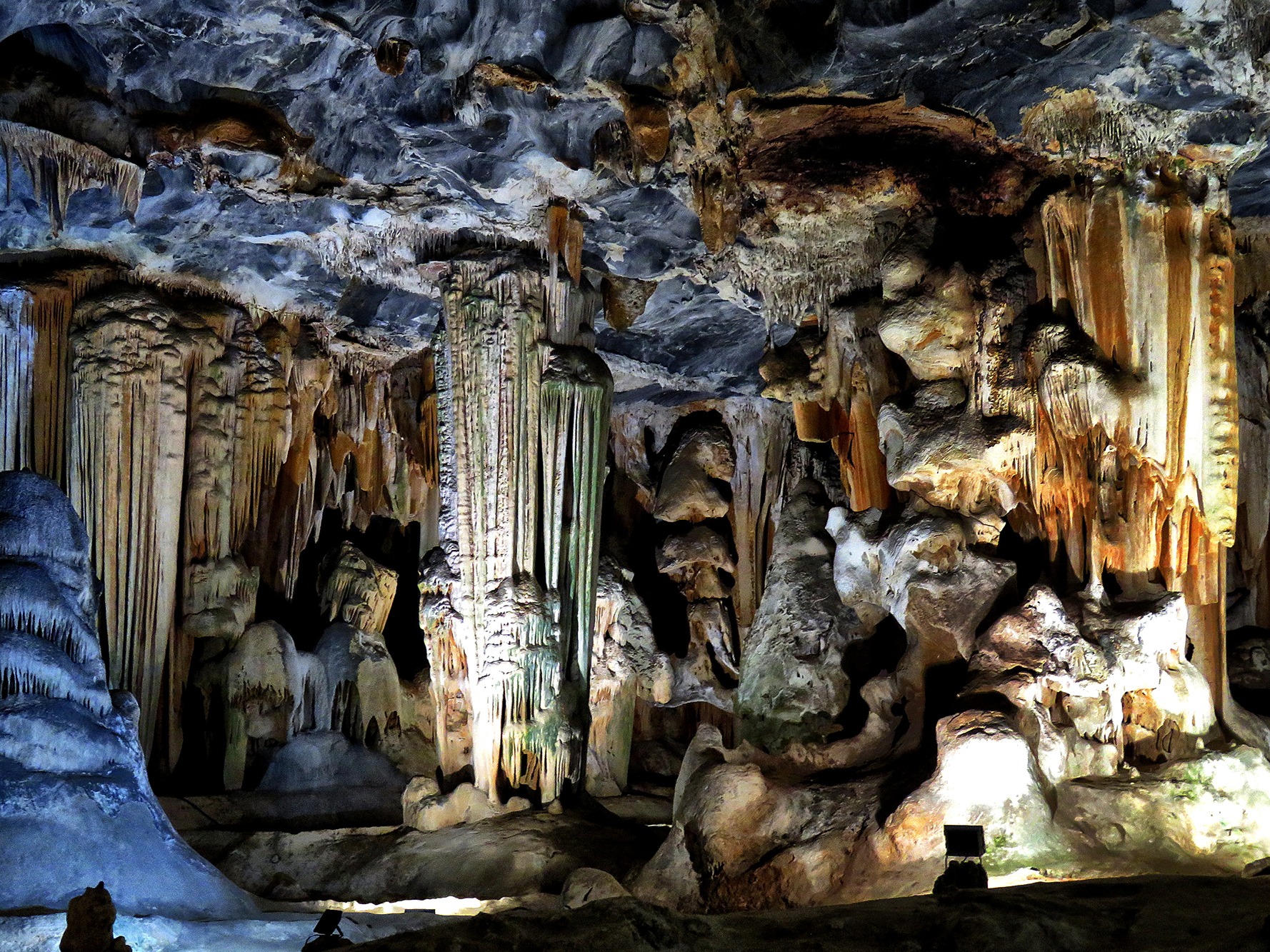
 The Cango Caves, one of the jewels of Oudtshoorn and the Klein Karoo. (Photo: Chris Marais)
 It’s time for a day trip to South Africa’s first tourist attraction, the Cango Caves.
The mysterious limestone chambers full of glistening stalactites and stalagmites and strange formations proved irresistible to people in the early 1800s, even though the entry fee was five rixdollars (the equivalent of R2,300 today).
Tourists came from all over the world and despite the massive entry fee – or maybe because of it – they were a destructive lot.
So many hacked off stalactites and dripstone formations as souvenirs and carved their names on walls and limestone pillars, that in 1820 Lord Charles Somerset passed the country’s first environmental laws to protect the delicate cave ecology.
/file/attachments/orphans/GoodlightingisessentialwhendisplayingthewaresoftheCangoCaves_ChrisMarais1_554018.jpg "Good lighting is essential when displaying the wares of the Cango Caves. (Photo: Chris Marais)")
/file/attachments/orphans/Natureassuperbinteriordesign_ChrisMarais_973855.jpg "Nature as superb interior design. (Photo: Chris Marais)")
/file/attachments/orphans/AsalwaysthewarningtotouristsisDontTouch_ChrisMarais_881397.jpg "Architectural inspirations in every accessible chamber of the Cango Caves. (Photo: Chris Marais)")
/file/attachments/orphans/An1807groupofschoolteachersgatheratthemouthoftheCavesbeforeentering_ChrisMarais_393696.jpg "An 1807 group of schoolteachers gather at the mouth of the caves before entering. (Photo: Chris Marais)")
The Cango Caves also boasted South Africa’s first tour guide – Johnnie van Wassenaar – who helped open many side-chambers between 1891 and 1934.
Popular legend has it that a man called Jacobus van Zyl “discovered” the caves in 1780 after being alerted to them by a herder, Klaas Windvogel, who stumbled across a great hole while looking for lost livestock. Lowered down by rawhide thongs, Van Zyl was the first in unknown centuries to see the initial chamber, the size of a rugby field, now named for him.
But finding rock paintings along with ancient tools proved that these caves had been inhabited or used for 80,000 years or more.
The cave system was originally thought to be about a kilometre long. However, spelunkers are still finding crawlspaces into new and astonishingly beautiful sections, most of which will never seen by the public – especially, I might add, by the likes of me.
/file/attachments/orphans/Themysteriouslimestonechambersfullofglisteningstalactitesandstalagmites_ChrisMarais_870277.jpg "The mysterious limestone chambers full of glistening stalactites and stalagmites. (Photo: Chris Marais)")
/file/attachments/orphans/TouristsgazeupinaweatthesplendidMainChamberceiling_ChrisMarais_541220.jpg "Tourists gaze up in awe at the splendid Main Chamber ceiling. (Photo: Chris Marais)")
/file/attachments/orphans/AvisitorgrouptroopsintooneoftheCangochambers_ChrisMarais_100453.jpg "A visitor group troops into one of the Cango chambers. (Photo: Chris Marais)")
/file/attachments/orphans/Illuminatedshapesandformsasifembossedingold_ChrisMarais_285495.jpg "Illuminated shapes and forms, as if embossed in gold. (Photo: Chris Marais)")
Some of the chambers carry names like Grand Hall, Van Zyl’s Hall, Devil’s Chimney, Lumbago Alley and African Drum Room. Some years ago, we visited the caves with a couple of overseas-based friends. In the African Drum Room, known for its acoustics, the guide switched off the lights and invited someone brave in the group to sing out loud.
My husband Chris and I obliged, with a shaky rendition of Down to the River to Pray, from the soundtrack of that great movie, O Brother, Where Art Thou. It was fun, there was some applause – probably for having the courage to test the sound in public.
Today, we’ve connected with our long-standing media friends, Roger and Pat de la Harpe, and we join a gang of tourists clutching tickets at the mouth of the famous caves. Within minutes of entering the vast and colourful chambers, Pat and I spot a young British vandal who keeps fondling the stalactites.
We sidle up to him and begin to stage-whisper loudly to one another:
“Why does this guy keep touching everything?”
The tourist gets the message and rejoins his mates, muttering something about having paid good money to do what he likes in here. No, sir. It doesn’t work that way. Rather give us a good, rousing Welsh coal mining song once we get into the African Drum Cave. DM
Klein Karoo Magic (390 pages, full colour) by Chris Marais and Julienne du Toit will be released in May, 2026. To order your author-signed copy (R400 including SA courier service), email Julie at julie@karoospace.co.za
/file/attachments/2988/HeaderKLEINKAROO_510874.jpg)
Comments
Scroll down to load comments...