



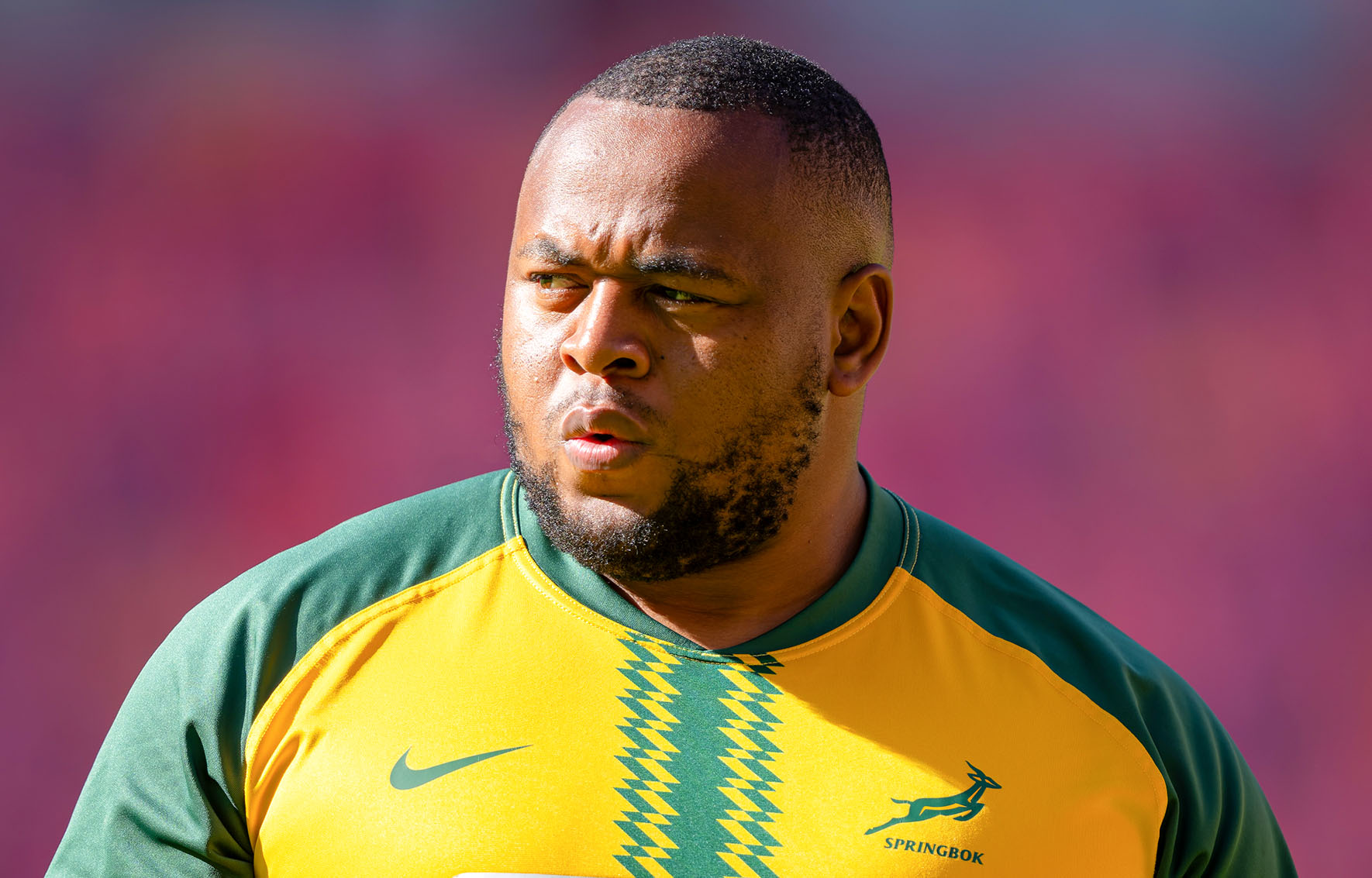
 Springbok and Lions prop Asenathi Ntlabakanye has been banned for 18 months for a doping violation. (Photo: Anton Geyser / Gallo Images)
Giant Springbok prop Asenathi Ntlabakanye will miss Rugby World Cup 2027 after being suspended for 18 months for an adverse finding that showed traces of the specified substance Anastrozole and self-declared use of a non-specified drug, Dehydroepiandrosterone (DHEA).
The decision was taken by an Independent Doping Tribunal Panel, following two weeks of evidence and three weeks of deliberation.
“The player is banned for 18 months from sport for his doping offence, effective from 13 May 2026. The player, the South African Institute for Drug Free Sports (Saids), World Rugby and the World Anti-Doping Agency (Wada) have 21 days within which to file an appeal against the sanction to the Court of Arbitration for Sport (CAS). The ban will expire on 13 November 2027,” a statement from Saids read.
Ntlabakanye maintained his innocence throughout the process, having been prescribed medication by an endocrinologist. He also sought another medical opinion on whether he could take the medication, which was cleared.
/file/dailymaverick/wp-content/uploads/2025/11/TL_2422530.jpg "Springbok Asenathi Ntlabakanye in action against Italy at Nelson Mandela Bay Stadium on 12 July. (Photo: Richard Huggard / Gallo Images)")
But under doping’s stringent laws, Ntlabakanye was found guilty and stands to lose up to R5-million in earnings from the Springboks alone, over the next 18 months.
Whether Saids, Wada, or World Rugby appeal within their 21-day window matters enormously. An appeal upward could lengthen the ban; an appeal by the player to CAS could lead to a small reduction, but also runs the risk of the sanction being lengthened.
Saids has indicated it is “reviewing the merits”, but it is unlikely it will pursue it further.
The Lions, where Ntlabakanye is contracted to play his club rugby, have withdrawn him from the team to face Munster in Ireland this week. He was set to fly home on Thursday evening.
“The Lions Rugby Company confirms that it has received communication from Saids regarding the decision to sanction Lions prop Asenathi Ntlabakanye for a period of 18 months following an anti-doping rule violation,” a statement from the Lions read.
“The Lions Rugby Company, together with MyPlayers – the rugby players’ organisation, will deliberate on the appropriate next steps. During this time, the Lions Rugby Company will continue to support Ntlabakanye as he navigates the process ahead.”
Daily Maverick understands that the Lions intend to honour Ntlabankanye’s club contract as this appears to be a case of medical negligence.
/file/attachments/orphans/2267226119_316307.jpg "Asenathi Ntlabakanye in action for the Lions against Edinburgh at Ellis Park on 21 March, 2026. (Photo: Gallo Images / Getty Images)")
Formally charged
On 9 September, 2025, Saids formally charged Ntlabakanye for taking the specified drug Anastrozole and for admitting to taking medication that contained the non-specified (performance-enhancing) drug DHEA, which he declared on a medical form.
He did not test positive for DHEA.
Saru confirmed an adverse finding for a specified (non-performance enhancing) substance found during a routine doping test while Ntlabakanye was on Springbok duty in May that year.
Ntlabakanye, following protocol, listed the drugs he was on at a routine testing, after clearing the prescription with both the endocrinologist he had seen to address his weight issues, and another sports doctor.
Saids had no option to charge Ntlabakanye with a doping violation and set the wheels in motion for a hearing.
Transparent
The non-specified (performance-enhancing) drug did not show up in the blood test results taken from the 22 May 2025 sample, probably because it was out of his system. But by declaring it on a form, Ntlabakanye incriminated himself under the “strict liability” rule.
It’s important to emphasise that, according to several sources, both these drugs were prescribed and cleared by two medical professionals.
Saru’s original statement last August was unusually direct in pointing the finger at the doctors involved in the case.
“The non-performance-enhancing substance for which he (Ntlabakanye) tested positive was prescribed by a specialist physician early in 2025 for medical reasons,” Saru’s 24 August statement reads. “It was taken with the approval and the supervision of a medical doctor specifically appointed to manage the medical affairs of professional rugby players.
“Ntlabakanye was transparent in his declarations, acted in good faith and, at all times, followed the medical due process as prescribed by the industry.
“He relied on the relevant professional medical advice and at no time did he seek to obtain an unfair advantage, nor did he take any medical substance without prior medical authorisation.”
/file/attachments/2990/2244461756_258334.jpg "Asenathi Ntlabakanye plays for the Barbarians against an All Blacks XV in Brentford, England, last November. (Photo: Steve Bardens / Getty Images for Barbarians)")
Strict liability
From the moment Ntlabakanye declared the DHEA on a form though, the wheels were put in motion for a suspension under the rule of strict liability.
Unlike almost every court of law where innocence is presumed and guilt must be proven, strict liability works in reverse. After an adverse finding, athletes are immediately assumed guilty and must prove their innocence through various tribunals.
Even if a player can prove they acted under medical supervision and in good faith, the best realistic outcome is typically a reduced sentence, not full exoneration. In this case that appears to be what transpired.
The maximum sentence for a first time non-specified violation is four years. Ntlabakanye’s ban comes in at the low end.
The strict liability framework exists for good reason as it prevents athletes from using the “I didn’t know” excuse as a blanket defence.
But in cases such as this one, it appears to create a sense of injustice, where the athlete was manifestly more diligent and honest than the system required.
Given all of this, 18 months is arguably at the more lenient end of what was possible under the rules, and represents some recognition of the circumstances.
However, for a player who did not knowingly dope, it still feels punitive. DM
Comments
Scroll down to load comments...