




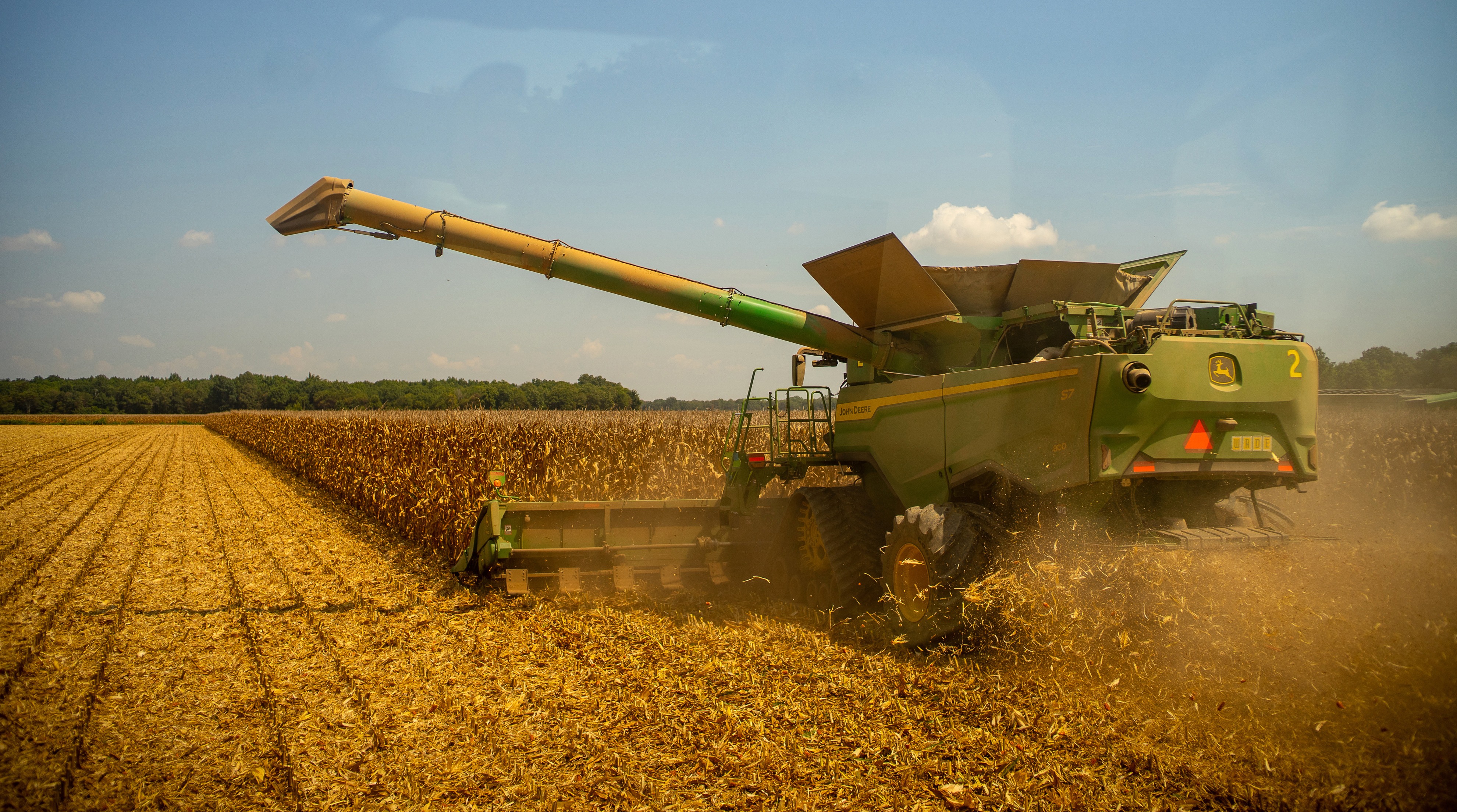
 SA grain farmers face dire challenges as surging fuel and fertiliser costs, coupled with low maize prices, make it easier to buy maize than grow it. (Photo: Alan Chin / Bloomberg via Getty Images)
Between the unfolding Iran conflict and a looming El Niño, South Africa’s maize farmers are reaping a harvest of sorrow with potentially grave consequences for SA’s economy and food security.
“We are at a tipping point, and in many cases it is cheaper to buy maize than produce it,” Corné Louw, the head of applied economics at industry group Grain SA, told Daily Maverick at the Nampo Harvest Day near the Free State town of Bothaville.
Louw was speaking about maize producers who are also in the commercial livestock business – the case for many grain farmers.
“So if I’m a farmer and I normally need my own maize for my cattle, it’s actually more economic in that case to buy maize on the market than to produce it,” he said.
That underlines starkly the situation facing maize farmers, and wheat producers are sinking into an even bigger pile of manure.
Futures prices for yellow maize – the variety primarily used for animal feed – are currently fetching under R3,500 a tonne, a fall of 40% since their recent peaks of over R5,800 in January 2025.
Input costs surging
On top of this, input costs are surging because of the Middle East war unleashed at the end of February when the US and Israel launched attacks on Iran. Louw said that domestic nitrogen prices had soared 40% since the start of the Iran war.
“About 60% of our nitrogen comes through the Strait of Hormuz. We import more than 80% of our local fertiliser needs, so it makes us very exposed to this turmoil. And for grain and seed oil farmers the variable costs are between 30% and 50% from fertilisers,” Louw said.
Diesel costs are also going through the roof, and Louw said the estimates were that the fast-rising input costs would increase the debt that commercial farmers owed to SA’s banks by R40-billion to a whopping R290-billion.
And then there is the prospect of a potential “Super El Niño” on the horizon, which global forecasters say could emerge as early as this month and last well into the South African summer grain season. Louw said this was already keeping farmers up at night.
The previous El Niño scorched southern Africa, leaving a trail of misery and poor harvests of maize – the region’s caloric staple – in its wake.
Louw said one option for farmers was to only plant maize in their best fields, and elsewhere sow grazing or fodder crops for livestock that did not require as much fertiliser and other inputs.
Tom van Rooyen, a maize and cattle farmer from North West, said he was thinking of doing just that.
“I may plant less maize and more fodder crops for cattle. It’s all very uncertain,” he told Daily Maverick.
This is also making it more difficult for emerging black farmers to become commercial operators, thwarting a key plank of government agricultural policy.
Wilting wheat sector
Farmers of wheat, a winter crop, are facing an even more uncertain and bleak future.
Grain SA warned earlier this year that SA’s domestic wheat sector – which only produces about half of what the country consumers, with the rest imported – “faces a structural economic failure that now threatens producer survival, future planting decisions and the country’s long-term food security”.
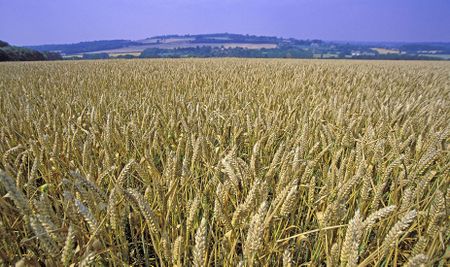
According to the latest estimate from SA’s Crop Estimates Committee, wheat farmers intend to cut their plantings by 6% to 486,400 hectares – the lowest area devoted to the crop in 12 years.
“What we hear from our members is that there are lots of wheat farms on the market. Normally farms in that area don’t even get advertised – if someone wants to sell the neighbour or someone in the community buys it before it goes to market,” Louw said.
“This tells us that nobody wants to buy their neighbour’s farm because of the dire situation. That tells me the guys are really struggling.”
Andries Theron, an affable wheat farmer from the Swartland in the Western Cape, confirmed this was the case.
He told Daily Maverick at Nampo that wheat farmers who wanted to expand – based on an economy of scale model to confront the challenges – could not because they could not afford to buy more land or raise the money from the bank to do so because of the risks.
“With the current wheat price and rising input costs you can’t pay back the debt. It’s high risk for a bank to lend money to a wheat farmer now,” Theron said.
Asked if he expected his margins to be tight this year, Theron replied: “My goodness! If I have an excellent year with an excellent crop I'll make a bit of money, but I have to pay off my debts.
“This year we need to harvest 3.2 tonnes per hectare to break even, and that’s very close to our long-term average of 3.3 tonnes. That’s the risk margin we are working on,” he said.
Adding fuel to fires of inflation
A stunted wheat and then maize crop would also add fuel to the fires of inflation that are already accelerating because of the surge in fuel prices triggered by the Iran conflict. This will inflict further pain on South African consumers, especially the poor and vulnerable.
“Before the Middle East conflict, our farmers already had a challenge in terms of profitability. We come from a cycle where we have had very low international grain prices because of ample stock,” Louw said.
Of course, not all commercial grain farmers are on the brink – far from it.
One of the many striking things about the sprawling Nampo grounds is the adjoining airfield. Wealthy farmers do not drive a bakkie to Nampo – they fly in.
According to data provided by Grain SA to journalists, on Tuesday – the first day – 39 aeroplanes and 14 helicopters flew in. On Wednesday, 53 aeroplanes and 40 helicopters landed there.
Who knows, maybe some of those aircraft will have to be sold to pay off debt. DM
Comments
Scroll down to load comments...