



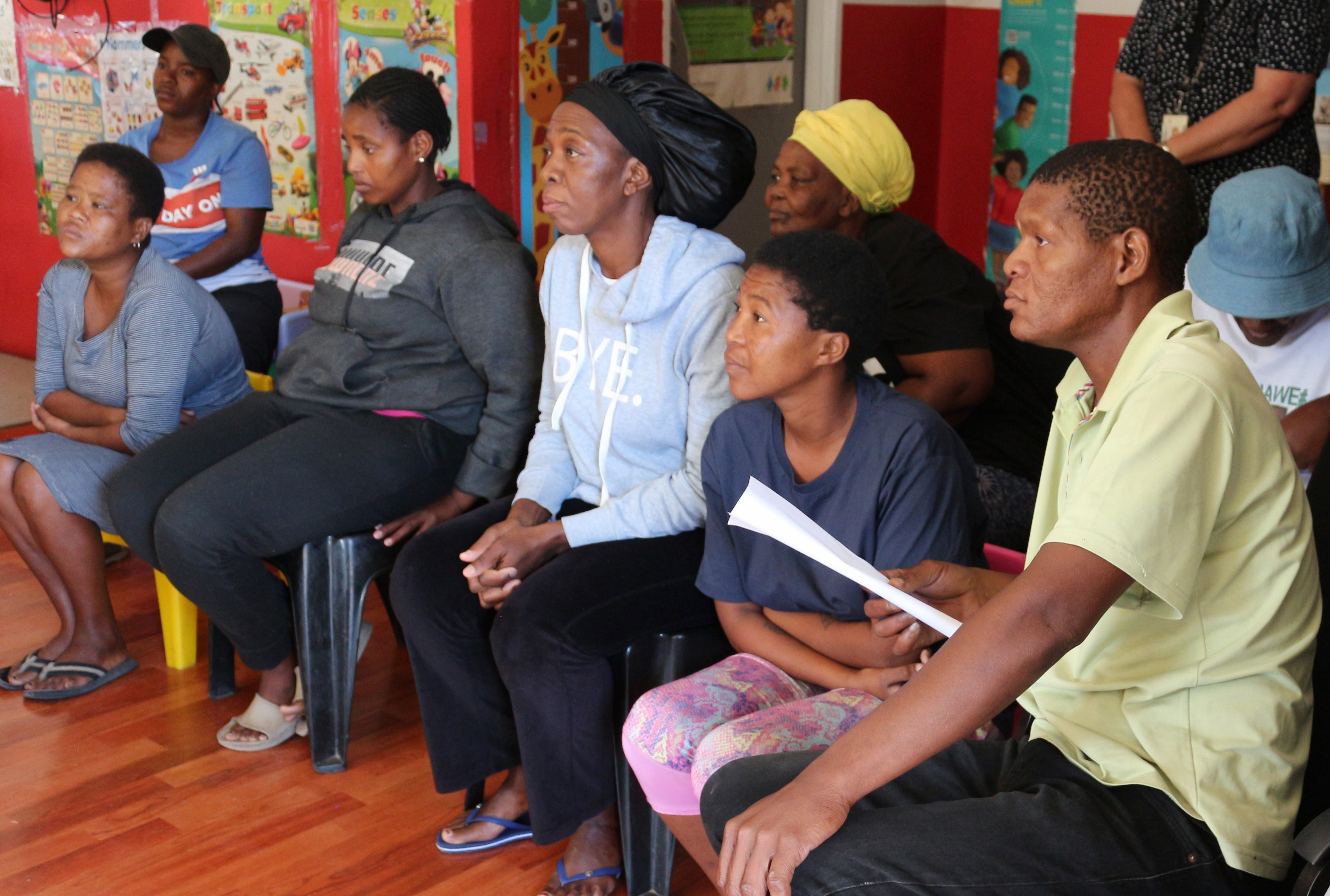
 Beneficiaries of FoodForward SA’s mother-and-child nutrition programme gather at a food parcel collection point in Zwelethemba, Worcester, in the Western Cape on 16 April 2026. (Photo: Tamsin Metelerkamp)
Once a month, Vuyiswa Dlikilili walks to a local early childhood development centre in Zwelethemba, Worcester, to collect a box of food items delivered by FoodForward SA’s mother-and-child nutrition programme. She loads eggs, fresh vegetables and non-perishables into a pram, ready to be taken back to the household where she helps to look after her young grandchild.
Worcester lies about 120km northeast of Cape Town, in the Western Cape’s Breede Valley Local Municipality. It is nestled in an agricultural hub for grapes and fruit processing, but seasonal work and limited opportunities mean that many families remain reliant on social grants to stay afloat.
Dlikilili told Daily Maverick that before joining the food programme, her family struggled to access adequate nutrition. Her grandchild, who had been diagnosed with tuberculosis, was underweight and suffering from stunted growth. Now, the child’s development had greatly improved.
Unemployment and reliance on grants had been made more challenging by rising food prices, Dlikilili said. The money the family was able to get needed to cover not only meals, but also crèche costs, doctor’s appointments and transport.
Receiving the monthly food parcels had relieved some pressure and allowed the grant money to be used for other essentials.
/file/attachments/2991/08VuyiswaDlikilili_912258.jpg "Vuyiswa Dlikilili, a resident of Zwelethemba, Worcester, says the access to the FoodForward SA mother-and-child nutrition programme has led to great improvements in her grandson’s growth and health. (Photo: Tamsin Metelerkamp)")
Rising food prices have long been a problem for income-insecure households in SA, but the recent spike in fuel costs driven by the US-Israel war on Iran has driven the crisis to new heights, making food distribution programmes like those of FoodForward SA a life-saver for families living below the breadline.
Mother-and-child nutrition
FoodForward SA’s mother-and-child nutrition programme has been running for about 18 months. It was rolled out in partnership with the Philani Nutrition Centre, Grow Great and two provincial departments of health.
The programme targets at-risk pregnant women and children under five in vulnerable communities in the Western and Eastern Cape, and is supporting about 200 beneficiaries through four clinics, with capacity to go up to 250, according to Mahbobah Jacobs, FoodForward SA’s fund development manager.
The box of food provided is designed to feed a family of four for a month. FoodForward SA procures the foodstuffs specifically to ensure a healthy combination of protein, starch and fresh produce, and items include rice, oil, eggs, tinned pilchards, peanut butter and fortified sorghum porridge.
/file/attachments/2991/08foodparcels_279575.jpg "The food parcels distributed under FoodForwardSA’s mother-and-child nutrition programme are designed to feed a family of four for a month. (Photo: Tamsin Metelerkamp)")
“I think the space where people are willing to invest in youth and in the future of SA is evolving,” said Jacobs. “For a while it was all about matrics, and then it was all about reading for meaning. Now, we’re back to the foundational 1,000 days. We can make the biggest difference in a child’s life and life trajectory by preventing stunting before the age of five. After that, it’s irreversible.
“We make a massive investment in SA in education, and we’re still not seeing the kind of results that we would expect to see… from our investment per child. A lot of it could potentially be ascribed to early childhood development that was not ideal.”
Fundraising for the programme was one of FoodForward SA’s priorities, added Jacobs. The cost per box was R850 and creating 250 boxes every month for 12 months came to R1.5-million.
“Food inflation being what it is, the contents of the box have become more expensive just in the two years that I’ve been here,” said Jacobs. “The big growth plan was that we were trying to reach 300 [families] by the end of this year, and then, with Grow Great, to develop a framework for strategic expansion to other provinces. We know the need is great in the Eastern Cape.”
Multi-stakeholder effort
During a visit to the Zwelethemba food distribution outreach in April, it was evident that many stakeholders from the children’s sector were coming together to support the programme.
Representatives from the Western Cape Department of Health and Wellness and Boland Hospice were overseeing growth monitoring for the children of beneficiaries, and dietician students from Stellenbosch University were on site to learn and provide nutritional recommendations to family members.
/file/attachments/2991/08packingfoodparcels_656418.jpg "Beneficiaries of FoodForward SA’s mother-and-child nutrition programme pack food parcels into prams and trolleys in Zwelethemba, Worcester, on 16 April 2026. (Photo: Tamsin Metelerkamp)")
Margerite Hartung, a dietician with the Cape Winelands district office of the Department of Health, said beneficiaries were identified by dieticians at local clinics. The food parcels were then distributed to families through collection points or home visits, whereas growth monitoring was usually conducted by community health workers at households’ homes.
“I have a big love for community nutrition… This is my first time with the FoodForward SA [programme], but it’s just so nice to be able to give those families something because some of them really don’t have any food. And it’s not like they don’t care for their children – it’s more like they can’t provide for them,” said Hartung.
Nazeem Meyson, whose 20-month-old grandson is part of the programme, said the food parcel had notably improved the child’s growth, as well as overall health outcomes in the family.
“Personally, I would like to see [the programme] continue. It’s a good thing. Sometimes, as parents, you wonder where your next meal will come from. With efforts like this, it’s actually of benefit for us, because it will guarantee that [my grandson] will be growing healthy and strong, and it means so much less stress for us in the house,” said Meyson. DM
/file/attachments/orphans/ChildrensReporterV2_187851.jpg)
This story first appeared in our weekly DM168 newspaper, available countrywide for R35.
/file/attachments/2991/DM-080526_208362.jpg)
Comments
Scroll down to load comments...