




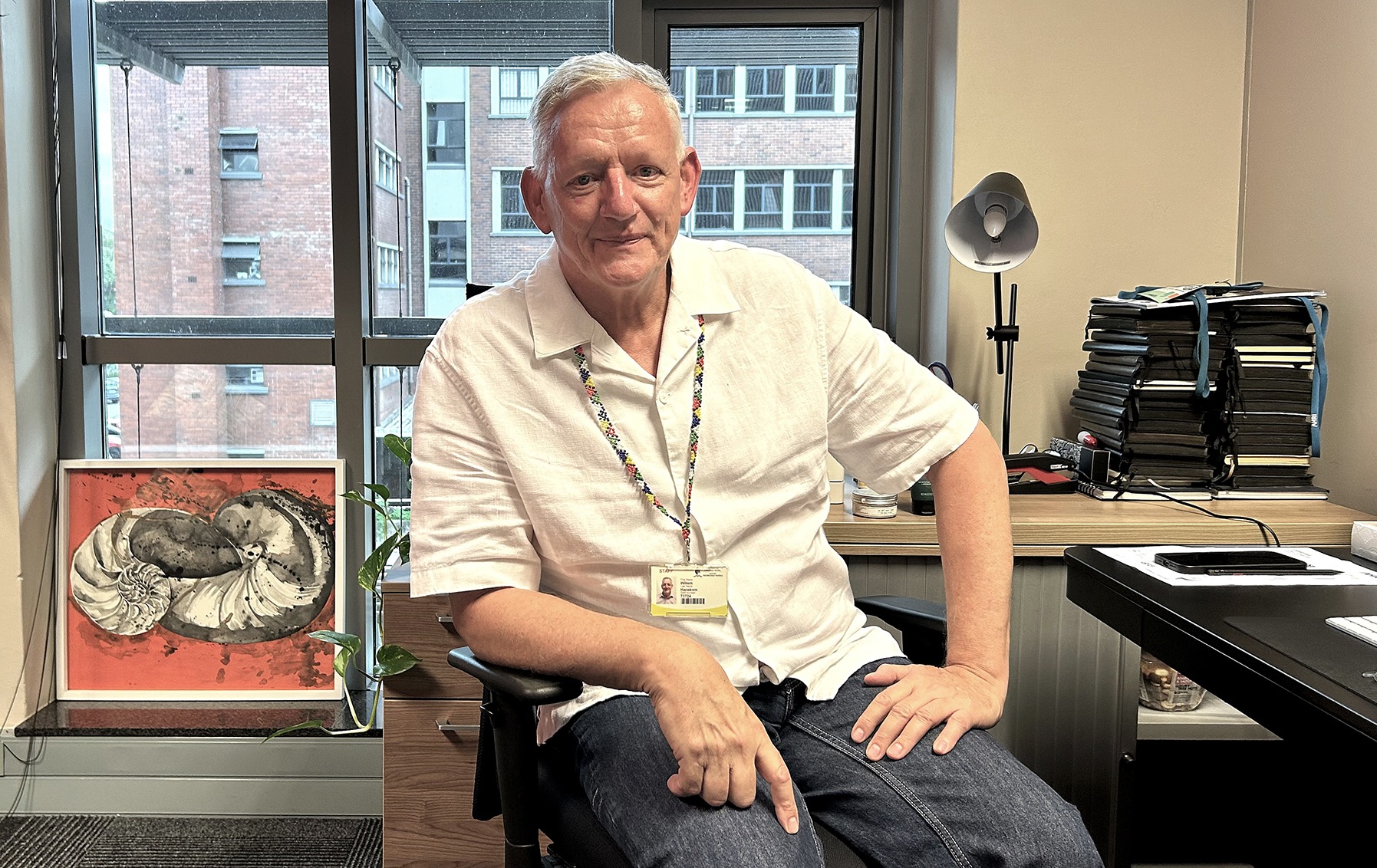
 Professor Willem Hanekom iin his office at the Africa Health Research Institute. (Photo: Biénne Huisman / Spotlight)
 Attached to a beaded lanyard, Professor Willem Hanekom’s employee badge simply states “staff”. He is wearing a white cotton shirt and jeans. His sparsely decorated office bears one painting of coiled ammonite fossil shells, and moleskin books stacked in a corner.
Hanekom’s modest bearing barely suggests that he leads 800 employees and a R1.1-billion budget as executive director of the Africa Health Research Institute (AHRI) – the scientific powerhouse spanning two campuses in KwaZulu-Natal, the epicentre of South Africa’s HIV and TB epidemics.
Hanekom holds professor positions at the University of KwaZulu-Natal, the University of Cape Town, University College London and the University of Washington. For the past two years he also served as a strategic adviser on the World Health Organization’s TB Vaccine Accelerator. Among other projects, the global body monitors the landmark M72/AS01E phase three clinical trial, of which Hanekom is a co-principal investigator. To date, the trial has enrolled 20,000 participants in five countries, and is expected to be completed over the next two years.
“I’m enjoying the TB Vaccine Accelerator tremendously,” he says. “It’s my little hobby away from AHRI where I’ve been very involved in science and clinical trials. Now I’m also involved in that on a global strategic level, downstream.”
Hanekom adds that he will meet the council in Geneva the week after our interview. “It’s a little boring because I go to Geneva so often,” he quips, eyes crinkled with mischief. “I wish it would be Barcelona, for a change.”
Indeed, the clinician-scientist speaks plainly, but with unexpected analogies and turns of phrase. In a public lecture in 2024, he illustrated the scope of TB deaths in South Africa using the Moses Mabhida Stadium on Durban’s beachfront.
“About 54,000 people die of tuberculosis in South Africa every year,” he said. “Next time you’re watching soccer or rugby or whatever at the beautiful stadium here in Durban, that’s just about everyone in there.”
Our interview is taking place mid-afternoon and Hanekom is just off another online meeting. In a glass-encased building on the University of KwaZulu-Natal’s medicine campus in Durban, he swivels on his desk chair.
People who have and those who have not
Hanekom was diagnosed with HIV 19 years ago, at the tail end of Thabo Mbeki’s Aids-denialist presidency. This happened in a context of “privilege”, he says, as he was in a position to fight for his own health by obtaining antiretroviral therapy through a medical aid scheme. Even this took some persuasion, he adds. In 2007, only about 390,000 of the more than five million people living with HIV in the country were on treatment.
“I’m still very aware of the discrepancies between people who have and those who have not,” he says. “And that’s why I work in science that specifically addresses underresourced communities.”
The Africa Health Research Institute sees him driving work that refines and democratises breakthrough HIV, TB and other infectious disease interventions. Recently, the institute participated in multinational studies to test the efficacy of the HIV prevention drug lenacapavir, a game-changing, twice-yearly jab. It will roll out lenacapavir around its rural Somkhele campus from June, in partnership with the Department of Health.
Hanekom reflects that “normally, science happens in little steps”, adding that lenacapavir had been a “massive jump”. He says daily HIV-prevention PrEP (pre-exposure prophylaxis) tablets can be inefficient due to adherence issues. “I even have friends who don’t want to take a daily tablet,” he says. “And some of my friends, because of their interactions with me, have heard about lenacapavir and have asked me when it will be in pharmacies. So this is a huge thing, just in talking to people, realising that there is a demand. And that for me is a massive jump in the science.”
Covid-19: At the forefront
Other notable leaps at the institute relate to Covid-19. In December 2020, in one of its state-of-the-art biosafety level 3 (BSL-3) laboratories, scientists Professor Alex Sigal and Sandile Cele first successfully “grew” the SARS-CoV-2 Beta variant.
In the same building, at the KwaZulu-Natal Research and Innovation Sequencing Platform, Professor Tulio de Oliveira studied virus samples for genetic clues, culminating in the initial detection of both the Beta and Omicron variants.
“We were at the forefront here,” says Hanekom. “So I chaired with Tulio this committee [the SA Covid-19 Research Consortium], we decided we needed to bring South African researchers together… And that’s what allowed all these new variants to be described, and the immune responses to be described.”
On living with HIV
He says that while he has not used his HIV status as “an advocacy tool”, he has been open about it, including at the institute. “Being gay, it’s never been an issue for me, I’ve always had a very open life. But living with HIV is slightly different. I decided 18 years ago that I would be completely transparent about this to everyone, wherever I go.”
While he rarely experienced stigma himself, Hanekom recognises the magnitude of stigma around the disease. “The stigma that I experience is really very occasional and more just ignorance around what it means to have an undetectable viral load, and basically what that means in terms of sex.”
He adds: “I don’t know why I would be special compared to the other millions of people in South Africa that live with HIV. Perhaps the only thing that I can think of is using this platform to say that one can be open and can talk about it. At our institute, this has allowed some people to come speak to me personally. But all of them have said that they want it to remain completely confidential.”
Running with opportunities
Reflecting on his journey, Hanekom describes his life and career as a confluence of great opportunities and “best times” – an attitude that perhaps generates the very luck he so readily encounters.
“My philosophy in life is to notice opportunities and to run with them,” he says. “I mean I cannot think of a period that I haven’t been really very happy.”
Raised in the Stellenbosch suburb of Onderpapegaaiberg, Hanekom matriculated at Paul Roos Gymnasium. He studied medicine at Stellenbosch University, later specialising in paediatrics at the Red Cross War Memorial Children’s Hospital, affiliated to the University of Cape Town.
A special memory
“Red Cross for me was unbelievable,” he says. “The best years of my life. We worked incredibly hard, it was just so collegial and everything we did made a difference.” A treasured memory was taking an ailing four-year-old patient, who required a ventilator machine to breathe, on an outing to the sea.
He recalls: “What stands out to me is building up relationships with some chronic patients. I remember one kid that was ventilator-dependent. And we took him out, on the ventilator in a wheelchair, to the Sea Point Promenade. Those were the days before all these approvals. I will never forget that day when he was out there, he loved it! He would never leave the hospital otherwise, and of course, he didn’t survive forever.”
In 1994, Hanekom enrolled for clinical sub-specialty training at Northwestern University in Chicago. “Again, I thought this was some of the best years of my life as it was completely different,” he says.
“Suddenly there was this highly resourced hospital with too many doctors for the amount of patients. And you learn a completely different kind of medicine, where you actually have time and resources. Rather than the crisis management at Red Cross Hospital.”
Next, he cut his teeth in TB and immunology research as a postdoctoral fellow at Rockefeller University in New York City. In 2005, he returned to the University of Cape Town to become the laboratory director of its South African Tuberculosis Vaccine Initiative, where one of his notable studies was on blood biomarkers for the “prospective prediction of tuberculosis disease”.
“What this means is, what can you measure in the blood of a healthy person, to show that that person is going to develop TB?” says Hanekom, adding that application of their findings is still pending. “This moved the field forward dramatically. There have been studies to see whether it can be used in practice – it’s very difficult though. But it did enhance our understanding of what’s happening in the body when you develop TB, which of course can lead to other interventions.”
To Seattle and back
In 2013, he was recruited to the Gates Foundation in Seattle to lead its TB vaccine group, and to develop its first global TB vaccine strategy. “They just said ‘come and see us’. I went there, not even sure whether it was an interview. And they just offered me the position.”
Despite “the rain, the continuous rain” in the city, it was a splendid time. “I loved it at the Gates Foundation,” he says. “What I learnt there was strategy first of all. So I feel in academia and medicine and science, people are not trained in strategy and the basic principles of strategy and how important that is to get somewhere.”
His second observation was the “incredibly high level of interaction globally and really steering things, having impact on that level”, and the third was the value of his own perspective. “I felt I could make a difference because many people at the Gates Foundation had a limited understanding of what things were like in the field. We did encourage people to visit places and to see what’s happening.”
Six years later, in 2019, Hanekom was recruited to head up the Africa Health Research Institute in Durban. “And I was incredibly thankful because I had wanted to return to having more hands-on engagement with research teams on the ground, which is what this job offers.”
He alternates between Durban and the institute’s Somkhele campus, two and a half hours’ drive north. During Spotlight’s visit to the Somkhele campus, several electric BYD Seal cars with the institute’s branding could be seen, and charging ports.
Asked about this, Hanekom says that while this aligns with their sustainability goals, it is also a preventative measure against hijackings. “In this environment, we have the challenge of organised crime. We went through a period where we had repeated hijackings. And one of the strategies to deal with that is to get electric cars because they’re not attractive to criminals. Syndicates won’t take them across the border to Mozambique, because where would they charge them?” Presently they’re procuring an electric car for him, too.
The future
At nearly 64, Hanekom says he still has work to complete at the institute, while playing with ideas for the future: ideas around African funding to support a research agenda for Africa.
“I think the crisis last year about funding, it just exposed the risks for South Africa and that we don’t look after our own needs. I think there’s room in Africa for Africans to run their own Gates Foundation or Wellcome Trust. An Africa-driven funding organisation. There is money, there are very rich Africans who want to make a difference,” he says.
“At the moment, most of the quality research that gets done here is funded by northern stakeholders, and is therefore directed by northern stakeholders, because they decide what they want to fund. So I think we need structures where we can create huge funding agencies within Africa to look after our own needs.”
Given his career, Hanekom has been living a nomadic lifestyle, and while saying “I’m very thankful for this. I’m very happy”, he might be scanning the horizon for an opportunity back to Cape Town. “My life has felt as if I’m never in one place. And it’s just something that I have embraced. It’s quite nice in many ways. But I might want to get to Cape Town more; to have more of a home, something like that.”
A book Hanekom recently enjoyed was the 2025 Booker Prize winner Flesh by David Szalay, about Hungarian protagonist István. “It was so real,” he says. “It makes one think, you know, that life is not always perfect. And as soon as you accept that, you'll be happier, I guess.” DM
Disclosure: The Gates Foundation is mentioned in this article. Spotlight receives funding from the Gates Foundation, but is editorially independent – an independence that the editors guard jealously. Spotlight is a member of the South African Press Council.
This article was first published by Spotlight – health journalism in the public interest. Sign up to the Spotlight newsletter.
/file/dailymaverick/wp-content/uploads/2024/08/image1-1.jpg)