




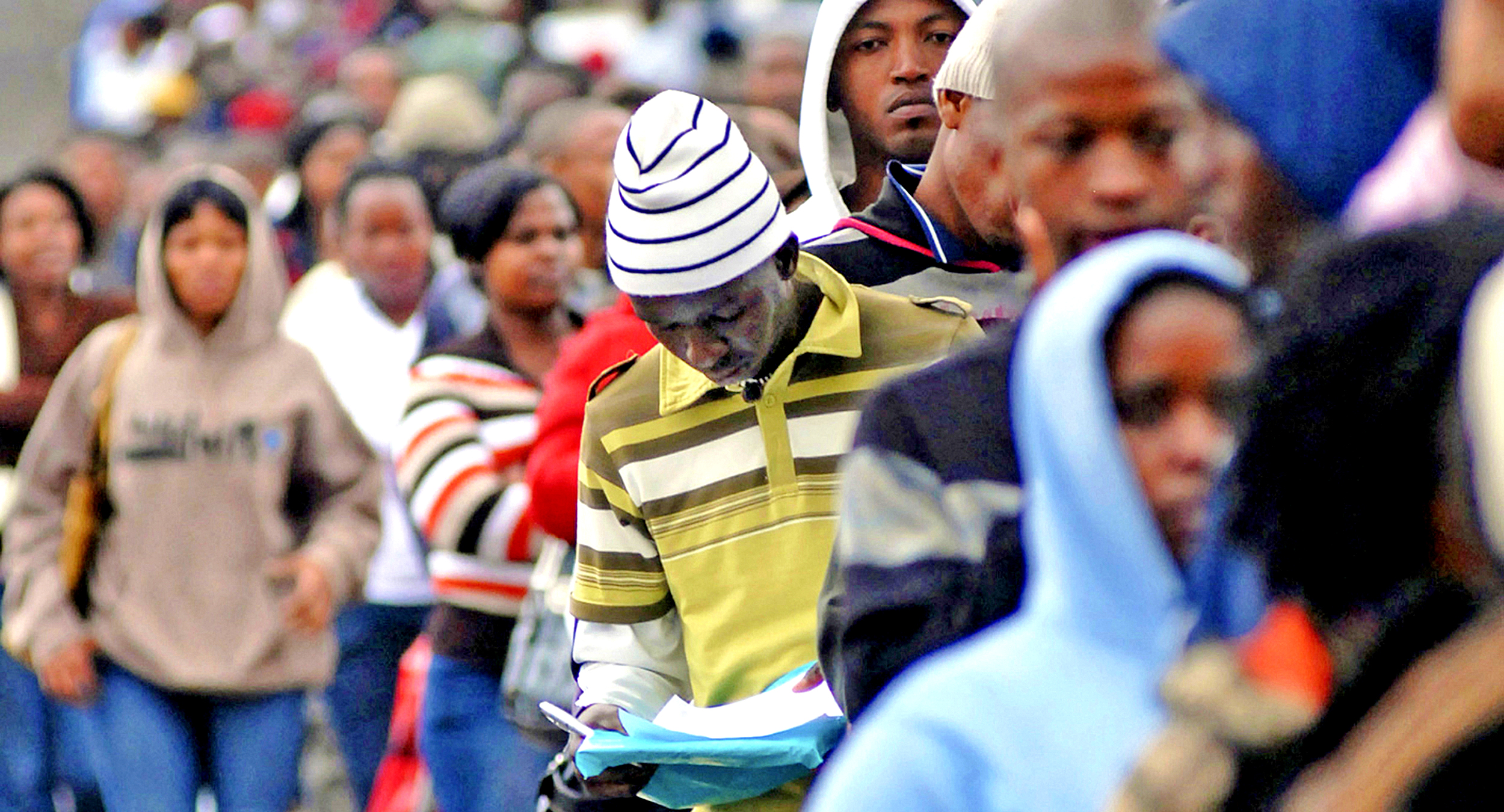
 Thousands of hopeful job applicants queue for 200 positions advertised by the Metro Police Department in Durban. (Photo: Reuters / Rogan Ward)
The Social Employment Fund (SEF) is not charity. It is paid work for the common good – and one of the clearest examples of government, civil society and communities building something South Africa urgently needs.
At a children’s centre in Riebeek Kasteel, an 18-year-old helps children write their names while quietly rebuilding his own future.
His name is Jowan Gys. He finished school last year. He comes from Esterhof, a farming community where opportunity is scarce. Through the Social Employment Fund, he earns a modest income for seven days of work a month while helping children with numbers, letters, discipline and respect. The stipend also helps him replace barbering tools he once lost, so that when the programme ends, he can restart his small business.
This is what public investment looks like when it reaches the ground.
Not a slogan. Not a tender. Not a press release.
A young man helping children write their names while learning to write the next chapter of his own life.
The wound in our democracy
At the Industrial Development Corporation (IDC) Social Employment Fund (SEF) meeting on 7 May 2026, Rian Coetzee, Executive: Industry Planning and Project Development at the Industrial Development Corporation, said something that should be placed on every boardroom table in the country:
South Africa does not lack work to be done.
He is right.
There is work everywhere: children who need safe spaces after school, households that need food gardens, public spaces that need care, young people who need structure and rural communities that need rebuilding.
Yet millions remain unemployed.
That is the wound at the heart of our democracy.
Why the fund matters
At around 1% growth, South Africa’s economy is creating far too few jobs to absorb the hundreds of thousands of young people leaving school each year. In 2025, more than 900,000 learners wrote the NSC examination, and the national pass rate was 88%, meaning roughly 656,000 learners passed.
Every year we celebrate matric results. We should. But a country cannot keep celebrating young people’s achievement while quietly accepting that hundreds of thousands of them are being released into economic abandonment.
This is why the Social Employment Fund matters.
Put simply, SEF pays unemployed people to do work for the common good for seven days a month through trusted community organisations. Participants work in food security, early childhood development, after-school support, care work, agriculture, literacy, environmental restoration and local development. The work is real, structured and monitored. Participants receive a stipend, training and experience, while communities receive services that would often otherwise not exist.
Administered by the IDC as part of the Presidential Employment Stimulus, SEF strengthens partnerships with social and civic organisations to enable “whole of society” initiatives with greater scale and impact. At the IDC meeting, Coetzee noted that SEF works with 40 strategic implementing partners, who in turn collaborate with more than 2,500 community-based organisations. More than 180,000 people have participated since its inception.
These are not abstract partnerships. They are trusted delivery networks.
Goedgedacht Trust
At Goedgedacht Trust, based in the rural Swartland, we have seen SEF change not only individual lives, but also the way a development organisation works.
Since 2022, Goedgedacht has served as a strategic implementation partner to the IDC through SEF. Through the Goedgedacht Trust Consortium, SEF has enabled us to reach seven municipalities across the Western and Northern Cape: Swartland, Redhill in the City of Cape Town, Hantam, Kamiesberg, Karoo-Hoogland, Ubuntu and Khai-Ma.
At Goedgedacht, SEF participants work in food gardens, child development programmes, after-school care, literacy support, regenerative agriculture and psychosocial support for vulnerable families.
It has also changed our discipline.
SEF has required us to move from activity-based reporting to verified impact. Every output must be logged, evidenced and reported. This has not always been easy, but it has strengthened us. It has forced us to demonstrate impact, not merely describe intention.
Across SEF Rounds 2 and 3, the Goedgedacht Trust Consortium created 4,100 work opportunities and logged 386,000 output units. Beyond these numbers, the programme demonstrated clear social and economic value: public money was converted into paid work, community service, skills development and practical support in communities where unemployment remains devastatingly high. In the current SEF Round 4, the consortium is building on this track record, with 1,200 work opportunities projected and a continued focus on ensuring that every rand invested creates value both for participants and for the communities they serve.
That is not sentiment. That is evidence.
Recovering agency — closing a painful gap
For Goedgedacht, SEF also completes a missing part of our life-cycle approach. For decades, we have accompanied children and young people through the first 8,000 days of life – from pregnancy and infancy, through childhood, school years and young adulthood.
But we always faced a painful gap.
A young person could receive support, meals, after-school care, mentoring, life skills and emotional strengthening – and still arrive at adulthood with no work to step into.
I must confess that I did not always understand SEF in this way.
At first, I thought its main value was that it could help people find jobs. I still believe that matters. We must never stop building pathways into employment, enterprise and further learning.
But I now think its deeper value is that it helps people recover agency in a country where the formal economy has no place for too many of them.
SEF does not solve South Africa’s unemployment crisis.
But it creates a bridge.
It gives people structure, income, skills, belonging and a reason to wake up in the morning. It gives them a place where they are expected. It gives them the experience of being useful.
‘I don’t feel dumb any more’
At Goedgedacht, agriculture has become one of the strongest examples. SEF participants are not merely placed in gardens. They are trained in soil preparation, composting, irrigation, propagation, regenerative agriculture, record-keeping and the business of farming.
One participant said after training: “I don’t feel dumb any more.” He finally understood what was happening on the farm. His harvest improved because he knew what had to be done. Another said that before, he “just freestyled”; now he writes things down, tracks mistakes and improves.
That sentence – “I don’t feel dumb any more” – should stop us.
Because poverty does not only empty pockets. It often convinces people that they are less capable than they are.
Good development reverses that lie.
A recent accredited regenerative agriculture course at Goedgedacht showed what is possible when rural workers are given serious training and serious expectations. Twenty-four participants completed five full days of theory, followed by three months of practical work, farm records, verification and moderation. All passed.
This is not a tick-box exercise. It is competence, earned through evidence.
Andrea Isaks, a 24-year-old SEF participant working in aftercare at one of Goedgedacht’s community children’s centres in Riebeek West, tells a quieter, but equally important story. She has always loved children, but never believed she was “cut out” to work with them. Through SEF, she found a place where she could contribute meaningfully while also learning about herself. “I know I make a difference in the children’s lives,” she says, “even if only just a little”.
That “little” is not little.
A child learns to read.
A young man rebuilds a barbering business.
A woman discovers she can work with children.
A farm worker understands soil.
A parent goes to work knowing their child is safe.
A community organisation becomes a place of trust.
Social infrastructure: How big business can help
We usually speak about economic infrastructure as roads, ports, rail and energy. Of course, South Africa needs all of these. But a country also needs social infrastructure: trusted local institutions, safe spaces for children, community-based care, food security systems and pathways for young people who would otherwise disappear into unemployment.
Without social stability, economic growth will not hold.
This is where big business must enter the room.
Corporate South Africa often says it is worried about unemployment, instability, crime, weak growth and the future of the country. These concerns are real. But concern is not a strategy.
If business is serious about stability, it must stop treating social investment as generosity and start treating it as economic self-preservation.
SEF offers business something rare: a public platform that already works through trusted civil society networks, already reaches communities, already has monitoring systems, and already produces evidence of value.
Business can strengthen SEF in practical ways: accredited training, agricultural infrastructure, digital learning, transport, water systems, psychosocial support, enterprise development and market access. Business can help emerging growers become suppliers. It can help young participants move from social employment into real livelihood pathways.
This is not charity.
It is risk management.
It is market development.
It is social stability.
It is investment in the future workforce, future consumers and future communities of this country.
SEF is not perfect. Reporting is demanding. Implementation is uneven. Some participants will not move into formal jobs. But perfection is not the test.
In South Africa, the real test is whether public money reaches people, builds capability and leaves communities stronger.
By that test, SEF matters.
The importance of civil society
The nonprofit sector has long been praised for doing much with very little. That is true. But it is also dangerous. Across South Africa, NGOs are under severe pressure. International funding is shrinking. Donor priorities are changing. Many community organisations are retrenching staff, reducing services or quietly trying to survive.
If civil society weakens, South Africa weakens.
Children lose safe spaces. Families lose support. Rural communities lose trusted institutions. The distance between citizens and opportunity grows wider.
Coetzee made another important point: civil society should not be treated merely as a subcontractor, but as a steward of outcomes. Civil society holds trust where formal institutions often struggle to reach. That trust is what allows large-scale public investment to become a real impact on the ground.
That is what Goedgedacht’s SEF work has shown.
When government provides funding, when civil society implements with accountability, and when communities participate with dignity, people do not simply receive help.
They begin to move.
Not all will find formal jobs. We must be honest about that. An economy growing at 1% cannot absorb everyone. But SEF gives people a better starting point: skills, confidence, experience, food security, routine, connection and, in some cases, a pathway into enterprise or employment.
That is not enough for South Africa, but it is far better than leaving people outside the economy completely.
The Social Employment Fund is one of the clearest examples of government getting something right. Goedgedacht’s experience shows that it can deliver measurable outcomes, human dignity and community resilience.
Now, business must help take it further.
The platform exists. Government is investing. Civil society is delivering. Communities are participating.
Business now has the opportunity – and responsibility – to scale what works.
When Jowan helps a child write their name, two futures are being written at once.
The child’s, and his.
That is what SEF makes possible.
Business should not walk past it. DM
Deon Snyman is the MD of the Goedgedacht Trust, a rural development organisation working in the Swartland region of the Western Cape.
Comments
Scroll down to load comments...