




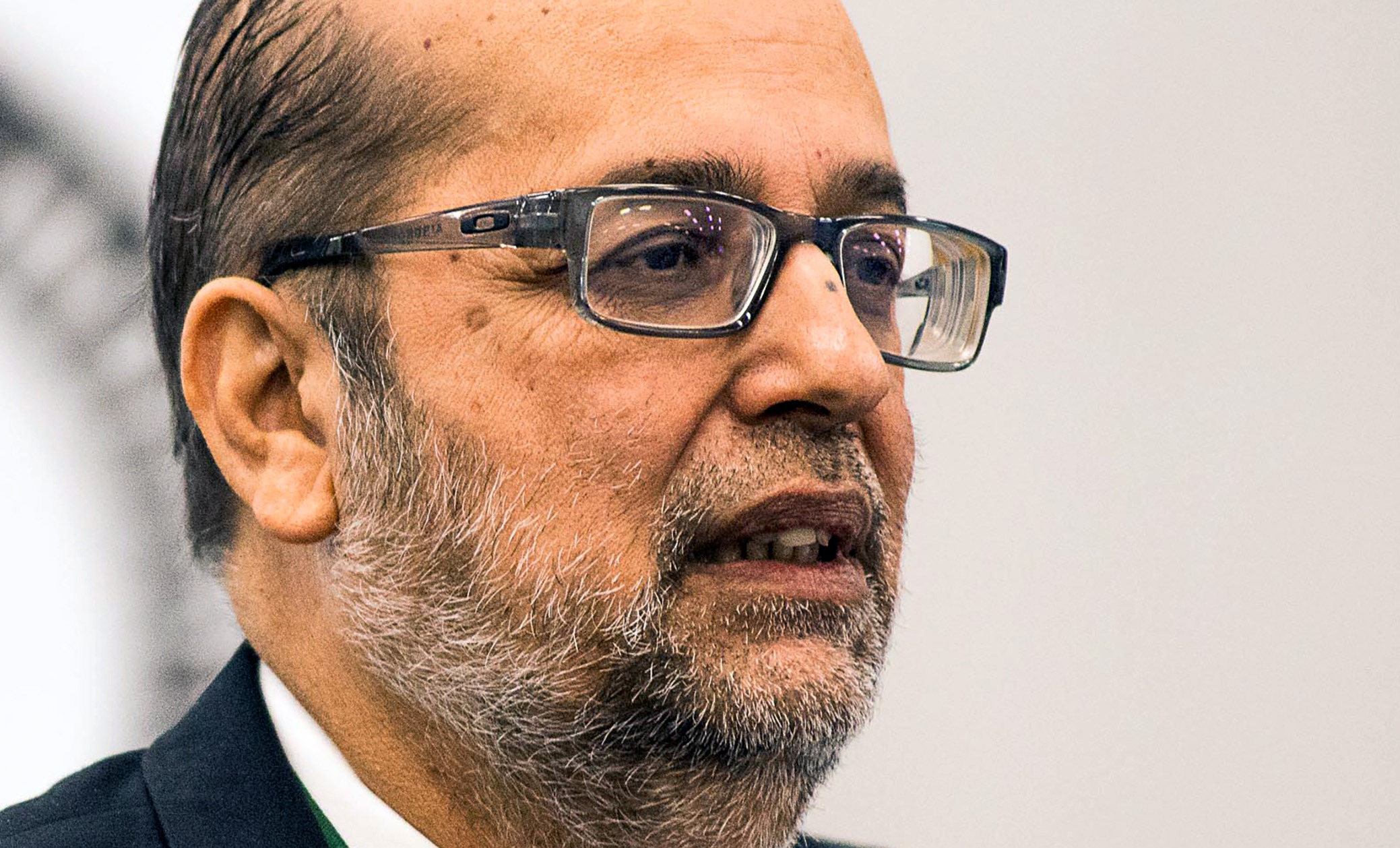
 Former communications minister Yunus Carrim testifies at the State Capture Commission of Inquiry in Johannesburg on 25 February 2020. (Photo: Gallo Images / ER Lombard)
 Of course, it’s the right of any organisation or person to take a law to court because they believe its content, or the process of it being legislated, or both are unconstitutional. But Caroline James’s “Why amaBhungane is challenging the Public Procurement Act” (Daily Maverick, 24 April) is an extreme caricature of how Parliament processed the Bill and an immense insult to the enormous work MPs and National Treasury officials put into the Bill, including through significant consultation with civil society stakeholders. I speak of the National Council of Provinces (NCOP) Select Committee on Finance (SeCOF) process, as I chaired the committee at the time. It would not be appropriate for me to speak on behalf of the National Assembly Standing Committee on Finance (SCoF).
Actually, since I’m not an MP anymore, I would have preferred Parliament’s Legal Services Unit to deal with this matter in the courts, and not to respond to James’s article at all. But given how extreme it is, how could I not? And while decisions are made by a majority in the committee, her article ultimately reflects negatively on me personally, at least in the NCOP processing of the Bill. It also makes a mockery of all that I have said, written and, together with others, done over the 30 years I was in Parliament on the indispensable role of public participation in Parliament and local government (for example, “Towards a more activist Parliament more engaged with civil society”, Community Law Centre, 20 October 2010; “Processing the Property Rates Bill”, Witness, March 2014; and several presentations: “Active citizenship crucial in an effective democracy”, 20 May 2019; “Unrealised potential: Community participation in local government”, 20 May 2002; “Linking Local Government Elections with Ongoing Community Participation”, 15 May 2011, etc).
I have long moved on from Parliament, a lot has happened since May 2024 in my political life, I don’t have all the relevant documents before me and I don’t want to burden Parliament to trace them all for me, so I won’t be able to be as thorough as I’d like. But there’s enough here, I hope, to be a useful initial response.
Let me be utterly clear upfront. There is a staggering level of corruption in our country that decimates our democracy, severely undermines economic growth and job creation, significantly impedes service delivery and development, considerably demoralises people, widens our polarisation and is destructive in so many other ways. Much of this corruption occurs through the public procurement system. And if in any way the Public Procurement Act has loopholes that allow this corruption to fester, of course it must be amended. In any case, it’s up for review soon in terms of section 68 of the Act.
But this article is not about the content of the Public Procurement Act. And it’s not a response to any legal papers before the court. It’s about the public participation process as James’s article mainly deals with that.
It’s a pity really that James can write an article like this on behalf of amaBhungane, which generally does very good work in exposing corruption within the state and in society. In fact, although amaBhungane can get things wrong at times, overall they have played a very important role, and Parliament, government, other sections of the state and the public owe them a huge debt for that.
When it comes to fighting corruption, we’re certainly on the same side. But when it comes to their Daily Maverick article, no, no…
The court may decide that the public participation process was inadequate. So, it’s not clear why amaBhungane didn’t just present its case instead of dishing out this emotionally charged, blindly one-sided, highly subjective parody.
Let me start by responding to James with some facts that she actively ignores. Of course, she knows all this as it’s in the NCOP committee’s report to Parliament (Announcements, Tablings and Committee Reports, 8 May 2024, pages 6 to 30), hereinafter referred to as the “committee report”.
Public consultation far beyond a single formal hearing
The NCOP committee processed the Bill over three months from 6 February to 7 May 2024.
The committee spent 40 hours on the Bill. This was in the formal processing of the Bill. I probably spent as many hours in engagements with stakeholders, lawyers and National Treasury (NT) officials outside of these meetings – and the outcomes of this were processed through the committee. Moreover, NT spent another 12 hours or so meeting stakeholders, as required by the committee. A report on these engagements was presented to the committee.
“To create more space and time for public participation,” the report notes, “the Committee applied for permission to the NCOP Chairperson for an extension beyond the usual eight-week cycle to process Bills. The permission was granted. According to Adv Frank Jenkins of Parliament’s Legal Services Unit, to his knowledge, this is the first time a committee has sought such an extension. The Committee, in fact, spent an extra five to six weeks beyond the eight-week cycle, which ended on or about 2 March 2024, on this Bill.”
The norm in parliamentary committees is for stakeholders and individuals to make written and/or oral submissions for public hearings. Questions are put to those who appear before the committees, and following the hearings the committees process a Bill.
But in committees I served in we often had far more engagements than just a one-off public hearing. “Instead of a 10-minute-per-input, conveyer-belt system of public submissions, we encouraged participants to stay for as long as they could, and had discussion periods regularly during the hearings in which the representatives of organisations did not simply take questions from members of Parliament (MPs), but engaged with each other, so encouraging a dialogue between civil society organisations, not just between MPs and representatives of civil society organisations.
With some bills, such as the Municipal Systems Bill, Property Rates Bill and Child Justice Bill, we allowed a representative group of civil society organisations to constantly confer with us as we processed the Bill. They were often asked to sit in committee meetings and, within limits, participate. Where possible – not always, but often enough – a week or so before voting on a Bill we sent the final draft to key stakeholders to comment on without reopening all the earlier debates.” (“Towards a more activist Parliament more engaged with civil society”)
An irate minister described this process as “rolling public participation” (a play on the ANC’s term “rolling mass action” during the Struggle era, in case you didn’t know, Ms James). A former Speaker complained that we were wrongly conflating the role of MPs and civil society.
In the case of the Public Procurement Bill, we had an initial public hearing and then a second one in which Treasury responded to the submissions of the stakeholders and they were in turn given an opportunity to respond to Treasury both at the hearing and subsequently in writing. It was only after listening to both sides that the committee began to deal with the policy issues in the Bill and later consider it clause by clause.
Importantly, the stakeholders’ submissions, including those who only made written comments, on each clause was put into a matrix and as we processed the clauses we also considered what the stakeholders had to say about them. And at times some stakeholders were brought into the committee to make inputs on sections of the Bill that they had a direct interest in. In fact, the stakeholders were allowed to make constant written submissions on the Bill up until the day before the Bill was voted on. Yet, James says that we “briefly debated the clauses” and showed “utter lack of respect for the public participation process, for the citizens and institutions seeking to improve the Bill.” How utterly absurd (to throw her word back at her)!
The committee report quotes from a letter we wrote to stakeholders: “We hope to send you the Bill with the amendments by Friday evening for you to send your comments by noon on Monday (6 May 2024). We know that some of you will argue it is too brief a period for you to comment. I’m afraid that’s the best we can do. Some of you have been engaging with this Bill over several years, including when it was first gazetted for comment and in the Nedlac process and since, including through the SCoF process. As you might know, we are not obliged in terms of Parliament’s rules and norms on processing legislation to take further comments from you beyond the engagements we have already had with you, subject to the standard of reasonableness. We will consider your responses to the amendments at our meeting of 7 May.”
The Bill wasn’t suddenly thrust on Parliament. Stakeholders had a lot of time to have a say on it even before it reached us. The process of bringing the Bill to Parliament spread over 10 years and a version of the Bill was first published by Treasury for public comment in February 2020. Stakeholders were given about four months to comment on it. The committee report noted that “[National Treasury] conducted a comprehensive consultation process with stakeholders in all spheres of government, Cabinet, and government institutions. NT also subjected the Bill to the Nedlac process for six months in 2022 and to the [National Assembly] process.” Treasury also did a socioeconomic impact assessment on the Bill. Overall, the Bill was in the parliamentary process for about 10 months.
In respect of Chapter 4 of the Bill, Treasury explained that it was based on the principles in the tabled version of the Bill and on inputs by MPs and some of the public submissions in the National Assembly process that the tabled version was vague and lacked detail. They explained that these amendments were aimed at strengthening the Bill. In any case, these amendments were in the version of the Bill tabled in the NCOP on 6 December 2023. And we did in fact make many changes to Chapter 4 based on submissions received.
Treasury explained that although the results of the MAPS process were presented at the March 2024 workshop, the MAPS report was not released. This happened in August 2024. The MAPS results are being considered in the regulations and other processes in taking the Act forward.
Parliament ’s Legal Services Unit was present at almost every SeCOF meeting and evaluated the legitimacy of the public participation process and found that it met the requirements of the Constitution. Its report was attached as an annexure to the committee report. Mostly when civil society has gone to the courts to challenge the adequacy of public participation in the processing of a Bill, the outcome was in their favour. So, why would we have the “shambolic” public consultation process that James insists it was?
The NCOP committee advertised for submissions for the public hearings to be sent in terms of the two-week deadline often used. Some stakeholders requested more time and we readily agreed to extend it by 10 days. There was no “outcry” from stakeholders. This “outcry” resounds in James’s head, not in the real world. Where’s her evidence of this? On whose behalf does she speak?
The committee had the public hearings the day after the last date for submissions. That’s often the case. In any case, some of the submissions get to the committee before the deadline date. Members get a better understanding of the submissions over time as they consider them through the matrix we work with, not in the formal public hearing. Which is why, too, that we continue to engage with civil society beyond it.
Key content issues were discussed
Often when there is a large number of submissions on a Bill, there is a significant overlap in the issues raised by the stakeholders (sometimes using much the same wording), and at times it seems as if stakeholders have been mobilised by other stakeholders or political parties to make submissions. Of course, that’s fine. But it doesn’t mean that all the key issues raised by the stakeholders are not addressed in a Bill if absolutely every submission is not thoroughly scrutinised. It is not National Treasury alone that goes through the submissions on a Bill, but also the committee researcher, content adviser, Legal Services Unit representative, the committee chairperson, other MPs, the researchers of the political parties and at times an external expert.
The committee report covers in detail the views of the stakeholders, Treasury and the committee. As far as I know, no stakeholder complained that their submission had been completely ignored. In fact, many of the changes made in the Bill came from the submissions of the stakeholders. There were more than 100 amendments made. There were some excellent contributions from stakeholders who are technical experts with considerable experience in public procurement and we learnt a lot from them. They certainly helped to improve the quality of the Bill.
And we certainly didn’t just meekly accept Treasury’s views. The video clip James uses of me objecting to Treasury’s far-too-frequent use of “noted” in response to the stakeholders’ views in the matrix actually serves to undermine James’s argument that we blithely whizzed through the Bill in no time.
In fact, following our concern about too many proposals being “noted”, I met Treasury and got a far better response to the issues raised by stakeholders than what was in print. They explained that their “noted” responses related to issues that were not relevant to the content of the Bill but to the regulations, guidelines and aspects of implementation of the Bill in future, and that this would also entail further consultation. And, as the committee report notes, the “verbal responses by [National Treasury, NT] were significantly better and more comprehensive than the written submissions, especially because NT was constantly challenged by Committee members in robust exchanges. The Committee thoroughly went through NT’s report on its April meeting with stakeholders and its other responses to the stakeholder’s submissions.” Where was James when all this happened?
“The only reason there were any “time constraints” was because Treasury and Parliament wanted to get the Bill passed before the 2024 national elections,” she claims. “The chair of the NCOP’s committee acknowledged this. Yunus Carrim said: ‘The majority party needed to get this Bill through because it was part of its election manifesto, so it wanted to do it as quickly as possible. The opposition parties opposed this Bill, so they would create stumbling blocks like going to court, to prevent this from happening. This was so they could tell the public they had stopped the Bill and should be voted for in the upcoming elections. This was politics.’”
But James skews the context and meaning of this quote to suit her subjective needs. What she doesn’t say is what the PMG minutes (6 February 2024) from which she draws this quotation says just before it: “Addressing concerns over public participation timelines, the Chairperson assured Members of ongoing negotiations with the National Assembly, and stressed the importance of adhering to constitutional and legislative requirements. He cautioned against politicising the Bill, and urged a balanced approach to empowerment and efficiency.
“… the Chairperson urged Members to focus on the concrete provisions of the Bill, rather than polarising the debate. He emphasised the need for balanced empowerment measures and called for careful consideration of the implementation capacity at both national and provincial levels… He underscored the Committee’s commitment to thorough deliberation within constitutional and legal constraints, emphasising the imperative of efficient governance and inclusive economic transformation
“… He had been around for a very long time, and people often brought up (public participation) processes because they were opposed to a particular viewpoint (meaning clauses in a Bill). In this case, there were two opposing imperatives.” Then follows the quotation…
What’s bad about what I said? Isn’t this what happens in most parliaments on the eve of an election? MPs look too much at how Bills advance or hold back their electoral prospects. I raised the need to avoid this. What I said was meant to urge both the ANC and the opposition parties to look at the Bill on the specific merits of its content and also not use public participation deadlines as an excuse to stop processing the Bill because they don’t agree with its substance.
Given the number of hours spent on the Bill and much else said above, how, just how, can it be possible for James to say that we were “not interested in amending the main content of the Bill based on any submissions received from the public” and that they had “no chance of a meaningful contribution”? Where did many of the amendments come from if not the submissions? How could the committee report have covered the policy issues if they had not actually been dealt with in committee meetings? How could you reduce 40 hours of sittings in a committee and an extensive report on the key policy issues in a Bill to a “mere box-ticking exercise”? So what is James’s take on what we did in those 40 hours? Sing freedom songs and toyi-toyi?
We must be clear: while some stakeholders opposed the Bill, others strongly supported it. Understandably, those who opposed it dominated the processing of the Bill. Many of the stakeholders did not have major problems with the public participation process but with aspects of the content of the Bill. In fact, some of these stakeholders even contacted me to thank the committee for giving them so much space to have their say, one even saying something to the effect that he was very surprised at this.
Main concern of stakeholders was content, not participation, issues
Often – certainly not always – when stakeholders take an Act to court on the grounds that there wasn’t enough public participation, that they were not heard sufficiently, it’s because they disagree fundamentally with the content of the Act. They hope the courts will decide that the public participation process was inadequate so that the Act is reopened for them to pursue their views on what should change in a Bill.
While there was an overlap among the stakeholders on aspects of the Bill, different stakeholders opposed different aspects of it. Even if we had processed the Bill for another 40 hours it’s unlikely that we would have found agreement on the main policy differences on the Bill. Ultimately, SeCOF did what it had the right to do – vote on the Bill. That’s democracy at work.
James claims that I was “snarky” and “moaned” that civil society had sought to co-govern and not assist Parliament in executing its fiduciary duties”. I can’t recall saying the second half of this sentence, but I certainly said the first. It was in response to a letter received from some of the stakeholders. The PMG minutes (23 April 2024) has this: “To him, it seemed that, in this case, civil society had sought to co-govern and not assist Parliament in executing its fiduciary duties.” But the minutes also have this: “The Chairperson expressed his dismay at the tone and attitude of the letter. It gave the impression that the organisations sought to co-govern the country instead of providing meaningful and substantive advice to Parliament (my emphasis).”
The response was reasonable in the context. It was no “moan” or being “snarky” or taking snipes (what other “snipe”, by the way?). In some form or another I have raised in other more cordial contexts something similar about both Parliament recognising the value of public participation and civil society acknowledging that ultimately Parliament has the constitutional right to make the final decisions.
If I were part of a committee that was so contemptuous of public participation, why would NGOs ask me to speak at their workshops on the role of civil society organisations in Parliament? And even after I left Parliament?
So, a senior Treasury official told James and a colleague that they should stop the Bill in Parliament. So what? In a big department like Treasury, with a Bill like this one, that’s hardly surprising. Every now and then there’s a department official or more who doesn’t agree with a Bill, not just in this country but in many other democracies. Why was she “gobsmacked”? And why could she only “stammer” that “we were trying our best”? Her latter words echo the sense that she was the heroic do-gooder fighting the malicious, malevolent baddies. How could she be trying to do her best when amaBhungane did not make an oral submission to SeCOF, only a written one? And her being knocked over by the Treasury official’s words, finding the process an “eye-opening experience” and her other responses make one wonder how much experience she has of Parliament and its public hearings. And it seems she’s not clear about the specific roles of the National Assembly and NCOP committees in considering section 76 Bills, and sometimes confuses what happened in which committee.
Review of the Act pending
The request by some stakeholders that the Bill not be passed and be referred to the next parliamentary term was not reasonable. The Bill had been a long time in the making. A lot of work was put into it in the parliamentary process, as explained. And it would have meant delaying the Bill for maybe another two years or more. In recent times there has been a high turnover of MPs after elections. This would have meant a significant majority of the two finance committees would be new members – as indeed has happened – who would have to get to grips with a complex Bill, and that would take quite some time.
But it’s not as if we were immune to possible gaps in the Bill. For a Bill to be effective, the regulations adopted and the capacity and resources for its implementation, among other issues, are important. It’s through addressing this that over time the usefulness of a Bill can be evaluated and changes to it may become necessary. Also, the committee did not accept some of the stakeholders’ proposals on the Bill about which they felt strongly. So the committee decided that the Bill passed by Parliament should be seen as a “first phase” bill. There should be a “second phase”. This has been done in different forms with other Bills anyway. The committee decided on section 68 of the Act:
“The Minister must:
(a) within 24 months after this Act is first published as an Act in the Gazette, review the implementation of this Act and the need for amendments to this Act;
(b) consult stakeholders, including Nedlac, during the review; and
(c) within 27 months after this Act is first published as an Act in the Gazette, make public a report on the review and submit it to Parliament.”
So, amaBhungane and the other stakeholders are free to engage further on the Act in this process.
My overall response can be seen as acerbic. If so, I apologise to the reader. But James has brought this upon herself by the extreme words she used and the general tone and timbre of her language. She says that many MPs treat constituents with contempt and have utter lack of respect for the public participation process. That may be true of some MPs but certainly not the majority. She speaks of a “cauldron of insults”. Really? I cannot recall a single instance of a member of the NCOP committee insulting her or any other stakeholder. It’s actually James who shows utter lack of respect for our democratically elected Parliament with voters deciding the outcome of who ends up in Parliament, for better or worse. What does James want? For amaBhungane to appoint the MPs?
Much of what she says is “political posturing”, which James accuses us of.
And if the public participation was the circus made out by James, why did the vast majority of stakeholders not stampede the courts? It’s Solidarity, the City of Cape Town and the premier of the Western Cape that’s gone to court. And amaBhungane has chosen to join them.
All of this is not to say that everything James says, stripped of the melodrama, has no value. Obviously, the court will come to its independent decision. But it doesn’t justify her semi-surrealistic account of the processing of the Bill. It simply wasn’t the circus she makes it out to be.
AmaBhungane is an investigative journalism organisation. But James’s article is largely a highly subjective and very personal account. Where’s the “investigative” fact-based side? And where is the adherence to being “truthful, accurate and fair”? DM
Yunus Carrim was an ANC MP from 1994 to 2024 and is an SACP Central Committee and Politburo member.