




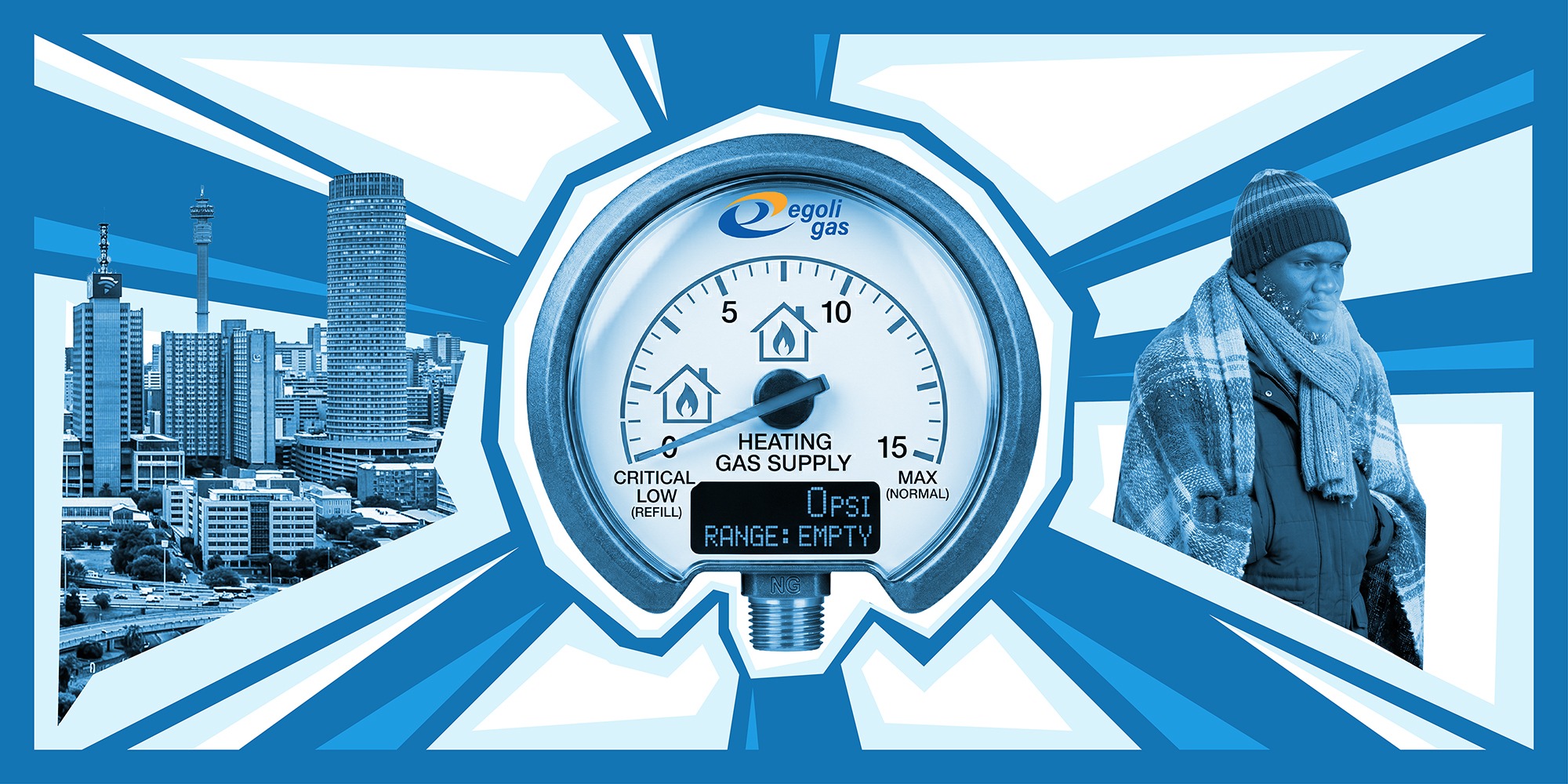
 Egoli Gas has cut off supply to Joburg’s inner east just as winter sets in. (llustration: Kevin Momberg)
Piped gas supply to parts of Johannesburg’s eastern inner city – including sections of Yeoville, Berea, Hillbrow and Observatory – was terminated in April, leaving some of the city’s most densely populated and low-income communities scrambling to afford alternatives just as winter sets in, with residents saying they were promised rebates of about R8,000 to help cover conversion costs.
Egoli Gas said the decision to terminate supply followed extensive internal assessments and was driven primarily by safety concerns.
“Following technical, operational and safety assessments, a decision was taken to terminate supply to customers in certain parts of the Eastern Johannesburg network,” the company said in reply to Daily Maverick.
It said a combination of factors had made it increasingly difficult to safely operate the network in these areas.
“This decision is driven first and foremost by safety. In addition, a combination of illegal utility connections, tampering, building access constraints, encroachment, informal settlement activity, and elevated crime and security risks has significantly impaired Egoli Gas’ ability to safely inspect, maintain, repair and operate parts of this network.”
The company stressed that the inability to access infrastructure was a critical issue.
‘Safety cannot be reasonably assured’
“Where a distributor cannot safely access or maintain infrastructure, public safety becomes the overriding consideration. Egoli Gas cannot continue operating infrastructure in circumstances where safe maintenance and emergency response cannot be reasonably assured.”
It added that its position was grounded in the legal and regulatory framework governing gas supply.
“Egoli Gas’ position is governed by the applicable gas by-laws and legal framework, which make provision for the termination of supply where continued operation is unsafe, impracticable or otherwise not feasible.”
The company rejected claims that it was obligated to continue supplying affected areas or compensate residents.
“For this reason, any suggestion that Egoli Gas is obliged to continue supplying unsafe or non-viable areas is incorrect,” it said. “Egoli Gas does not accept that there is any automatic entitlement to compensation, conversion assistance or rebates arising from such terminations.”
It also denied that the shutdown targeted lower-income communities.
“Egoli Gas rejects any characterisation that these decisions are based on income profile or any other improper consideration. Network decisions are made on the basis of infrastructure condition, safety, accessibility, operational sustainability and feasibility.”
The company said it remained committed to maintaining a viable core network.
“Egoli Gas remains committed to maintaining a safe and sustainable core network and to engaging directly and responsibly with affected customers within the proper operational and legal framework.”
Residents question cost and timing
Residents say the reality on the ground told a different story – one of sudden disruption, rising costs and limited support.
Beauregard Tromp, an Observatory resident, said the timing and impact of the shutdown had left many households reeling.
“The gas cut-off comes just as we’re heading into winter, with many of us relying on gas for cooking and heating. It’s hard to imagine it being more ill-timed. This is a basic service that has been outsourced by the City to a private consortium acting in a typically cutthroat manner.”
/file/attachments/orphans/Anna-Egoli-Cutoff_677528.jpg "Beauregard Tromp from Observatory. (Photo: Supplied)")
He questioned the reasoning provided.
“They presented us with stories of ‘poor soil conditions’ for the gas pipes, as if the soil is any different to neighbouring Houghton or Norwood. It leaves one with a strong suspicion that they’re simply targeting working-class and lower middle-class areas.”
Tromp said the financial impact had been severe.
“From my own estimates and speaking to neighbours, the cost of a basic conversion to LPG runs to about R30,000 on average. Many of us spent a considerable sum investing in natural gas devices in an effort to be more energy efficient. Many of those devices are now simply expensive ornaments.
“In these trying times this is an additional cost not many can afford, with some having to reach into their bonds or taking on additional credit. Egoli Gas never offered us any assistance towards conversion. Queries to their helpline were left unanswered,” he said.
“One of the few advantages of living in ‘Old Joburg’, where the infrastructure is crumbling quicker than in much of the rest of the city, has been access to natural gas. Even this has now been taken away.”
‘Huge burden’ for households
Tshepo Mtubatuba, a Yeoville resident, said he had already spent R15,000 converting to a private gas supply.
“I have not had the R8,000 refund. They didn’t tell us,” he said. “It was a huge thing to carry out the conversion. People who can’t afford this amount of money are suffering. Most are just using gas cylinders, but this gets expensive – especially now with winter setting in. We were also only given one month’s notice, so it was unexpected and placed a big burden on people.”
Costs
For a typical two-bedroom flat or small house, households are now facing conversion costs of roughly R10,000 to R20,000, depending on the appliances involved.
Residents say the costs are often significantly higher in practice, particularly where multiple appliances or geysers are involved.
While bottled gas can be cheaper for cooking and hot water, the shift is not straightforward. A typical household using LPG for basic needs may spend R600 to R900 a month, but where residents are forced onto electricity – particularly for geysers and heating – costs can rise to R1,200 to R1,700 or more.
Unlike piped gas, which provided a continuous and relatively stable supply, bottled gas requires upfront purchases and regular refills, while electricity remains both costly and unreliable.
Civic groups warn of impact
Nomsa Mabatha, of the Yeoville Bellevue Civic Association, said residents had been caught off guard – even though they were aware of what had happened in Kensington.
“It is a private company, so we can’t tell it what to do. Residents lost the case in Kensington,” she said. “There are a lot of people who relied on gas and are now battling, having to buy expensive gas bottles.”
/file/attachments/orphans/Anna-Egoli-Cutoff2_785313.jpg "Nomsa Mbatha of the Yeoville Bellevue Civic Association. (Photo: Supplied)")
Kensington case set precedent
The situation mirrors an earlier shutdown in Kensington, where residents attempted to stop Egoli Gas from terminating supply through the courts.
The high court dismissed the application, finding that as a private company, Egoli Gas is not obliged to continue supplying an ageing or economically unviable network.
During that shutdown, Egoli Gas offered residents a package to convert to bottled gas that included a rebate of about R8,000 – increased from an initial R3,000 – along with LPG cylinders and other incentives.
At the time, the Kensington Community Association urged residents not to accept the offer, describing it as inadequate and warning that households were being forced into a costly transition.
Reports indicated that a majority of affected households eventually accepted the offer, although it remains unclear how many residents received the full rebate or were able to cover the remaining costs of conversion.
In its response to questions for this article, Egoli Gas did not confirm whether a similar package was being offered to residents in Yeoville, Observatory or other currently affected areas, nor did it provide details on how many households had received any financial assistance.
Onset of winter
The shutdown has largely affected older, high-density neighbourhoods – including parts of Hillbrow – where households are least able to absorb sudden costs.
While Egoli Gas maintains the decision is based on safety and operational feasibility, residents say the pattern raises broader concerns about who carries the burden when essential infrastructure is withdrawn.
As winter sets in, the consequences are becoming increasingly stark.
For many households, the issue is no longer which energy source is cheaper – but whether they can afford reliable energy at all. DM
Comments
Scroll down to load comments...