




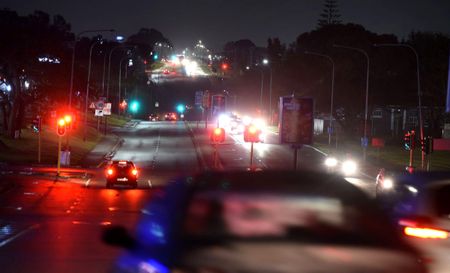
 Nelson Mandela Bay’s streetlight tender scandal resulted in more than 10,000 streetlights going unrepaired or unreplaced, leaving vast areas of the city in the dark for years. (Photo: iStock)
 The Nelson Mandela Bay Municipality administration’s apparent lack of willingness to take decisive action against 21 officials implicated in the R35-million streetlight tender scandal “points to the absolute failure of consequence management [in the metro]”, according to Marina van Zyl, a DA MP and member of Parliament’s portfolio committee on cooperative governance and traditional affairs (Cogta).
Van Zyl said, “Residents must note these allegations of serious corruption that are met with delays and political protection instead of bold and decisive leadership. The buck stops with Mayor Babalwa Lobishe and her administration. Under her watch, governance in [Nelson Mandela Bay Metropolitan Municipality] has deteriorated into chaos, with residents paying the price through collapsing service delivery, failing infrastructure and no plan for the recent disasters that have hit the metro.
“Nowhere can an employee still remain at the same desk they influenced to enrich themselves with public money.”
The leader of the Mayibuye Civic Movement, Tukela Zumani — who raised the alarm on the scandal — accused the administration of failing residents by delaying action.
Zumani said the apparent reluctance to suspend implicated officials pointed to deeper dysfunction within the municipality’s leadership structures.
/file/attachments/2990/WhatsAppImage2026-03-24at183821_157607.jpeg "The leader of the Mayibuye Civic Movement, Tukela Zumani. (Photo: Supplied / Facebook)")
According to a Special Investigating Unit (SIU) report — previously presented before the Cogta committee and before the council in April — evidence of alleged misconduct involving 21 municipal officials was referred to the municipality between 25 November 2025 and 31 March 2026.
The SIU probe stems from a whistleblower report by Zumani, who flagged alleged irregularities in streetlight tenders approved by the metro on 10 November 2020.
‘Internal assessment process’
Municipal spokesperson Sithembiso Soyaya said, “Given the extent, complexity and seriousness of the matters raised in the report, the municipality is currently undertaking a detailed internal assessment process to ensure that all matters are handled lawfully, fairly, procedurally, and in line with applicable labour legislation, governance frameworks, and principles of administrative justice.
“It is therefore important to indicate that it would be premature and unrealistic at this early stage to expect the municipality to have already finalised or implemented all disciplinary, precautionary, or administrative processes relating to the matters raised in the SIU report.”
Soyaya denied that the city was reluctant to suspend officials.
Zumani said one of the most glaring issues was the absence of a permanent municipal manager to take decisive action.
“The city does not have a municipal manager, who ultimately bears the burden of taking such action. Even when there was an acting city manager ... no action was taken. So there have to be other factors contributing to it.”
DA councillor Ondela Kepe wrote to the then acting city manager, Lonwabo Ngoqo, on 20 April, urging the municipality to act against officials implicated in the scandal and to launch a forensic investigation into the electricity and energy department.
Nearly a month later, Kepe said he had yet to receive a response and believed it was unlikely one would be forthcoming.
/file/attachments/orphans/OndelaKepe_503202_342863.jpeg "DA councillor Ondela Kepe, (Photo: Ondele Kepe)")
“The first motion I submitted was already in January, but it was voted out in council. It has now been five months since I first engaged with the acting city manager’s office and I have still not received an adequate response. It shows there is no appetite for consequence management or accountability. It is very telling of the state we are in,” he said.
However, he said he hoped newly appointed acting city manager Charity Sihunu, who was deployed to the municipality from the Eastern Cape Department of Cooperative Governance and Traditional Affairs, would adopt a different approach.
‘Compromised’ officials
Meanwhile, Zumani suggested that those responsible for instituting disciplinary processes may themselves fear being implicated.
“One can only hope it is not a matter of everyone being affected in one way or the other by these disciplinary actions that need to be taken,” he said.
“If someone is in a position where they need to take action against people who might also be able to implicate them, they are most likely reluctant to take action.”
He said the failure to act could indicate that officials tasked with responding to the scandal were “compromised themselves” and feared “rocking the boat”.
Zumani linked the alleged corruption in the electricity and energy department to worsening service delivery failures across Nelson Mandela Bay.
He said corruption within the department was being “felt on the ground” through deteriorating electricity infrastructure and recurring outages.
“Nelson Mandela Bay is experiencing a severe collapse of service delivery when it comes to the electricity and energy department,” said Zumani.
He added he had “absolutely no hope left” in the current administration and criticised delays in appointing a permanent executive director for electricity and energy. The electricity and energy department is one of several departments in the municipality without a permanent executive director.
Zumani said, “The rot in the electricity and energy department is not confined to the two streetlight tenders that have been thrust into the public eye in recent times. It is a department in disrepair. It is a department of chaos. It is a department of dysfunction.”
The who, what and how of the SIU
In April, the Nelson Mandela Bay council was presented with a report detailing a series of questionable processes in the awarding of a R35-million streetlight tender, dating back to November 2020.
The report was the product of months of intensive investigative work by the Special Investigating Unit (SIU).
While the SIU has gained momentum with several high-profile investigations in recent years, its origin and mandate may be a mystery to some.
SIU spokesperson Selby Makgotho explained that the unit was established in terms of the Special Investigating Units and Special Tribunals Act of 1996, when a need was identified for a special independent authority to probe malpractice and maladministration of state resources.
“The purpose was to streamline the recovery of state funds lost due to corruption, maladministration and malfeasance. The SIU is an independent unit that is brought in by state entities when misconduct is suspected and swift action is required.”
Makgotho said the unit investigates a matter after it has been reported through government structures and the President issues a proclamation that the SIU become involved.
The unit has authority similar to the police and National Prosecuting Authority (NPA) in that it can subpoena and interrogate witnesses and seize evidence — such as financial, cellphone and digital records — needed to conduct a full forensic investigation into the allegations that initiated the probe.
Once the investigation is complete, the SIU has the mandate to institute civil litigation to recoup any funds lost due to maladministration.
This is where the second part of the Act — the special tribunal — comes into play, explained Makgotho.
“Because the courts are often inundated with civil matters, and cases can drag on for months or even years, it was found that a special court is needed to streamline the process of civil litigation where government funds are at stake.
“The special tribunal consists of independent judges, appointed on a fixed term, to focus on matters brought before them by the SIU.”
He said the Special Tribunal has the same judicial power as a high court when it comes to civil litigation.
Parties implicated during the SIU investigation will have the same legal rights as they would in a normal high court when they appear before the special tribunal.
Makgotho said the SIU’s mandate does not extend to criminal prosecution.
“If, during its investigation, the SIU uncovers evidence that points to criminal conduct, it can make recommendations to the NPA to pursue the matter.”
Once an investigation is completed, the state entity where the alleged maladministration took place will be expected to foot the bill.
The R35m streetlight tender
The SIU launched its investigation into the NMB streetlight scandal after Zumani flagged irregularities in R35-million worth of contracts approved in November 2020. The real-world consequence was devastating: more than 10,000 streetlights went unrepaired or unreplaced, leaving vast areas of the city in the dark for years.
The SIU was instructed to investigate and recoup the funds. It flagged 21 municipal officials and 20 contractors for their alleged involvement in the scandal. Their names have reportedly been referred for possible criminal and civil litigation.
Recommendations were also made that nine service providers and their directors be blacklisted as municipal contractors.
The municipality is yet to cover the costs for the SIU’s investigation. DM