



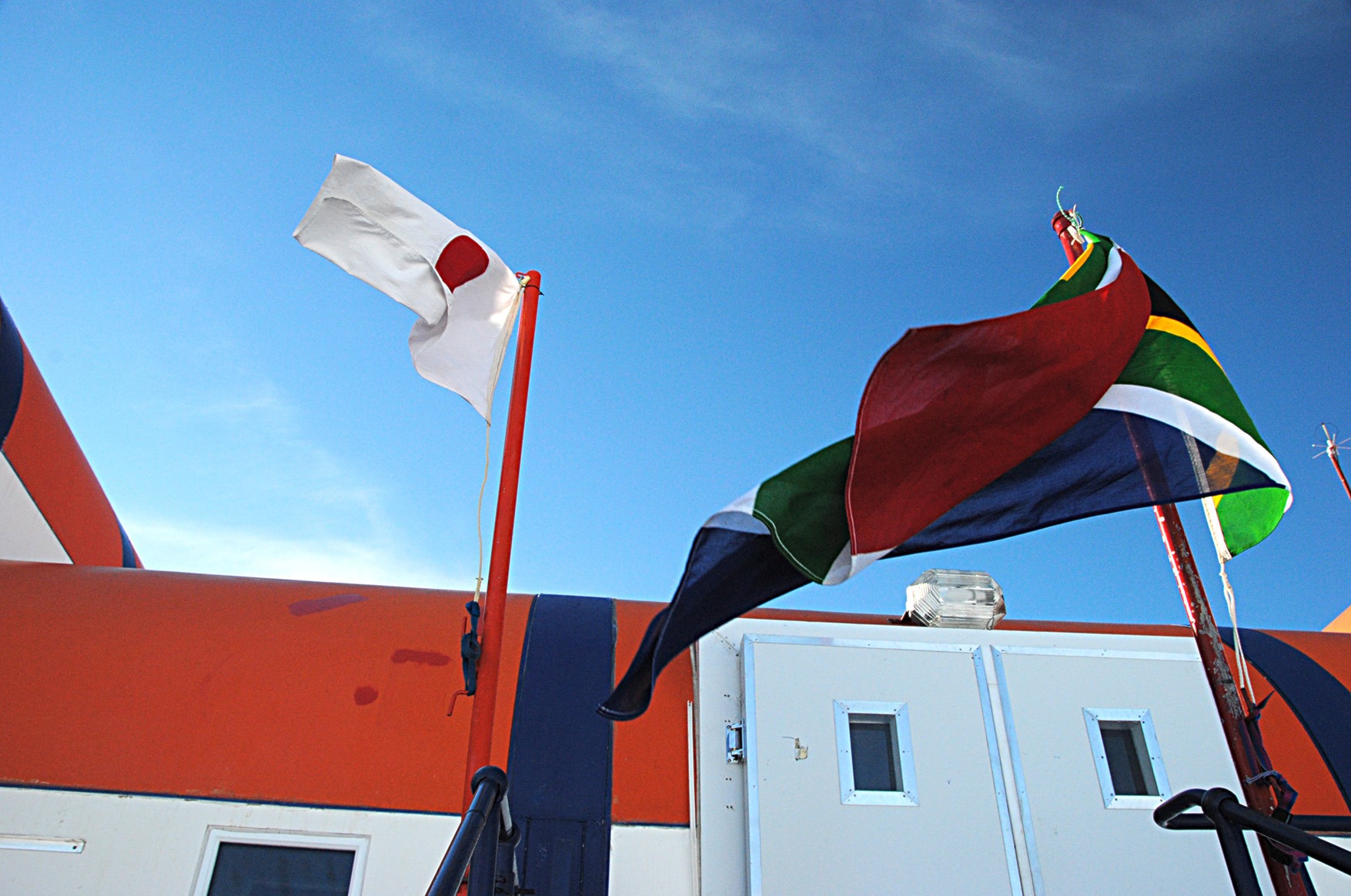
 In the interests of transparency, South Africa's East Antarctic research station opened its doors to an inspection team from Japan on 7 February 2010. These states represent two of 12 founding consultative parties to the 1959 Antarctic Treaty. About 16 years later, Japan denied press accreditation to Daily Maverick – a South African news organisation – to conduct public interest reporting on the 2026 Antarctic Treaty Consultative Meeting in Hiroshima, Japan. (Photo: Tiara Walters)
Today, as delegates gathered in Hiroshima for the latest closed-door Antarctic Treaty Consultative Meeting (ATCM), Japan had an opportunity to do what no rotating host nation had done in almost seven decades: honour its own transparency rule.
Instead, early signs suggest something more familiar – and troubling. One of the world’s most consequential environmental forums was once again staged behind a carefully managed façade of openness.
At the centre of this contradiction lies Rule 8 of the ATCM. Updated as recently as October 2024, it is unambiguous:
“The opening plenary session shall be held in public … ”
Not partially public. Not symbolically public. Public.
Yet, as Daily Maverick has documented across meetings from Paris to Milan, that requirement has been steadily hollowed out — reduced in practice to a brief, stage-managed opening ceremony while substantive discussions proceed out of view.
Our scrutiny of 66 years of records has shown that only the diplomatic ceremonial speeches, lasting about 20 or 30 minutes, are inconsistently streamed.
The full legally public opening plenary session normally lasts two or three hours behind closed doors.
The Kobe case: a window into a closed system
On 1 May, the foreign ministry’s ATCM secretariat reportedly rejected an application by Kobe University – and its internationally respected polar law institution – to observe part of the Hiroshima opening session.
The Polar Cooperation Research Centre, said its director Akiho Shibata, has “an important role in education and outreach on Antarctic issues” and vowed to “analyse this case objectively”.
Shibata, a law expert writing on his LinkedIn profile, said the Centre intended “to follow [the case’s] consequences”. A media researcher from the centre had also applied for accreditation to two press conferences. This, too, was rebuffed, Shibata wrote.
Asked for comment, he referred to a 742-word document and told Daily Maverick: “I have no further comments at this moment beyond what I have already commented in my working document dated 3 May. If you intend to refer to my name (or Kobe University) in your article, please quote my texts precisely and in its entirety.”
The question, then, is not whether diplomacy is usually private. It is whether this particular forum is complying with the one moment of a 10-day meeting of global interest it has committed to making public.
On that test, Hiroshima is already falling short.
And how much of #ATCM48 will escape the #IceCurtain? https://t.co/PGuvKmIYxX
— Andrew Darby (@looksouth) May 12, 2026
The UN is a completely separate intergovernmental system.
It livestreams its opening sessions to the global public and it typically opens press accreditation three, four to five months ahead. The substance of its meetings is also closed.
Tokyo opened press accreditation for the Hiroshima opening session and two press conferences five weeks before the ATCM.
In a press statement, the foreign ministry has framed transparency, tourism and climate change as the top themes for this year’s meeting.
Tokyo denies Daily Maverick’s request for press accreditation
Daily Maverick first emailed Japan’s foreign ministry with a detailed set of questions on 5 August. Would access details to the opening plenary be advertised in an early fashion, allowing arrangements for international travel to be made?
At the time of publication on 12 May, after the 2.5-hour opening session had wrapped, we had not received streaming details despite multiple sets of questions sent repeatedly since August.
Specialising in Antarctic investigative reporting, Daily Maverick did not receive a decision on our application for press accreditation.
Our application was acknowledged by the ATCM secretariat. “We have already received your application,” it noted on 5 May. “We will inform you of the details for media opportunity probably on 7 May.”
On 8 May, we received “interview guidelines” – but the secretariat had denied our 28 April request to interview ATCM chair Hideki Uyama.
On 5 May – just a week before the Hiroshima talks – an email from the ATCM secretariat conceded that “only” Japanese media had been accredited up to that point. We sent a follow-up email to the secretariat, asking for clarification on why Japanese media claimed to have interviewed Uyama on 1 May when at least one request by international media was given the cold shoulder.
Predictably, we received no response and subsequently attempted to crowd-source the link on social media.
The Buenos Aires-based Antarctic Treaty secretariat, which has no media spokesperson, did not respond to immediate requests for comment on 12 May. The opening session has come and gone – a de facto denial wrapped in silence.
Caution behind the Ice Curtain
Several Antarctic law experts turned down our comment requests due to political sensitivities, institutional ties or involvement in the meeting.
The Antarctic and Southern Ocean Coalition (Asoc) explained the persistent systemic trials they face as the only environmental advocacy group with embedded access.
“It is very difficult for Asoc to challenge the status quo because our influence as an observer is very limited,” argued group campaigner Meike Schuetzek.
But formal “observer” status applies to the likes of the Scientific Committee on Antarctic Research and the treaty’s fisheries commission. Asoc is actually an official “expert” organisation that tables a yearly report. At 21 registered delegates, it likely sent the largest non-state delegation to ATCM 2025 in Milan, Italy – where only one member of the press reported gaining entry into 30 minutes of the opening session.
“Asoc plays a minor role in the meeting, which both democratic and non-democratic member countries attend,” argued Schuetzek. “If a group of member countries advocated a stronger presence of transparency, we would of course welcome the opportunity to support this, but given our current role, it seems difficult.”
For “some” diplomatic discussions, the group was “asked to leave the room”.
/file/attachments/orphans/JapanSouthAfricaninspectionwelcome_931361.jpg "Professor Ian Meiklejohn of Rhodes University welcomes an inspection team from Japan at Sanae IV, South Africa's Antarctic research station, in Queen Maud Land, East Antarctica, 7 February 2010. (Photo: Tiara Walters)")
For its part, Hiroshima extends a two-year public blackout: no public livestream and no streaming details received by Daily Maverick spanning a collective 19 months of requests to both Japan and Italy.
This year, the opening session agenda included applications by Belarus and Canada for consultative (decision-making) powers which have stalled since Russia’s illegal full-scale invasion of Ukraine, a fellow consultative party. Ukraine has blocked Belarus’s application; Chinese and Russian vetoes have marooned Canada on the observer island.
The 2026 opening session included feedback from the Committee on Environmental Protection (CEP) as well as a report from the Commission for the Conservation of Antarctic Marine Living Resources (CCAMLR).
Yet, ATCM 2025's post-hoc minutes reveal that CCAMLR’s feedback session dropped a global krill bombshell: “Several parties expressed concern” that a lapsed conservation measure blocked by China and Russia had resulted “in the highest krill catch in the region for decades”.
Thus, treaty states knew about the record catch by the time it was leaked to the Associated Press end July. Days later, on 5 August, the wire organisation reported that Antarctica’s krill fishery was “shut down” after a record catch triggered an “unprecedented early closure”.
It was Antarctic news dynamite. And it was discussed behind the Ice Curtain.
Antarctica and its surrounding ocean regulate our climate, store carbon, and support life globally. As #ATCM48 kicks off in Hiroshima, Japan, ASOC urges Parties to act decisively to protect this vital region, for nature and for humanity. #ProtectAntarctica pic.twitter.com/aycvX8KPIt
— Antarctic and Southern Ocean Coalition (@AntarcticaSouth) May 11, 2026
What even is “public”?
ATCM 25 yielded another transparency-themed bombshell. While arguing for the standard and necessary diplomatic confidentiality that defines most international conferences, the Netherlands, Australia and South Korea also tabled a historic call for more transparent meetings based on a phased approach.
South Africa, when asked for comment, said it supported a balance between openness and confidentiality. It also supported Rule 8 as a public event – but flagged that there was no standard definition of the word “public”.
Not being entirely content to cosplay as the match girl of Antarctic governance journalism, Daily Maverick channelled the determined ghost of Ernest Shackleton and asked other experts.
Professor Alan Hemmings, an Antarctic governance specialist at the University of Canterbury in New Zealand, did not see the definition as particularly mysterious.
“Well, my Oxford English Dictionary’s opening explication of ‘public’ is ‘of or pertaining to the people as a whole’. Which seems a pretty good working definition to me.”
For Hemmings, that leaves little room for ambiguity: “Livestreaming the opening plenary would seem to be the only way to reach that public.”
A virtual broadcast would also reduce the financial and environmental absurdity of requiring travel across the world merely to witness a diplomatic exercise of a couple hours.
He framed the contradiction sharply:
“It seems strange that the Kobe centre, now perhaps the world’s leading polar law centre, would be rebuffed for a meeting held in their own country,” he said.
“Why does the ATCM, as the annual body claiming hegemonic responsibility and duties for roughly 10% of the planet, not want to reach out to the widest possible international community, so that this community can see how valuable and necessary its work is? Why does it deliberately seclude itself?”
Today the #ATCM48 - #CEP28 officially began. 🇦🇶
— AntarcticTreaty (@AntarcticTreaty) May 12, 2026
Delegates from 44 countries and 8 scientific, intergovernmental and non-governmental organisations will work together in Hiroshima until 21 May. #Antarctica #InternationalCooperation
➡️ https://t.co/EaxkoiVLaz pic.twitter.com/wcrZSdy7QT
He pointed to the treaty’s own language, which recognises Antarctica as being governed “in the interest of all mankind”, arguing that the system’s behaviour increasingly sat uneasily beside its rhetoric.
Professor Klaus Dodds, science and technology dean at Middlesex University, warned that secrecy risked reviving old legitimacy problems.
“In the 1980s the Antarctic Treaty System suffered a legitimacy crisis over minerals which was made worse by secrecy and opacity,” Dodds said. “At a moment of geopolitical discontent, the ATS should remind the world of the value of a rules-based and norms-driven system of governance, which includes a commitment to free exchange of knowledge. The ‘Ice Curtain’ is counterproductive.”
Alejandra Mancilla, professor of philosophy at the University of Oslo, argued that Antarctica’s governance was too globally important to remain fenced off behind narrow accreditation rules.
“Antarctica occupies 10% percent of the earth’s land surface, it is key in the regulation of air and ocean currents; it is our global thermostat,” said Mancilla, author of From Sovereignty to Guardianship – Governing Antarctica, Governing the World. “I cannot think of a topic of more global interest in environmental terms, except maybe for the atmosphere and the oceans.”
Mancilla, an attendee of the 2016 ATCM in Chile, added: “It opened my eyes to Antarctic politics in a way no books or written information would have… ”
Mancilla’s seat offered “a first-hand look at how working papers get discussed, delegations negotiate in smaller rooms and how decisions ultimately get made”.
Today a Workshop on Education and Outreach took place in Hiroshima in the framework of #ATCM48, with the participation of 150 delegates.
— AntarcticTreaty (@AntarcticTreaty) May 11, 2026
Sharing knowledge and fostering global awareness are vital for the future of #Antarctica. 🇦🇶 pic.twitter.com/Vk2Iae8t5u
Can we please also have a recording of the opening session?
Professor Peter Convey, chief editor of Cambridge University Press’ Antarctic Science, said the credibility of the treaty system depended on openness.
“Antarctica is often portrayed by those involved in its management and the operation of the ATS as being in some sense ‘above’ or ‘separate’ from the all-too-clear problems facing the rest of the world,” said Convey, expressing his personal views.
“If it becomes increasingly clear that the ATS is operating as a secretive closed shop of those very same power merchants, then confidence of all sectors in the system will be lost.”
A recipient of the UK Polar Medal, he has never attended an ATCM – or an opening session. But he does not sound keen, either.
“I suspect I would find all the manoeuvring, slithering and dishonesty so irritating I probably would leave in disgust before the session finished.”
And on the current application of “public”, Convey was similarly direct: “As a plain question of language, such extremely limited access can’t be described as ‘public’.”
William Muntean, who served as Antarctic policy chief under both the Biden and Trump administrations, commended Tokyo for “announcing plans to hold two press conferences” and “moving in the correct direction for the media”. But the current approach fell short.
“After all, the public includes more than just card-carrying reporters,” he said. “Future hosts should consider diversifying in-person attendance and providing virtual access for others.”
Convey said the Antarctic Treaty Secretariat should hold a recorded copy of such sessions, because “it is meant to be the repository/record holder for treaty business”.
“And just because the ability to do so with ease did not exist in the past is not an excuse to avoid doing it now.”
Hemmings said: “The ATCMs were themselves streamed to the diplomatic community participants. So, the ATCM knows how to do technology these days.” DM
- Hosted on Awaji Island, Kobe University’s “out-of-diplomacy” public seminar on ATCM 2026 is scheduled to be livestreamed.


Comments
Scroll down to load comments...