




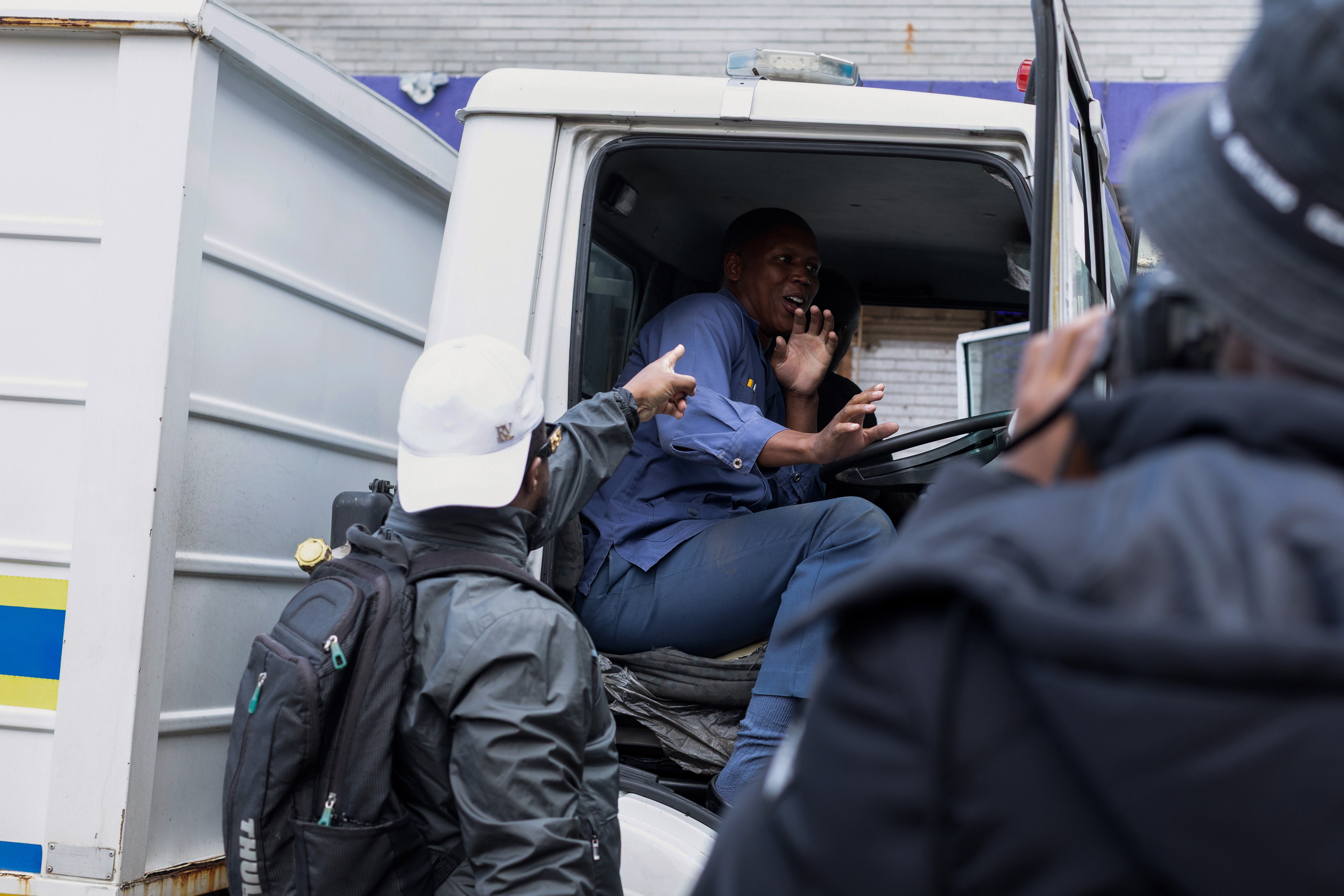
 Protesters confront police during a march against illegal immigrants in Johannesburg on 29 April 2026. (Photo: OUR CITY NEWS / James Oatway)
In recent months, groups campaigning against “illegal immigration” and crime have gathered growing momentum, drawing large crowds into streets. Their marches are often framed as a response to state failure, but they have also raised questions about what happens when members of the public are allowed to confront, accuse and search people they suspect of being undocumented or involved in crime.
Last week, that campaign returned to Durban, where another large march again placed migrants and foreign-owned businesses in the group’s sights.
/file/attachments/orphans/OCN_lawlessness_02_751745.jpg "An unknown man with a holstered firearm (left) is pictured walking next to actor and anti-immigrant protest leader Nkosikhona Phakelumthakathi Ndabandaba during a march in Johannesburg on 29 April 2026. (Photo: OUR CITY NEWS / James Oatway)")
ActionSA’s Ekurhuleni mayoral candidate Xolani Khumalo was also present and visibly involved in the day’s events. People associated with Ngizwe Mchunu and Nkosikhona “Phakelumthakathi” Ndabandaba have since said they intend to return to Johannesburg in the coming weeks.
Mchunu, Ndabandaba and their supporters have repeatedly denied that their marches are violent or xenophobic, insisting they are responding to failures to police crime and undocumented migrants in cities such as Durban, Johannesburg and Pretoria. But these denials sit uneasily alongside what has actually played out on the ground.
/file/attachments/orphans/JHB_March_09_745744.jpg "Protesters take part in the March and March anti-migrant demonstration in Johannesburg on 29 April 2026. (Photo: OUR CITY NEWS / James Oatway)")
When the group marched twice in Johannesburg recently, Our City News reporters witnessed a Cameroonian migrant being hit over the head and numerous people in the group running at people harassing and intimidating them. Some within the March and March grouping threw rocks at people accused of being migrants, on the street and in apartment buildings in densely populated neighbourhoods. In one incident, marchers surrounded a police van and opened the door to threaten the driver.
These groups have also been carrying weapons, with a number of men seen carrying firearms during the marches in Johannesburg.
Despite all of this, Gauteng provincial police spokesperson Colonel Dimakatso Nevhuhulwi told Our City News that the gatherings had been peaceful so far, and that no incidents had been reported to the SAPS.
“No incidents of crime emanated from the marches that were reported to the police, hence I indicated on the response that the march was with no incidents recorded,” Nevhuhulwi said when pressed on the matter.
Nevhuhulwi also said that the groups marching in Johannesburg received approval for both days, but Johannesburg Metro Police Department spokesperson Superintendent Xolani Fihla contradicted that. He told Our City News that the group had received approval only for the march held on 29 April.
Nevhuhulwi failed to respond to several specific questions sent by Our City News. When pressed for answers, she instead snarkily responded with: “Please read my response with comprehension, I may not have answered one by one, but my response covers your questions.”
Sharon Ekambaram, the Head of the Refugee and Migrant Rights Project at Lawyers for Human Rights, said there had been regular reports of police and other law enforcement standing by while looting and other acts of vigilantism by groups such as Operation Dudula took place.
She indicated a recent court judgment in a case between Kopanang Africa Against Xenophobia and others against Operation Dudula and other respondents, where the Gauteng Division of the High Court in Johannesburg ruled that the SAPS and the departments of Home Affairs and Justice and Correctional Services failed to protect migrants from vigilantism.
/file/attachments/orphans/EDITORS_CHOICE_OCN_lawlessness_03_701419.jpg "A man who was attacked by anti-immigrant protesters under the noses of the police during a march in Johannesburg on 29 April 2026. (Photo: OUR CITY NEWS / James Oatway)")
“Furthermore, the court declared that only an immigration officer or a police officer has the power to demand that someone produce their passport or other identity documents, and can only do so in public places. No warrantless searches may occur at home, school, work or business,” Ekambaram said.
“The court also affirmed the duty of the state to take steps to prevent xenophobic harassment and violence, recognising the constitutional obligation of public authorities to protect all who live in South Africa,” she said.
Ekambaram emphasised that the court ruling wasn’t specifically against Operation Dudula or confined to Gauteng, but was in reference to any and all acts of vigilantism across the country.
Lizette Lancaster, the Head of the Justice and Violence Prevention Programme at the Institute for Security Studies, said there was no evidence that the police “tolerated” this violence, even when there had been a failure to protect victims.
“Having said that, they are also constitutionally bound to maintain public order, to protect and secure the inhabitants of the republic and their property, and to uphold and enforce the law. It does not say citizens. If the police fail to do this, they are in breach of their mandate,” she said.
“The police will be compelled to investigate if criminal cases are opened by victims. It may be that this has not yet happened,” she said.
/file/attachments/orphans/OCN_lawlessness_01_892042.jpg "An unknown man with a holstered firearm during a march against immigrants in Johannesburg on 29 April 2026. (Photo: OUR CITY NEWS / James Oatway)")
Professor Loren Landau, co-director of the Wits-Oxford Mobility Governance Lab (MGL), warned that the widespread appropriation of state authority by ordinary people, such as vigilante groups and opportunistic politicians, effectively privatised one of the core functions of the state.
“This shifts the underlying logic of impartial and equitable law to that of politics and the markets. Ultimately, anyone who is not desirable, based on race, ethnicity, religion, sexuality or nationality, can be censured, excluded, or punished at the whim of local grandees and gangsters,” he said.
He said these vigilante groups had borrowed and been inspired by parallel mobilisation groups in the US and Europe by narratively framing matters in terms of legality and illegality. They avoided attacking immigrants directly by framing their campaign around “illegal entry”, which made any defence of migrants’ rights easier to cast as a defence of lawlessness.
“The irony is that the vigilantism associated with these movements directly threatens the rule of law. The more they are effectively ‘deputised’ to control movement – through explicit speech or ‘non-action’ – the more the Constitution will be remade and arbitrarily applied across the country.
“If this were truly about ensuring townships are safe and equitably governed by law, they would be calling for indictments against councillors and constables and the incarceration of the gangsters and tsotsis who effectively govern thousands of locations across the country,” he said. DM
This story is produced by Our City News, a non-profit newsroom that serves the people of Johannesburg.
/file/attachments/2985/WhatsAppImage2025-11-21at1946001_346702_1cea9e715c05dc0a538fc79753ac3401.jpeg)
Comments
Scroll down to load comments...