



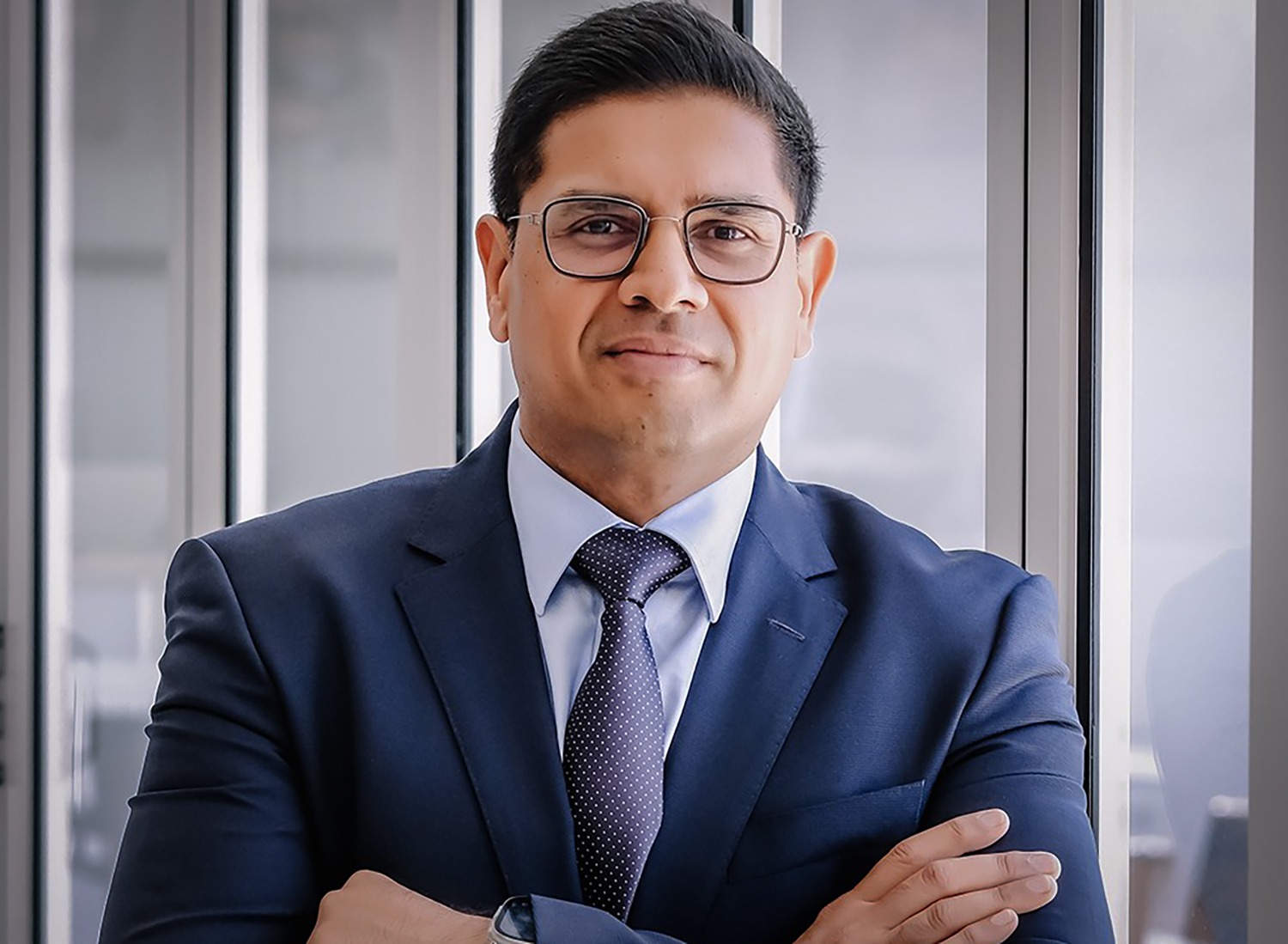
 Yuresh Maharaj, the man holding two large executive realities in a single pair of hands: one rooted in the Liberty brand, with its long history in life insurance and investments, and another embedded in the broader Standard Bank machine of insurance and asset management. (Photo: Supplied)
Yuresh Maharaj stepped into the Liberty chief executive role in March 2022, after joining Liberty at the end of 2015 as financial director and later serving on the Liberty board from 2018. Before that, he spent 16 years at Deloitte, the last nine as a partner in the financial services team specialising in insurance.
That background is part of what makes his current role unusual. He is helping to land Liberty inside Standard Bank’s wider architecture after the group moved to bring Liberty and other insurance, investment and asset management assets together into a dedicated business unit. In the group’s own framing, Insurance and Asset Management is now one of Standard Bank’s core business units, alongside Personal and Private Banking, Business and Commercial Banking and Corporate and Investment Banking.
The mandate is both simple and intricate: use Standard Bank’s scale, distribution and client relationships to deepen insurance, investment and asset management offerings, while preserving the specialist capability and trust on which insurance depends. The Insurance and Asset Management client base spans individuals, corporates and institutions across African markets, supported by bank-led distribution, tied advisers, independent financial advisers and manufacturing capabilities across insurance, investments and asset management.
Teamwork and trust
Maharaj describes the structure less as a clean corporate chart and more as a living organism. There are legal entities, business lines, regulators, advisers, shareholders, clients and internal stakeholders, all needing attention. He says the only way to manage that complexity is to have the right executive team and to delegate with intent.
“You’re only as good as your strongest team and the people around you,” he says.
In the interview, he returned repeatedly to the same leadership spine: the team matters, trust matters, and command-and-control leadership will not carry an organisation through a multi-year integration.
Liberty’s recent history has demanded more than corporate optimism. The IAM strategy document describes Liberty’s earlier “proud roots”, including its establishment in 1957, its early retirement annuity offering, JSE listing and expansion into asset management and property. But it also records a period from 2015 to 2024 of “resetting and stabilising”, after performance came under pressure and earnings declined towards historic lows, culminating during the Covid period. Standard Bank used the acquisition to combine Liberty with other assets in a separate business unit, with the next phase described as unlocking value creation from 2024 onwards.
For Maharaj, the hard work of integration is less glamorous than the market may imagine. One of the toughest decisions of the past year, he suggests, involved building and reshaping the team: bringing in scarce external skills, closing capability gaps and doing so in a market where talent is fiercely contested. The boardroom version of this sounds neat, but the lived version was more jagged.
“If you don’t have a common goal and a common culture, it becomes very difficult. Having the right team is critical because you can never execute well if you don’t have a trusted team,” he says.
There is a small clue in how he structures his own day. Maharaj speaks about protecting a window between 1pm and 2pm where possible, a pause in the middle of the machine. It sounds minor, almost too ordinary for a CEO profile, but in a role of constant stakeholder gravity, that hour is a kind of executive ballast. Without some deliberate interruption, the day can become an endless conveyor belt of meetings, emails and decisions.
Durable instincts
His leadership philosophy owes much to his Deloitte years. Maharaj joined Deloitte & Touche as a trainee accountant and rose to partner, working in South Africa, the US, Namibia and Luxembourg. His bio notes that he was admitted to the Deloitte South African partnership in 2006 at the age of 28, later receiving awards for client service and revenue growth in the insurance service line.
The consulting and audit world appears to have left him with two durable instincts. The first is a feel for navigating large organisations, with their internal currents, formal structures and informal networks. The second is a bias towards factfulness. In fact, he recommends Factfulness by Hans Rosling, saying it teaches that opinions should be backed by facts that are understood.
That makes sense when you consider that insurance is, at heart, a contract with the future. A client pays today because they trust that an institution will still be there when illness, death, retirement, a flood or some other financial ambush arrives. Maharaj puts particular weight on that relationship of trust, saying Liberty clients trust the business to manage some of the most important aspects of their lives.
AI — augmentation, with a human emphasis
It is also why he is cautious about technology hype. He is not anti-AI. Far from it. Rather, he describes artificial intelligence as a form of “human augmentation” that can enhance relationships by improving how data is used to inform better solutions and choices. But the emphasis remains human.
In our interview, he drew a clear line between efficiency and emotional trust. AI may help with process, analytics and decision support, but financial advice is often delivered at vulnerable life moments. For now, Maharaj does not see AI replacing the human trust required when a client is making a decision about death, disability, retirement, loss or long-term security.
“AI is also an efficiency play. Everyone is experimenting, but I don’t think AI can deliver emotional trust in the next 10 to 15 years. Maybe it gets there, but that is not the use case now,” he observed.
That tension between technology and trust is likely to sharpen. Maharaj expects the industry to keep experimenting with AI, while regulation around advice, fees and conduct continues to evolve.
Agility amid change
He is quite candid when talking about change: “You have to have the willingness to say, okay, this is not working. There is a mindset of: we’ve put in so much time, our teams have worked on this, so we can’t just throw it out. But with technology, you have to be willing to stop and change course,” he said.
The broader challenge is that customers are becoming more informed, more digitally enabled and, at times, more exposed to unfiltered or unreliable financial guidance. The adviser of the future may have better tools, but the old test remains: can the client trust the promise?
The same question sits beneath retirement reform. Maharaj sees financial literacy as central, particularly after the introduction of the two-pot retirement system. The concern is both administrative and behavioural. People may understand that they can access money, but they may not fully understand the long-term consequence of doing so. Longer life expectancy makes this harder: money once expected to last 20 years may need to stretch across 30.
“People don’t realise that what they thought they needed for 20 years may now have to last 30 years. That’s a big difference. It’s about asking: what does it mean for every additional 10 years, based on your lifestyle?” he points out.
His worry is not abstract. Maharaj points to low economic growth, reduced consumer spending, the widening insurance gap, two-pot retirement changes and IFRS 17 as issues with major operational implications for the industry. He argues that insurers can no longer rely on a one-size-fits-all model and must become more agile while still providing a safety net.
Climate risk
Then there is climate risk, the new actuarial weather system blowing through insurance balance sheets. “Geocoding plays a big role in supporting us around climate change and sustainability. We have geocoded every single exposure and overlaid that with warning signals,” Maharaj says.
The implications are not only about pricing. They are also about advice: telling a client, for example, that a property may be highly exposed to flood risk changes the quality of the conversation.
For short-term insurance, this is becoming increasingly important as catastrophe frequency rises. For life insurance, Maharaj says the long-term effects of Covid are still being watched, although not all patterns are statistically significant yet.
When asked what he would want people to say when he eventually steps away from the role, the answer is not framed around personal legacy alone. He wants Liberty and the wider IAM business to have become more prominent, more integrated and more culturally aligned inside a large financial services group.
That may be the real balancing act. Maharaj is straddling two CEO roles, but the job is not simply to split his calendar between Liberty and Standard Bank. It is to make the two logics work together: the long-memory trust of an insurer and the scale engine of a bank; the carefulness of actuarial thinking and the hunger for growth; the personal nature of advice and the industrial power of distribution.
His closing leadership advice is almost stubbornly old-fashioned: get mentors early, surround yourself with strong people, build a trusted team and create a common culture.
“You can’t command and control. You have to have empowered leadership, and you have to have trust,” he told Daily Maverick. DM
Comments
Scroll down to load comments...