




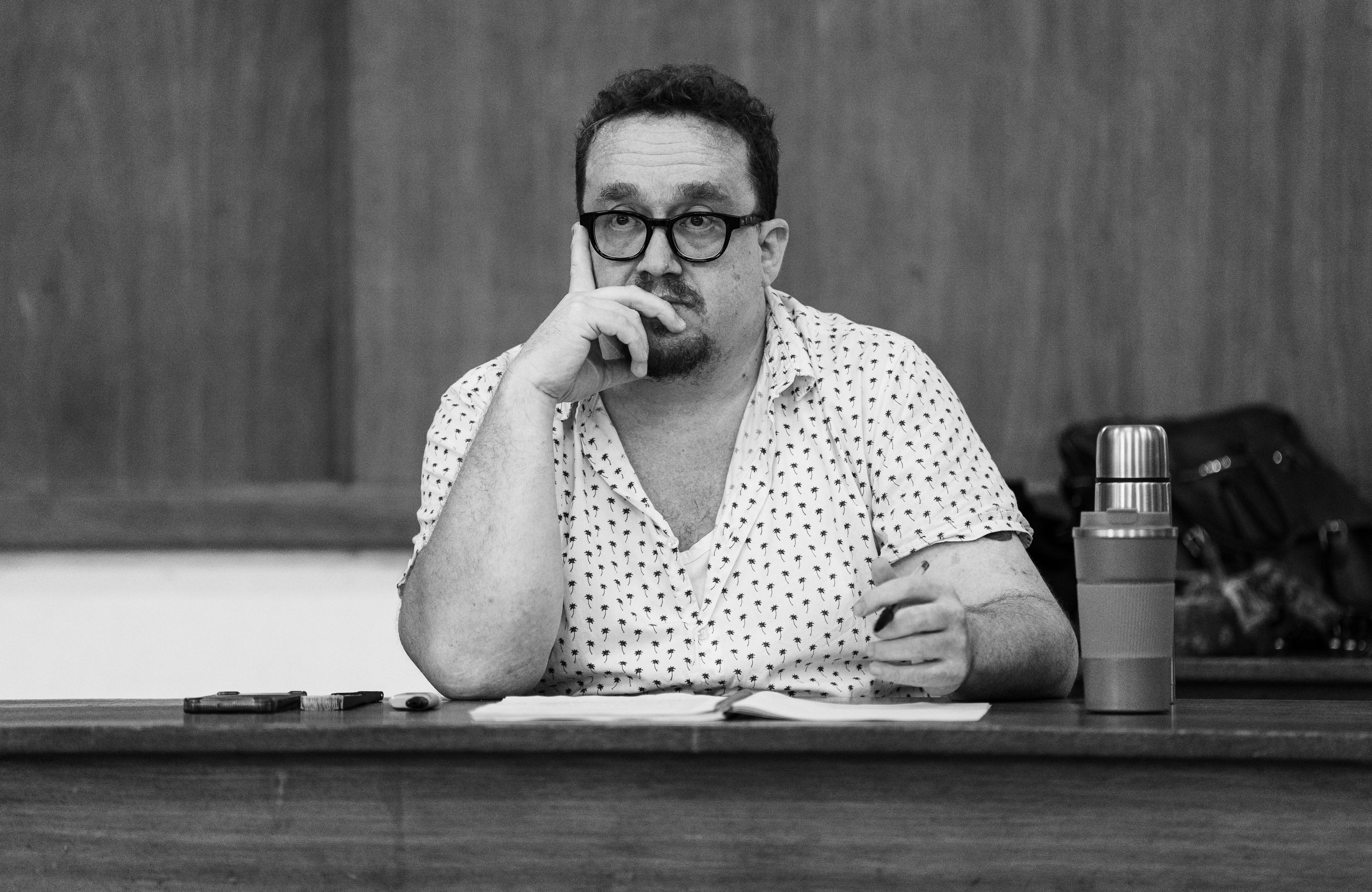
 Director Louis Viljoen rehearses his latest play, The Killing of a Union Leader. (Photo: Daniel Rutland Manners)
 Not that anyone’s counting, but there are probably fewer expletives in Louis Viljoen’s new play than his last. The Killing of a Union Leader is also considerably more serious than The Vulgarians, which was a sex comedy, and more Shakespearean in its tone, not quite as laugh-out-loud funny, despite plenty of verbal riffs that will absolutely make your eyes water.
In the new play, which opens at Artscape’s Arena theatre on 12 May, Viljoen takes us into the underbelly of a corrupt and morally reprehensible universe. It’s one where corporate and political interests intersect through vile dealmaking, the play zooming in on the blow-by-blow nuances of some splendidly awful human behaviour revealed in the guise of cold, unsentimental adult diatribe.
The thrust of it is pretty urgent: people – striking workers – have been killed by police action and now the political fallout and blame-shifting has reached the throne room of the powerful corporate entity concerned.
It’s big business in the true sense – should the corporation fall, it’s likely that the city in which it’s headquartered will collapse, too, perhaps bring a regime to its knees.
It’s heady stuff, universally poignant.
/file/attachments/orphans/louis-viljoen-interview3_857312.jpg "From the director's POV, Carl Beukes listening to Louis Viljoen during a rehearsal for The Killing of a Union Leader. (Photo: Daniel Rutland Manners)")
/file/attachments/orphans/louis-viljoen-interview5_657553.jpg "Sizwesandile Mnisi and Carl Beukes in rehearsal for The Killing of a Union Leader. (Photo: Daniel Rutland Manners)")
At a rehearsal run of the play, which somewhat sacrilegiously took place in a church hall in Mowbray, I watched as a kind of theatrical battle of wits unfolded, the drama’s fierce wordplay never letting up. Once I got into it, it hooked me completely, refused to let go.
The play’s title is a riff on the 1976 John Cassavetes film, The Killing of a Chinese Bookie, a slow-burn crime drama, yet its substance is pure Machiavellian brinkmanship, the characters not too far removed from the heinous cast of HBO’s Succession.
Viljoen’s characters are, for want of a better word, evil, and the language Viljoen puts in their mouths conjures a universe that seems entirely stitched together by avaricious, conspiratorial scheming.
Yet, while it is incredibly grim and dark, there is no actual violence, not even a fist raised, nor in fact any visual atrocity on stage. Instead, what produces the electricity in the air, makes the unfolding story feel dangerous and harrowing, is simply the words – and the manner in which they’re used.
The way these characters talk to one another is breathtaking – all the more unnerving because, despite the elevated style and sophistication of the language, Viljoen’s play feels like a window into precisely the sort of dirty, unscrupulous dealmaking and string-pulling that exists in the real world.
One has only to look at the daily White House dramas for a sense of how this play’s fiction inadvertently connects with day-to-day reality.
While Viljoen takes great delight in unravelling the twisted relationship that’s imagined to exist between politics and capital, it is also a sumptuous psychological thriller, following in a Shakespearean sense the steady descent into madness of a menacing arch-villain.
There’s something in it of the weight and emotional complexity of King Lear, which is among the classics that Viljoen referenced in designing the world of the play and its characters.
/file/attachments/orphans/louis-viljoen-interview4_362992.jpg "John Maytham in rehearsal for The Killing of a Union Leader. (Photo: Daniel Rutland Manners)")
He says he wrote one of the parts as a contemporary equivalent of Lear for actor John Maytham, who has starred in a number of Viljoen’s plays. In this one, Maytham plays an uncompromisingly antagonistic and venomously unlikeable corporate king who is fantastically nasty towards everyone and saves a few of the English language’s most eye-watering slurs for his own scheming, power-hungry daughter, played by another Viljoen regular, Emma Kotze.
“I never want to do a morality play,” Viljoen told me when I asked him about the ethical substrate that underscores the play. “I like a universe that would appear to be without consequence, where it’s cold and it’s mean, and then someone breaks within that.”
He says he’s interested in what happens to seemingly unshakeable characters within that morally untethered plane of existence.
“How do they deal with their sudden attack of morality in an amoral universe? It’s usually madness – they just go off their head. That interests me.”
Also an interesting challenge is convincing the audience to find, in some small way, a twinge of sympathy for the most reprehensible characters on stage.
“What’ll be really fun in this play is if we manage to get the audience to empathise with the worst person, because it’ll mean we’ve convinced them to recognise the humanity of someone who’s kind of like the devil.”
It’s a long shot, Viljoen admits, because the play “is about such awful people”.
Then again, as Succession so successfully proved, audiences have a certain attraction for vile characters.
“You also want them to revel in the darkness a little bit,” he says. “And then, every now and then, we change the language up a little bit and throw in a line that gets a laugh. I want the audience to go, ‘I can’t believe I laughed in that fucking play that was so awful!’”
But elevated language and inappropriate laughs aren’t the only tools Viljoen uses to win audiences over. There’s also the riveting nature of the unfolding drama, the suspenseful elements of the thriller.
“It’s about making it exciting enough that maybe the audience stops thinking for a moment about how awful these characters are and just wants to see where the story goes,” Viljoen says. “If we can do it at pace, just be like, ‘Okay, guys, let’s go’… That’s the idea.”
To achieve this forward momentum and fuel the audience’s desire to see what happens next, Viljoen refuses to use what he regards as the “lazy tricks” he sees used too often in theatre.
Among his pet peeves: monologues spoken into the imaginary void occupied by the audience.
“The audience can see the actor’s eyes, and they’re beautifully lit, but it’s empty, it’s devoid of meaning,” he says.
In a Louis Viljoen play, there’s no such thing as a meaningless, dreamy stare into the audience. In a Louis Viljoen play, “you look the other guy in the eye, and you try to get something out of them, because that’s what these interactions on stage are ultimately about – every character wants something”.
/file/attachments/orphans/louis-viljoen-interview2_958837.jpg "Emma Kotze in rehearsal for The Killing of a Union Leader. (Photo: Daniel Rutland Manners)")
/file/attachments/orphans/louis-viljoen-interview6_819178.jpg "Sizwesandile Mnisi in rehearsal for The Killing of a Union Leader. (Photo: Daniel Rutland Manners)")
Viljoen’s approach is to strip everything down. In terms of language and action there must be nothing extraneous.
“That way, everything that’s said is pure meaning,” he says. “If you strip away everything, all the little tricks that actors and directors rely on, and you are just left with pure text that the actors have to interpret so that they can look another actor in the eye and not lie… that’s interesting to me.”
This stripping everything down to the essence also informs his writing.
“I told myself that if I expect my actors to strip all of those crutches away, then I need to take all of my crutches away as well. So, the idea is to create this bare-bones text, pure language that’s whittled down to its essence.”
Viljoen calls himself a lifelong drama and film nerd who fell in love with the power of dramatised words at age nine, watching Death of a Salesman. He says it’s writers like Tennessee Williams and Shakespeare, Quentin Tarantino and David Mamet who influenced his love of heightened language.
“At the beginning of my career, everybody would ask me, ‘Why don’t you write the way people talk?’ Which is the stupidest fucking thing I’ve ever heard. There is no such thing as ‘the way people talk’ on stage, because it’s all fake – there is a stage and an audience, so why pretend anything is real?
“The only thing that can be real are moments between actors. So you work hard at creating those real moments, and what can help you create those moments is language.”
And language is what you get from Viljoen. Heightened, sparkling, frequently magnificent and often mind-bendy language.
And, while you might, if you’re counting, hear fewer swearwords in his new play, there’ll be no lack of sauciness, no sparing of modesty and plenty of beautifully twisted turns of phrase that will leave you with little doubt that the playwright has lost none of his power to bend the English language to his will. DM
Starring John Maytham, Emma Kotze, Sizwesandile Mnisi and Carl Beukes, The Killing of a Union Leader (www.unionleaderplay.co.za) will be performed at Artscape’s Arena theatre in Cape Town from 12 to 30 May. An anthology, Selected Plays, featuring 10 of Louis Viljoen’s 25 plays, was published this month by Karavan Press.