





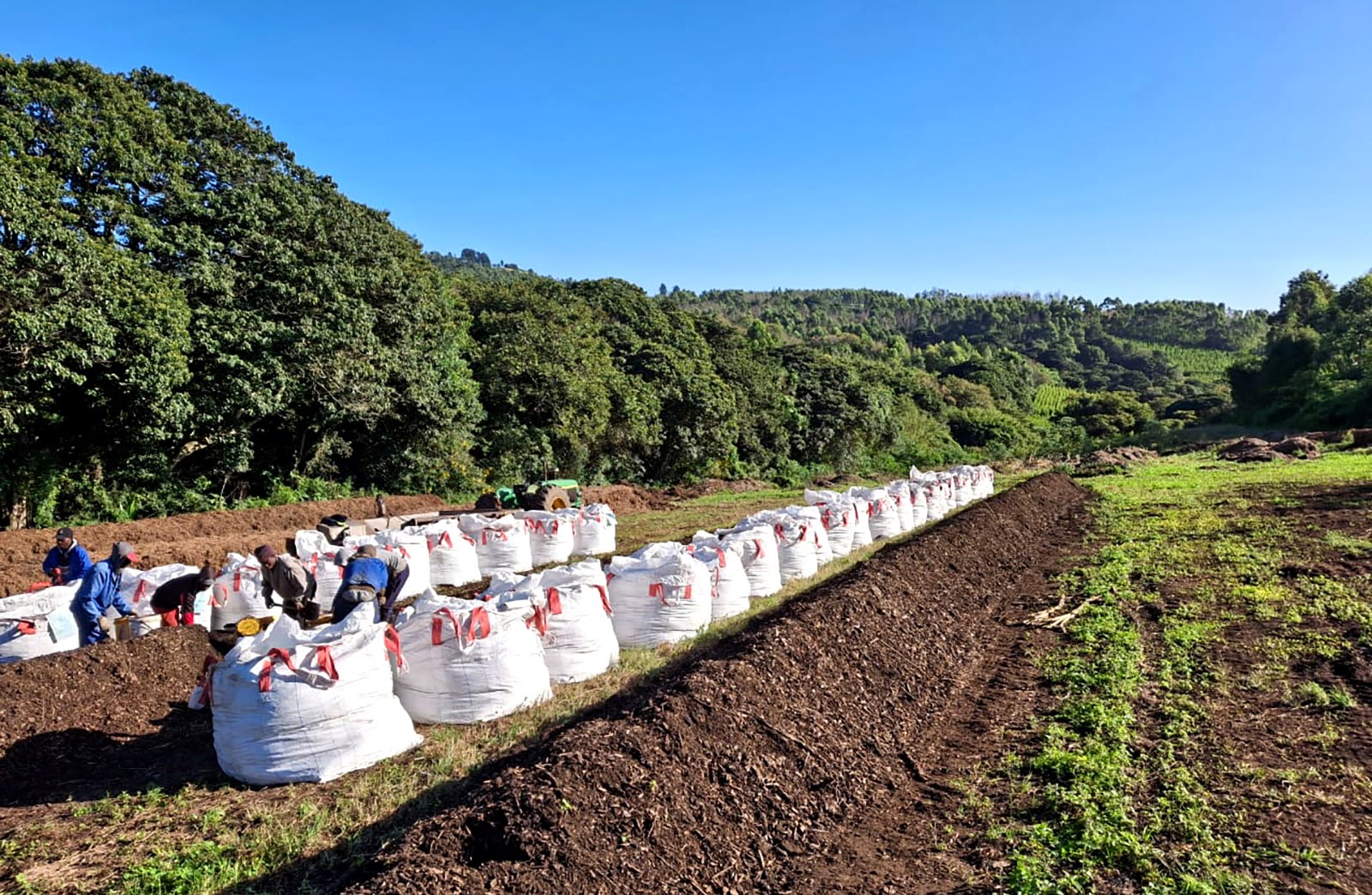
 Crop-specific compost built by Convert the Dirt for high-value agriculture. Founder Nathalie Teixeira says biological approaches work best when introduced alongside existing fertiliser programmes, allowing the soil’s own biology to gradually carry more of the nutritional load. (Photo: Nathalie Teixeira)
According to Rabobank’s April 2026 semiannual fertiliser outlook, the strait carries roughly 30% of global urea exports, 27% of ammonia, 24% of phosphates and 48% of sulfur, some of the key ingredients used to manufacture fertiliser.
Within weeks of the closure, South African import prices reflected the consequences. Grain SA’s April 2026 input monitoring report shows that local prices of urea, a widely used nitrogen fertiliser, rose 59% in a single month. MAP, a key phosphate fertiliser, rose 26%. Potassium chloride climbed 11%.
The vulnerability was always there
SA’s exposure to this kind of shock is structural. According to Wandile Sihlobo, Chief Economist of the Agricultural Business Chamber of South Africa (Agbiz) and a senior research fellow at Stellenbosch University, the country imports more than 80% of its annual fertiliser requirement of roughly two million tonnes, sourcing from Saudi Arabia, Russia, Qatar, Oman, China, Germany and Chile.
Omnia Holdings, one of SA’s local fertiliser producers, said the region had to balance demand between local sources and high import levels, and that during times of supply chain, port and logistics disruption, as was currently being experienced, “this makes for a very challenging environment for customers”, according to CEO Seelan Gobalsamy. Gobalsamy said Omnia had diversified its sourcing across multiple countries and regions outside the conflict zone, including Indonesia, Australia, North Africa, the United States, Canada, Europe, the Caribbean and China, and had invested in storage infrastructure to maintain buffer stocks.
“Fertiliser is a big component of South African farmers’ input costs – it accounts for 35%,” Sihlobo said. “So when prices increase, farming businesses are under pressure.” Grain SA puts the figure even higher, noting in its April 2026 input monitoring report that fertiliser makes up between 30% and 50% of a typical grain and oilseed producer’s variable production costs.
/file/dailymaverick/wp-content/uploads/2024/08/Opening-a-gate-to-a-government-farm-in-the-Karoo.jpg "Wandile Sihlobo on a government farm in the Karoo. (Photo: Wandile Sihlobo)")
Sihlobo described the current moment as being “stuck with rising farm input costs because of fear about fear”; prices being driven not just by actual supply disruption, but by uncertainty about when, or whether, the strait will reopen and stay open for normal shipping.
The situation is compounded by fuel. According to the Bureau for Food and Agricultural Policy and Absa Agribusiness’s April 2026 food inflation brief, Brent crude oil prices exceeded $100 per barrel following the conflict’s escalation.
Fuel accounted for roughly 13% of a grain farmer’s production costs, Sihlobo said, with the highest usage during planting and harvesting, both of which were approaching.
What it means on the ground
A livestock farmer from Senekal in the Free State who uses about 100 hectares of his land to plant different grains and crops, mostly as extra feed for his animals, told Daily Maverick that the biggest expenses his operation currently faced were electricity, fuel and fertiliser.
Making choices around what fertilisers to use had become less about what would be good for the crop and the soil, he said, and more about what they could afford. At this point, they were adding lime, the cheapest supplement they could, to the soil just to ensure the pH stayed neutral.
“If the current trend carries on because of the conflict in the Middle East, maize production does not make economic sense,” said Corné Louw, applied economics and member services lead at Grain SA. Producers may switch to less fertiliser-intensive crops like soybeans and sunflowers. A shift, he said, that would reduce planted maize area and could ultimately push maize prices higher for consumers.
Rabobank’s April 2026 fertiliser affordability index has moved decisively into negative territory and is expected to reach its lowest point in December 2026. Even if the conflict ends soon, normalisation would be slow, it said.
Those consequences are already beginning to reach consumers. Maverick Citizen’s tracking of 14 basic food items that can be bought with the R370 Social Relief of Distress grant found that the basket rose by R16 between March and April 2026, reaching R423.86 – R53 more than the grant itself.
The Bureau for Food and Agricultural Policy’s April 2026 food inflation brief warned that if the conflict persists, sustained increases in fuel and fertiliser prices could reduce future planting and output, ultimately exerting stronger upward pressure on food prices.
Growing differently
Some farmers and practitioners in SA believe that reducing dependence on synthetic fertiliser, through regenerative and soil health-focused farming systems, offers a way to cushion the blow of exactly this kind of price shock. It is not a simple or immediate fix, and those working in the space are careful to say so, but the argument is gaining traction as input costs make the status quo increasingly untenable.
“The more fertiliser you add, the weaker your soil gets, the more fertiliser it needs for the next season,” said John Gaisford, co-founder of Cape Town-based regenerative agriculture tool company Get Dirty. “It’s a drug addiction. It’s like our soils are addicted to fertiliser.”
Gaisford traces the dependency back to the aftermath of World War 2, when surplus phosphorus and nitrogen, previously used in explosives manufacturing, he said, were redirected into agricultural fertiliser production and actively marketed to farmers worldwide.
/file/attachments/orphans/18_387621.jpg "Nathalie Teixeira (right) and the Convert the Dirt team. Teixeira, who founded the KwaZulu-Natal-based composting and soil health consultancy, works with farmers to gradually reduce their dependence on synthetic fertilisers by rebuilding the biological function of their soil. (Photo: Nathalie Teixeira)")
Nathalie Teixeira, founder of KwaZulu-Natal-based composting and soil health consultancy Convert the Dirt, works with farmers to rebuild what synthetic inputs have, over time, suppressed. She is careful not to be ideological about it, and said it wasn’t practical for farmers to just quit using all chemical fertilisers.
“You can’t be purist,” she said. “If the system needs something, you give it what it needs.”
She described a healthy soil as functioning like a kitchen fully stocked with ingredients; compost and biological inputs are the people who know how to cook, but if key nutrients are missing from the soil, no amount of microbial activity will produce a result. You then need to add something that you didn’t have in the cupboards to make the recipe work.
The transition when trying to reduce the use of synthetic fertilisers, she said, works best when biological approaches are introduced alongside existing programmes, gradually allowing the soil’s own biology to carry more of the nutritional load.
Jako Pieterse, founder of Grabouw-based Ecosoil, has spent 21 years working with commercial farmers to break exactly that cycle. His company’s EcoDelta programme rebuilds soil biology through organic inputs and compost tea applications, reducing synthetic fertiliser use by between 50% and 100%.
“Even at only 50% reduction, we’re still cheaper than full chemical programmes,” he said. Working with one fruit farm, Ecosoil helped restore the soil health of a 46-year-old pear orchard that had been farming conventionally, in its second year under the biological programme, and without any chemical fertiliser the orchard produced the highest yield in its history. It is now 51 years old and still outperforming the conventional control. Ecosoil’s own data also shows a 6% production increase in canola and 10% in barley using its biological programme.
Louw acknowledged that the shift was accelerating. Precision agriculture and soil health approaches were already gaining traction before the current crisis, he said, but “situations like this would fast-track the adoption”. DM
Comments
Scroll down to load comments...