




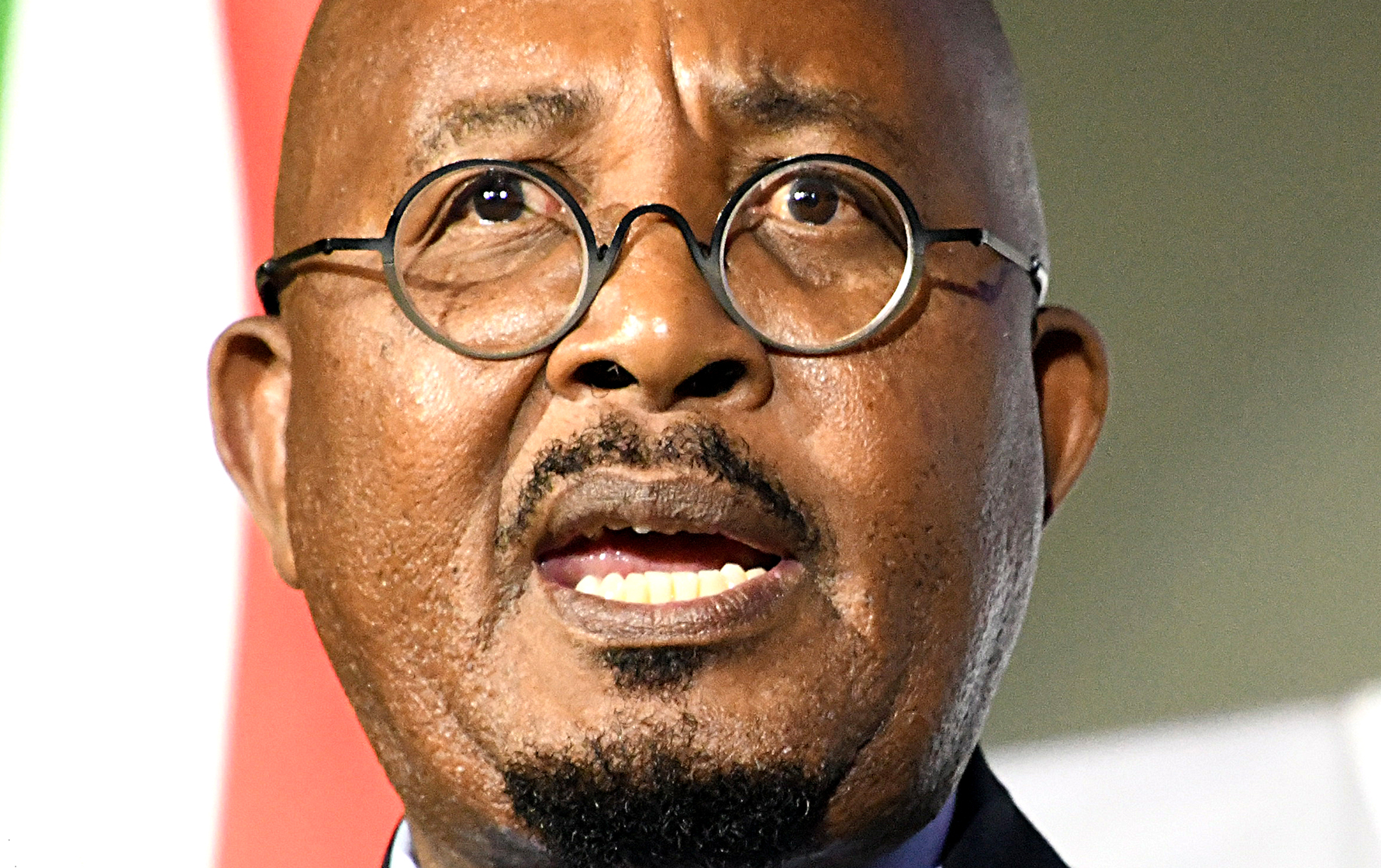
 The outgoing director-general of higher education and training, Nkosinathi Sishi. (Photo: Frennie Shivambu / Gallo Images)
The director-general of higher education and training, Dr Nkosinathi Sishi, is entering the final months of his term with a clear message: he wants to stay. Speaking to Daily Maverick, Sishi expressed a desire for another opportunity to steer the sector, a challenge he believes he has navigated with success.
Appointed in 2021 on a five-year contract, Sishi took the helm during a period of deep instability following the suspension and departure of his predecessor, Gwebinkundla Qonde. Sishi’s résumé suggests a seasoned hand; he previously served as the deputy director-general for planning, policy and strategy (2016–2017) and as the head of the KwaZulu-Natal education department (2011–2016).
Sishi’s tenure has been amid a whirlwind of political change. In just five years, he has served under three different ministers. He arrived under Dr Blade Nzimande (with whom he previously worked at the Department of Transport as CEO of Prasa), transitioned through the brief and controversial tenure of Nobuhle Nkabane, who was axed following a Seta appointment scandal, and now serves under the current minister, Buti Manamela.
/file/attachments/orphans/ED_568556_596494.jpg "Higher Education and Training Minister Buti Manamela. (Photo: Frennie Shivambu / Gallo Images)")
“It’s such a great honour to be allowed to serve, particularly in a department that is at the forefront of skills development in the country,” he told Daily Maverick.
He pointed to the recent launch of the Gert Sibande TVET College 4IR Digital Innovation Lab and the Centre of Specialisation at the Skills Academy as evidence of progress, which, he said, are initiatives designed to arm young people with future-proof skills, positioning TVET colleges as engines of economic growth.
Sishi says he has led a list of legislation: “I’ve got five pieces of legislation that are currently Bills due for Parliament to transform further the system of education.” Most notable are:
- The Skills Development Amendment Bill, introduced in 2024 to update the institutional framework for implementing national and sector-based skills, strategies, and improve the quality of training in the South African workforce.
- The NSFAS Amendment Bill, aimed at modernising the management and governance of the National Student Financial Aid Scheme and aligning its functions with current funding models (bursaries vs loans).
- The Central Application Service Bill, intended to create a formal legal entity for the Central Application Service that provides a single, integrated application process for post-school education and training institutions (universities and colleges).
“I am quite satisfied with what we are doing as a country, and with the experience that I have. I am ready to serve anywhere in the country that this country wants me to serve. My work speaks for itself,” Sishi asserted.
Central to his legacy is the “missing middle” student funding model, a policy shift designed to support students who fall outside the traditional NSFAS threshold. While Sishi oversaw its finalisation, the roll-out has been far from smooth. Strict eligibility has seen the model fall short of its targets. In response to a parliamentary query from MK’s Mnqobi Msezane, Manamela revealed the stark reality: in 2025, out of 65,812 loan applications, only 2,499 met the requirements.
While Sishi is happy with his achievements in the higher education sector, the Portfolio Committee on Higher Education is decidedly not so. The DA’s Karabo Khakhau said Sishi had presided over a “state of collapse” in the sector.
/file/attachments/orphans/ED_519670_683017_151478.jpg "The DA’s Karabo Khakhau. (Photo: Brenton Geach / Gallo Images)")
“There’s no way you’ve been at the helm of the department for nine years. In nine years, the Setas have collapsed. Not only have they collapsed in terms of their financial records, but they’ve also collapsed in terms of their management, and they’ve collapsed in terms of delivering their core effectively, which is skills development… We don’t want him,” said Khakhau.
The numbers back up some of these concerns. While Seta audits improved in the latest AG report with 13 clean audits out of 21, the TVET sector remains a concern, with only 12 out of 50 colleges achieving clean status. The Auditor-General continues to flag material irregularities in infrastructure and record-keeping.

The committee chairperson, Tebogo Letsie, noted that while there had been “good and bad days”, Sishi had ultimately fallen short. “Sometimes we struggle with getting information from the department, which is his forte. So the committee would have expressed itself a long time ago about what we feel about him there,” said Letsie.
/file/dailymaverick/wp-content/uploads/2025/06/WhatsApp-Image-2025-05-30-at-15.36.07.jpeg "The chairperson of the Portfolio Committee on Higher Education and Training, Tebogo Letsie. (Photo: Phando Jikelo / RSA Parliament)")
A question of accountability
The political opposition is even more blunt. MK’s Msezane said, “My true observation of the work of the department is very shaky. The accounting officer, through the DG, I don’t believe was the best candidate for the department, and I would not want to see him in that department.”
Sihle Lonzi of the EFF argued that the issue transcended Sishi, pointing toward a systemic failure of “cadre deployment”.
/file/dailymaverick/wp-content/uploads/2025/05/WhatsApp-Image-2025-05-07-at-16.18.52.jpeg "The EFF’s Sihle Lonzi. (Photo: Phando JIkelo /RSA Parliament)")
“The DG is like a secretary of the department. He must be able to take all responsibility for the faults and the weaknesses of the department. My problem with him is that he has not demonstrated that he is willing to take responsibility,” said Lonzi.
He added that the poor performance of rotating ministers often made it difficult to apportion blame. “What helps the DG is that even the ministers who get into the department are themselves bad, so you get caught in a hard place in who you must attribute the blame to.”
This sentiment follows the fallout from Nkabane’s tenure, which was rocked by allegations that she attempted to pack Seta boards with ANC loyalists, including relatives of high-ranking party officials.
As for Sishi’s future, Manamela is playing his cards close to his chest. The minister told Daily Maverick, “I don’t think that is a discussion I should be having now. I think the employment relations of anyone, including the DG, are governed by the contracts that exist; we will look at that contract.”
With his contract due to expire in October, Sishi is hopeful that there will be a second act. DM
Comments
Scroll down to load comments...