




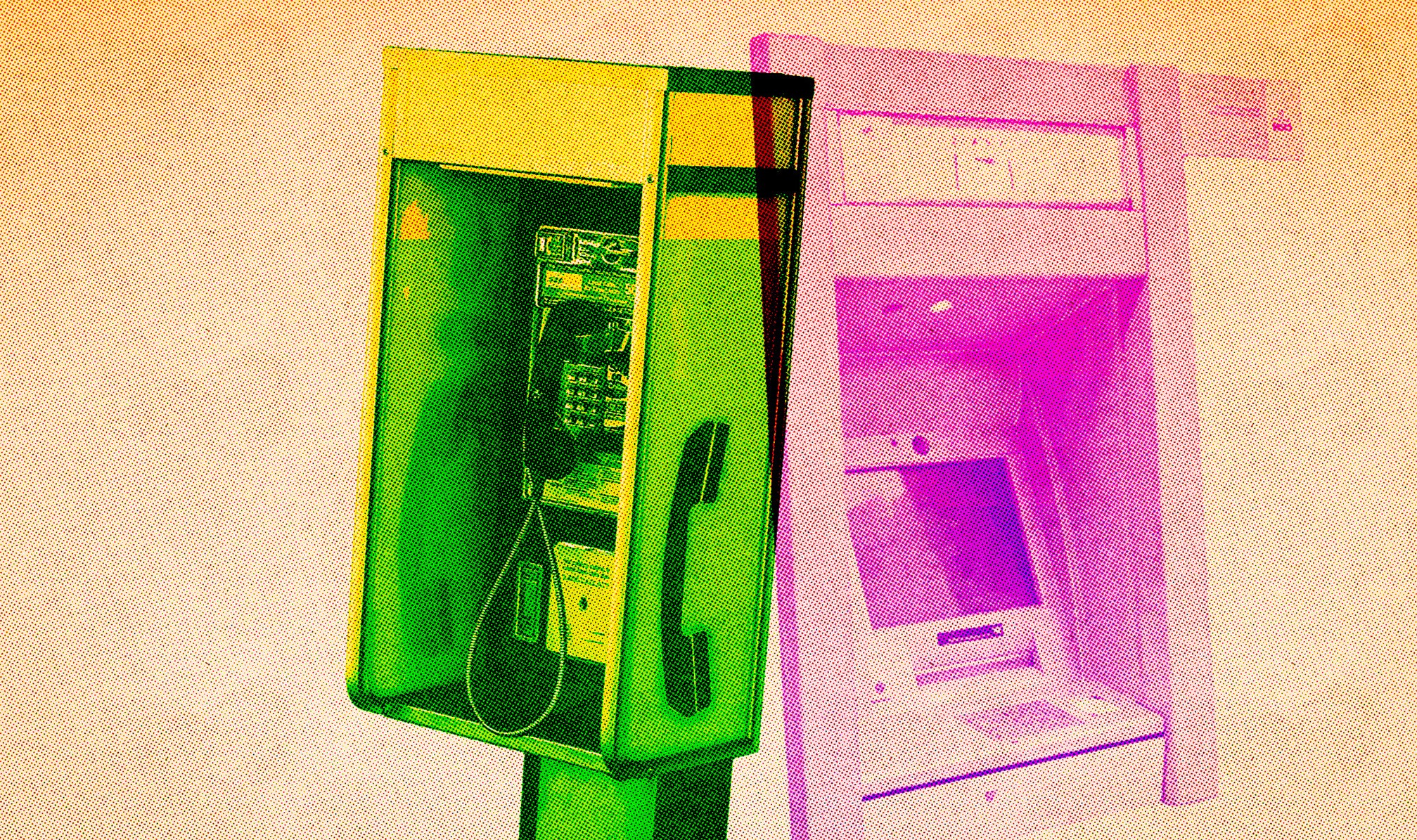
 Illustrative image: Payphone (Source: Wikipedia) | ATM (Source: iStock)
When I was younger I was the kind of kid who thought he was at the cutting edge of technology if he could get the timer record function on the family video recorder to work properly and reliably.
And for added points, I was even able to use the “simulcast” function which allowed me to record sound from Radio 2000 on an FM radio onto a video tape during a programme, meaning my mom could watch Remington Steel in English (the sight of a future James Bond in Pierce Brosnan speaking in Afrikaans might be slightly jarring to many now).
I’ve come to realise the technical frontier has moved out slightly since then. And it’s all about how to use your phone in the most cheap and effective way possible.
For the networks it’s all about making sure they’re at the cutting edge. And while it may seem quite simple (run a network reliably, make sure the voice and data networks are reliable, have lots of generators, etc), it’s really not.
Now you have to play in the phone space and the financial space. The overlap between what we used to know as banks that would facilitate financial transactions, and networks that provided phone calls, is growing dramatically.
Vodacom’s results released this morning display some of these transitions quite nicely.
Their financial service revenue was up by nearly 20%; it’s now nearly R19-billion out of a total of nearly R168-billion, or just more than 10%. And I suspect that percentage is going to grow very quickly.
Certainly we have seen Vodacom and MTN and others investing in this space quite aggressively.
Vodacom now owns 20% more of Safaricom in Kenya, a market that led the way in this. MTN is finalising its transaction to buy the MoMo payment service in Nigeria.
You can see what these firms are worried about. They now have to measure their market share not just against each other and in terms of calls and megabytes, but in terms of how many transactions their customers use them for.
This would mean that in some cases their real competitors are actually the banks and other fintech firms.
And I don’t know if you’ve noticed lately but fintech firms seem to be all over the place.
I worry then that I’m falling behind a little.
I say this because the only financial transactions I do on my phone are to login to my banking app to move money around (I don’t know if you know this about teenagers but their financial needs are varied and sometimes unpredictable) and to tap when I’m buying a healthy wrap for lunch (it is with infinite sadness I do this as I watch my younger colleagues happily consuming – and then efficiently digesting – a hamburger and chips).
I’m probably too old for FOMO but I can’t help but feel that perhaps people who use my phone more effectively than I are gaining something that I’m not.
Perhaps they’re saving themselves a huge amount of money and, more importantly, time.
One of the aspects of this business that often makes me a little happier is that the revenue networks are making from prepaid calls is going down consistently (Vodacom’s was down by 2% over the period).
This is obviously because people who used to make prepaid calls are now using data to speak to people over WhatsApp. And that means they are better able to speak to people literally all over the world very cheaply.
Now, in a further overlap between banks and cellphone networks, Capitec is offering free calls between people using their SIM cards.
For someone of my generation, who remembers trying to find the right coins for a pay phone, that seems almost like magic.
I recently went through my own phone efficiency programme. As part of an upgrade from my old writing device I moved from an iPad to a proper laptop. In the process I quietly celebrated reducing the number of family devices that need an Apple Lightning charging cable to just one.
But it also meant I had a data SIM card and nothing to do with it. Until I realised my clever phone actually had space for two SIMS, and I could use one SIM for data and one for calls.
When I first thought of it I presumed I would have to consult an expert (i.e. someone younger) to make it work. But it was so simple that it took me all of five minutes (of which three were spent looking in the drawer under the family charging station for the paperclip thingie to open the SIM port).
It gives me a lot more data than I’ve ever used before and keeps my laptop online when I need it.
But while it saves me money it doesn’t really give me the same satisfaction as mastering the video recorder. Because that required real skill.
This just needed Google. And data. DM
Comments
Scroll down to load comments...