




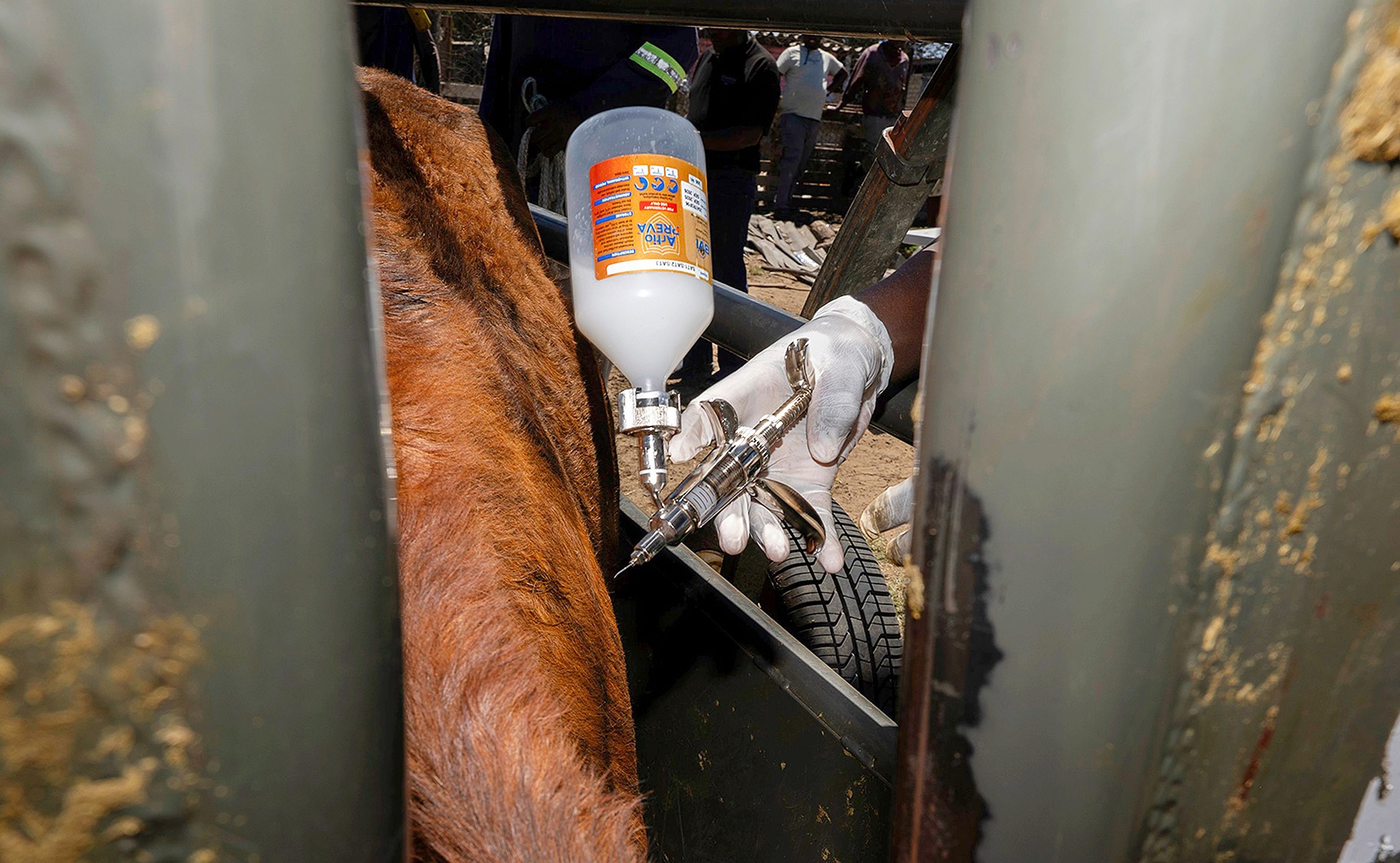
 The vaccination process for cattle against foot-and-mouth disease in Fisantekraal, Cape Town, on 15 February 2026. The process was aimed at vaccinating cattle in the informal and traditional farming sector. (Photo: Gallo Images / Die Burger / Jaco Marais)
The Routine Vaccination Scheme for foot-and-mouth disease (FMD) was gazetted on 4 May under Section 10 of the Animal Diseases Act.
Its publication came a day before a deadline set by Judge CJ van der Westhuizen in the Gauteng Division of the High Court in Pretoria, who at the 28 April hearing had “reluctantly” granted the Department of Agriculture an extension after the original deadline was missed.
The litigation was launched in February 2026 by Sakeliga, the Southern African Agri Initiative (Saai), and Free State Agriculture. The applicants argue there is no legal barrier to private-sector procurement and administration of FMD vaccines. They are seeking to stop government interference with private importation and use of approved vaccines. Even with the published scheme allowing for private vaccination, the case is returning to court on Monday, 11 May.
In a statement after the previous court appearance, Sakeliga said that the litigation would continue regardless of whether a scheme had been published, and described the minister’s approach as “no answer to the relief sought”.
Inside the scheme
The scheme allows owners of cattle, pigs, sheep and goats to appoint an authorised private veterinarian to vaccinate their animals under state oversight, without waiting for the state roll-out to reach them. It is voluntary, open nationwide, and the state programme continues separately at no cost to farmers.
To participate, all livestock must be permanently identified and ear-tagged, recorded on a digital traceability system, and the farm must have defined boundary fencing with a registered location number. Farmers must appoint an authorised veterinarian, keep detailed records and be open to audits.
A livestock farmer from the Free State, who has not had access to the vaccination for his animals, told Daily Maverick that even with the scheme in place, a large part of the problem still lay with communal herds. While the scheme might allow for a better attack of FMD on registered farms, thousands of unregistered cattle roamed free between farms and towns, still spreading the disease, he said.
The Industry Coordinating Committee confirmed this week that four preconditions still had to be met before farmers could formally enrol: the Section 10 Committee had to be constituted, with nominations due 13 May; a peer-reviewed management manual had to be issued within 90 days of the scheme coming into force; vaccines had to be formally allocated for private use; and private veterinarians had to obtain formal authorisation from the National Director of Animal Health.
Dr Emily Mogajane, who heads the ministerial task team and oversaw the scheme’s drafting, said at a media briefing on 5 May that standard operating procedures would take about a month to finalise.
/file/attachments/orphans/ED_562046_581876.jpg "The vaccination process during a visit to the Karan Beef Feedlot as part of visits to foot-and-mouth disease vaccination sites on 23 June 2025, in Heidelberg, Gauteng. The visit formed part of efforts to strengthen biosecurity and disease management protocols in partnership with provincial authorities and the private sector. (Photo: Gallo Images / OJ Koloti)")
Between the draft published on 10 April and the final gazette, some changes were made. The draft addressed costs within the committee’s Public-Private Partnership considerations, without explicitly assigning responsibility. The final version introduced a dedicated tariffs section stating plainly that vaccine and vaccination costs were the owner’s responsibility. It also provided for the possibility of ministerial guidelines on subsidies and cost-sharing, but did not attach a specific timeline.
On committee composition, the draft included guaranteed voting seats for representatives from the cattle/stud, dairy, feedlot, small stock and pig industries. The final version removed those guaranteed seats, and agricultural organisations may now be co-opted at the committee’s discretion.
The two FMD expert positions, responsible for advising on vaccine approvals, reviewing test results and recommending participation certificates, were also changed. The draft specified that these experts had to be a virologist and a vaccinologist from academia. The final version replaced those discipline-based requirements with institution-based nominations, requiring one expert each from the Agricultural Research Council and the University of Pretoria.
Saai’s François Rossouw said the scheme placed the burden squarely on farmers while the state faced no equivalent accountability.
“Farmers are now looking for permission, all the costs, strict closing dates, while the state has no time to work on it or has no consequences,” he said. “This is going to slow down the intervention and not accelerate it.”
Vaccines, alliances and the vaccine targets
The scheme’s publication followed Minister of Agriculture John Steenhuisen’s return from working visits to Argentina and Brazil on 29 April and 1 May, respectively. In Argentina, the delegation inspected production facilities at Biogénesis Bagó, where five million doses are ready for export pending import finalisation. Onderstepoort Biological Products and Biogénesis Bagó signed a distribution agreement during the visit to guarantee supply continuity.
According to Steenhuisen at the briefing on 5 May, South Africa has received six million vaccine doses to date, 2.5 million from Biogénesis Bagó and 3.5 million from Turkish manufacturer Dollvet, with four million more in transit. Projected expenditure on international vaccines will exceed R644-million.
As of 23 April, about 2.59 million animals had been vaccinated against a national herd of 14 million, against an 80% year-end target, Steenhuisen said. In Brazil, Steenhuisen signed a Memorandum of Intent with Agriculture Minister André de Paula, whose country achieved FMD-free status without vaccination in May 2025 after 64 years of coordinated effort. South African animal health experts are due to travel to Brazil on 19 May for a knowledge exchange on traceability and surveillance. Brazil will send field experts to South Africa within three months.
The KwaZulu-Natal Disease Management Area, a designated zone declared in 2021 that imposed movement restrictions on cloven-hoofed animals within its boundaries, was also lifted this week, Steenhuisen said. With FMD now recorded across every KZN district, the government determined that maintaining separate movement restrictions for a specific zone was no longer scientifically justifiable.
/file/attachments/orphans/FMD13_856314.jpg "Dairy cows usually recover from Foot-and-Mouth Disease (FMD) within weeks, but there can be permanent milk loss or reduced productivity. (Photo: Leano Larona)")
Vaccinated — and still infected
Tom Turner, a dairy farmer in KwaZulu-Natal, had his herd vaccinated under private veterinary supervision on 14 March. However, his beef farming neighbours had not been reached by the state roll-out yet, he said, and most were now positive. One of his own farms has since recorded an outbreak, despite being vaccinated.
“This disease is a community disease,” Turner said. “All farms in an area need to be vaccinated, otherwise the disease has a constant refuge and will not be eradicated.”
“Every animal, including small livestock like sheep and goats, has to be vaccinated within six months and then again within six months,” he said. “The state cannot do this without allowing the private sector to be involved in the sourcing, distribution and administering of vaccines.”
He said that oil-based vaccines provide only six months of protection and that animals built no lasting immunity, meaning the clock resets constantly, and any gap in coverage across neighbouring farms undermines the entire effort.
With the scheme placing the full cost of private vaccination, vaccines, veterinary fees and record-keeping directly on participating farmers, Turner says those who want to protect their herds have little choice but to absorb it.
“There is no alternative,” he said. “If we do not get a handle on FMD, it will be the end of dairy farming as a business in [KwaZulu-Natal].”
At the 5 May briefing, Steenhuisen said that he did not believe the publication of the scheme would resolve the court case. “The court case is far more political in nature than anything else,” he said. “I’m very confident that we’ll be able to answer those remaining prayers.”
Saai’s Rossouw is less convinced that the scheme addresses the underlying problem. In a statement last week, the organisation argued that the scheme granted extensive powers to the Director of Animal Health, the same directorate it held responsible for the crisis, while farmers who failed to meet deadlines faced consequences that did not apply equally to the state.
Monday’s proceedings will test both positions. DM
Comments
Scroll down to load comments...